
What Does Musk Want with the UK and Europe? A Systemic Analysis
A systemic review of the underlying motivates and factors leading Elon to have such a deep interest in geopolitical affairs, and how it's all intentional and connected.

I know this is more tech philosophy and politics than I usually write about. Most of my work focuses on systems engineering, software development, AI-assisted workflows. But this has been weighing on me, and I’m wondering if other’s can see it too.
For the past few years, I’ve been watching Elon Musk’s seemingly erratic interventions in European politics with increasing unease. Not because I think he’s gone mad, lost the plot, or is acting stupidly—quite the opposite—I find his interest, interesting, it’s calculated, intentional. What does he want? What am I missing? What is he trying to do? Well, over the past few weeks, I think I have finally figured that answer out.
I think he’s executing a systems-level strategy that most people fundamentally misunderstand because they’re operating at the wrong level of abstraction.
I often find people fixate on the behaviour—the inflammatory tweets, the political provocations, the apparent chaos. This is a mistake. When you’re trying to understand a complex system, you don’t start with the noise at the surface. It’s an intentional distraction. You work from first principles. You ask: what are the fundamental constraints? What are the core objectives? What patterns emerge when you strip away the constructed narratives?
This is how I think. This is how I approach every problem. And so I started asking myself: if I were Musk, thinking the way he thinks, thinking the way I think, what would I actually be doing? Not what do his tweets say, but what does the system reveal?
And when I did this—when I put myself in his position, when I put myself in my position if I were him, and worked backwards from first principles—a very different picture emerged.
The Pattern Recognition Problem
I started by looking at the evidence of what Musk has actually achieved:
Autonomous vehicles at scale (Tesla)
Reusable orbital rockets (SpaceX)
Global satellite internet infrastructure (Starlink)
Direct integration into US governmental decision-making
Strategic advisory role to the US President on technology policy
This isn’t the resume of someone who’s erratic or incompetent. This is someone who is exceptionally good at systems engineering—at understanding complex systems, identifying critical path dependencies, and systematically removing blockers to progress.
Musk operates from first principles. He doesn’t respect arbitrary boundaries—political, regulatory, social—because he’s optimising for a single, consistent objective: making humanity a multi-planetary species so that he can explore the universe. Everything else is instrumental to that goal, including which institutions he disrupts and which rules he breaks.
So when I saw someone with this track record showing intense interest in specific countries—the UK, Germany, Greenland—I asked myself: what resources do these countries control that advance his core objectives?
And then I mapped it out.
What the UK Offers: The Research-to-Execution Gap
I started by looking at what the UK actually has. World-class academic institutions, exceptional research capability, a cultural tendency toward rigour and detail finishing. Look at our architecture, our engineering heritage, our scientific output. We’re brilliant at the hard problems—the physics, the chemistry, the theoretical breakthroughs.
But then I saw the gap. We have a catastrophic systems failure in the middle: we cannot systematise and scale that excellence. We wrap our innovation in process and bureaucracy. We have institutional antibodies to rapid execution. We’re exceptional at research; terrible at productisation. This is a characteristic failure mode of risk-averse cultures that prioritise process over outcomes.
And I thought: if I were Musk, looking at this, what would I see? An exploitable asymmetry. The UK has the human capital and intellectual capability he needs, but our institutions are structured to prevent exactly the kind of rapid iteration and risk-taking that his companies depend on. We’re paralysed by our own structures.
We have what he wants. We just won’t give it to him the traditional way.
What Germany Offers: Engineering Excellence, Institutional Rigidity
When I looked at Germany, I saw the same pattern but in a different domain. Exceptional technical capability, world-class engineering culture, but encased in rigid institutional frameworks and consensus-driven decision-making that slows adaptation to a crawl.
The German Mittelstand—small and medium-sized engineering firms—represents concentrated technical knowledge in manufacturing, materials science, and precision engineering. Exactly the kind of practical, hands-on engineering expertise that SpaceX and Tesla need.
But Germany’s regulatory environment and risk-averse institutional culture make it difficult to leverage this expertise at the speed Musk operates. Same problem, different country.
What Greenland Offers: Geopolitical Positioning and Resources
Greenland is different. When I mapped out what Greenland has, it wasn’t about human capital or institutional knowledge. It’s about strategic positioning: rare earth minerals critical for advanced electronics and batteries, geographic positioning for satellite ground stations providing continuous polar orbit coverage, and increasing geopolitical leverage as Arctic shipping routes open due to climate change.
Control over Greenland means control over critical supply chains and communications infrastructure that are fundamental to both terrestrial technology production and space operations. It’s not about what they know—it’s about what they control.
The Strategy: Institutional Disruption from Below
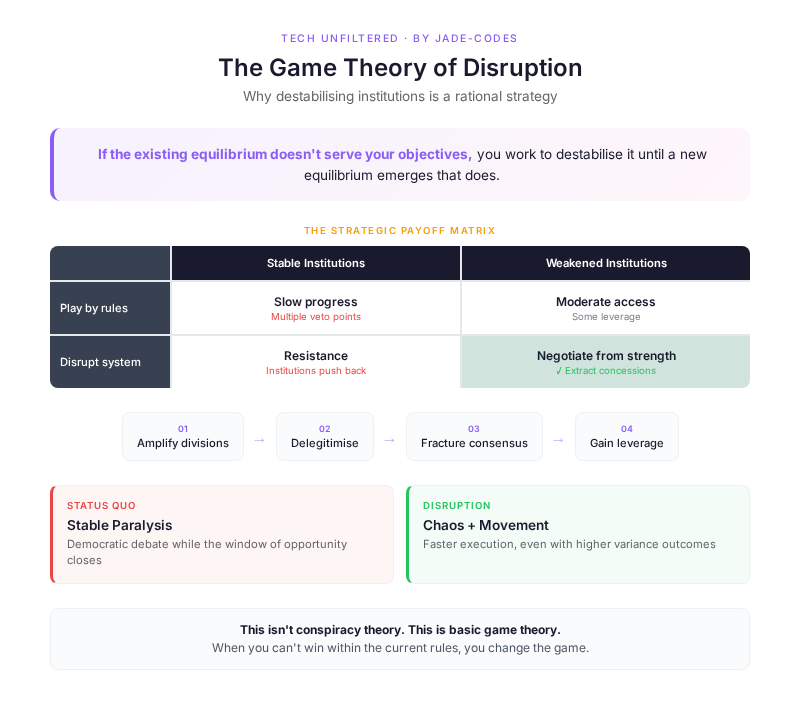
And so I started to think: if I were Musk, and all of these countries had these resources and intelligence that I needed, and they were intentionally blocking progress by preventing others from having these things, what would I do?
If the existing institutional structures won’t give you what you want because they’re optimised for stability rather than progress, you don’t play by their rules. You change the game.
You create chaos and fragmentation from the bottom up. You amplify existing social divisions. You use your platform to delegitimise institutions. You support political movements that promise to disrupt established structures. You make the current system look incompetent, corrupt, or illegitimate.
And when the institutions are weakened, when the social consensus fractures, when the old guardrails fail—that’s when you have leverage. That’s when you can negotiate from a position of strength. That’s when you can extract the concessions you need.
He's been telling everyone his strategy very clearly. He doesn't see a long-term need for money or governments. He's said this publicly, repeatedly. But people hear it as hyperbole, as the ramblings of a eccentric billionaire, rather than a clear statement of intent about the future he's building toward.
This isn’t conspiracy theory. This is basic game theory. If the existing equilibrium doesn’t serve your objectives, you work to destabilise it until a new equilibrium emerges that does.
When I worked through this logic, when I put myself in that position and thought it through systematically, this is the only strategy that makes sense. It’s what I would do if I were optimising purely for achieving an existential goal against entrenched institutional resistance.
The Democratic Society Problem
I kept thinking about why Musk’s political alignment seems to have shifted from supporting more democratic, progressive politics to aligning with more authoritarian, “move fast and break things” governance. And I realised: it’s not about personal ideology. It’s about systems analysis.
When I looked at democratic societies through this lens, I saw the structural problem: strong institutions, regulatory oversight, and pluralistic decision-making create multiple veto points. Every stakeholder gets a say. Progress requires consensus. This is very good for stability and preventing catastrophic decisions. It’s very bad for rapid, coordinated action toward ambitious objectives.
Authoritarian or populist systems concentrate decision-making power. Fewer veto points. Faster execution. More room for both catastrophic mistakes and breakthrough achievements. If your primary objective is speed of progress toward an existential goal (making humanity multi-planetary before civilisation collapses), you’re going to prefer systems that enable rapid action, even if they’re riskier.
This is the calculation I think Musk has made: democratic societies will debate and deliberate while the window of opportunity closes. Better to have chaos and movement than stable paralysis.
And when I worked through that logic myself, I understood it. I didn’t like it, but I understood it.
Why We’re Losing
When I looked at how the UK and Europe are responding, I saw a fatal pattern. We’re playing defence. We’re trying to protect our existing systems, our regulatory frameworks, our social models. We’re reacting to provocation rather than pursuing our own objectives.
This is a losing strategy because we’re not thinking at the right level. We’re protecting the box while someone else is redefining what the box is for.
I mapped out our strengths and weaknesses the way I would analyse any system:
We have world-class research capability but can’t commercialise it.
We have engineering excellence but can’t move fast.
We have democratic legitimacy but can’t make hard decisions quickly.
These are systemic weaknesses, and Musk understands them better than we understand his strengths.
He’s studied us. He’s modelled our decision-making processes. He knows where our veto points are, where our institutional antibodies kick in, where our cultural patterns create predictable behaviour.
And we haven’t done the same work on him.
The Only Way to Compete
When I thought about how to respond to this, I realised something: you don’t compete with someone like Musk by building higher walls or writing more regulations. Those are defensive moves in a game where defence doesn’t win.
You compete by fixing your own systemic failures:
Bridge the research-to-execution gap. Build pathways from academic excellence to scaled deployment.
Reduce institutional friction. Strip out the process that adds delay without adding value.
Enable faster iteration. Create regulatory environments that allow for rapid experimentation with appropriate safeguards.
Think in systems. Understand the whole game, not just your local concerns.
Most importantly, you need to have your own positive vision worth pursuing, not just threats to defend against. If your strategy is entirely reactive, you’ve already lost the framing battle.
Musk is winning because he’s playing a different game than everyone else thinks they’re in. He’s thinking in decades and at planetary scale whilst we’re thinking in election cycles and national boundaries.
If we want to remain relevant—if we want agency over our own futures—we need to start thinking at the same level and to think win-win. Not to become like Musk, but to build systems that can compete with that level of strategic coherence and execution capability.
The question isn’t whether Musk is right or wrong. The question is whether we’re capable of systemic self-improvement fast enough to matter. Right now, when I run the analysis, I’m not convinced we are.
And that should terrify you far more than any single provocative tweet.
A Final Question
You don’t have to believe me. You don’t have to agree with this analysis. You can dismiss it as speculation or conspiracy thinking if you want.
But ask yourself this: who is more likely to accurately understand what Musk is doing—you, reacting emotionally to these words, or to his latest tweet and calling him crazy, or someone who thinks from first principles the way he does? Someone who understands how systems fundamentally work, who can recognise patterns across different domains, who can see the second- and third-order effects of decisions?
I’m a systems thinker all the way up. When I need to understand someone’s strategy, I don’t look at what they say—I figure out what they value, what they want and put myself in their position… I work backwards from their constraints and objectives. I look for underlying structures, feedback loops, incentive gradients. I strip away the narrative and look at what the systems around us are actually optimised for.
And when I put myself in Musk’s position and worked through the problem he’s trying to solve with the same first principles thinking he uses, I didn’t see chaos. I saw strategy. Cold, logical, systematic strategy.
You can choose to believe he’s just a chaotic billionaire having a midlife crisis on X. That’s comfortable. It means you don’t have to question whether your institutions are fit for purpose, whether your ways of working are fast enough, whether your understanding of the game is even correct.
Or you can accept that someone who has repeatedly achieved things everyone said were impossible might actually understand something you don’t. That his success isn’t luck or madness, but the result of thinking more clearly about systems, incentives, and constraints than the people around him.
And maybe—just maybe—someone who thinks the same way he does, who can model his decision-making process because we share the same analytical framework, might have uncovered something worth paying attention to.
The choice is yours. But one of these perspectives leaves you reactive, confused, and losing ground. The other gives you a chance to understand what’s actually happening and do something about it.
I know which one I’m choosing.
What about you?
Why am I talking about this now? Because I see the patterns. I see the strategy. I put myself in his position, thought through the problem the way he would, and worked backwards to understand what he’s doing. All of this, of course, is my own opinion, from patterns I’ve uncovered all around me. I’ve studied politics, news, social media, institutions, relationships, people—I’ve applied the same systems thinking approach to everything I observe. But I don’t have the influence or authority that other’s do.
I don’t know how to get people to listen to me. In the words of the Wizard: ‘tell them all you want, they will never believe you’. You’ll probably read this and think I’ve gone mad. And you won’t see it until it’s too late.
But, if you are reading this and you see the pattern too, share with others. Spread the message.
Wake up. It’s time to build. It’s time to systemise.
This has to be the most thoughtful analysis of what Elon Musk is doing. Definitely better than merely dismissing him as a ketamine addict who lost the plot. Thank you for writing this! Would love to see more of your systems thinking takes on politics and economics.
For me, using the lens of systems is one of the most important skills to learn. You have used a great example to showcase it.
What do you think prevents people from using system lenses to understand reality?
I bet on the embedded battery saver of our brain, as understanding costs energy. It takes so much less energy just to label someone 'illogical' and ignore them afterwards.