

Two people in a room? Predictable. You can map it. Model it. Draw a straight line between cause and effect.
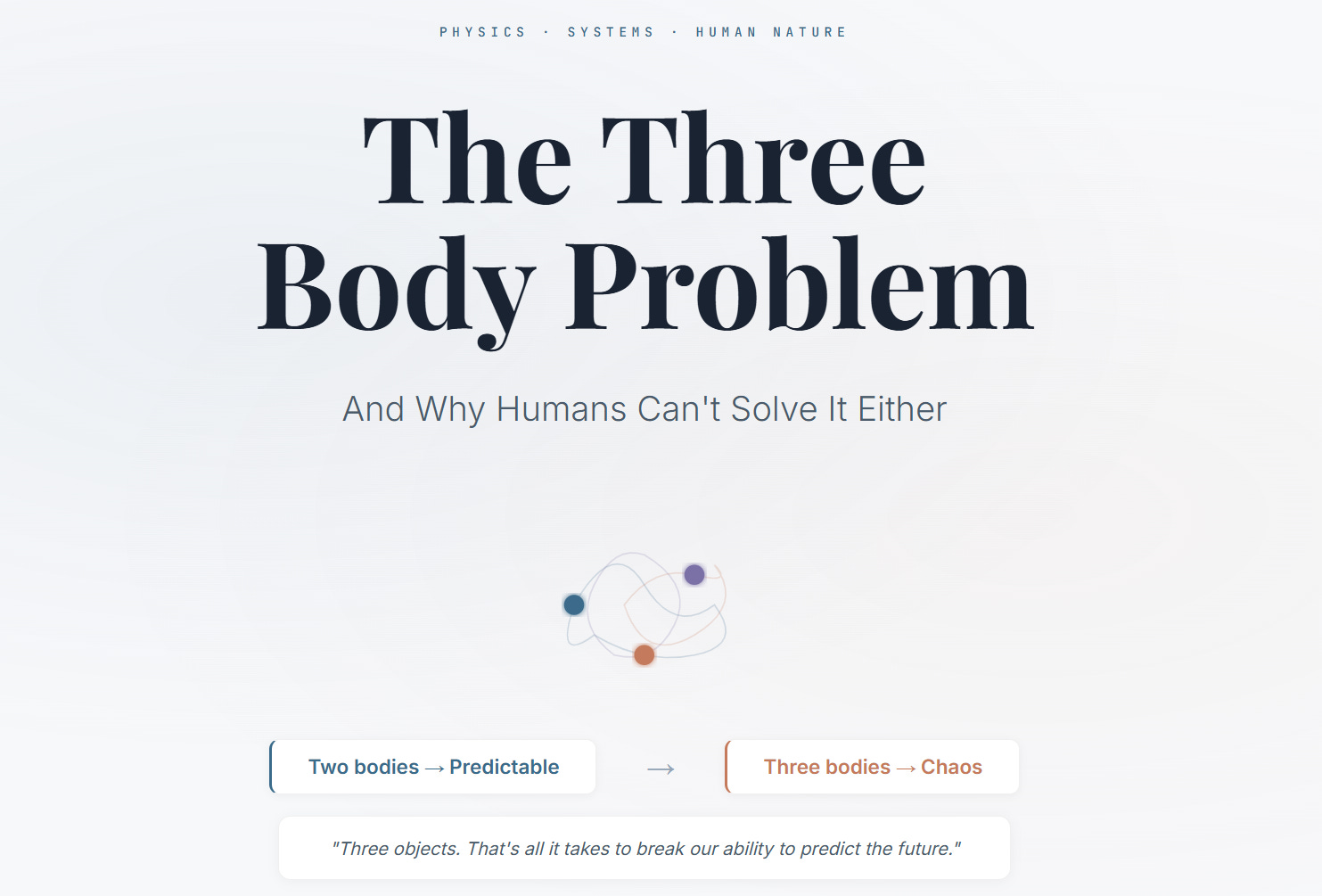
Add a third person and everything breaks.
This isn’t metaphor. It’s physics. And it might be the most important pattern nobody talks about honestly.
The Physics First
In 1687, Isaac Newton solved the two-body problem. Two objects in gravitational interaction — the Earth and Moon, the Sun and a single planet — follow elegant, predictable elliptical orbits. You can write the equations. You can compute their positions centuries into the future. The maths is clean because the system is closed: two masses, one gravitational relationship, one set of differential equations with an exact analytical solution.
Then people tried to add a third body. And for over three hundred years, nobody has been able to solve it.
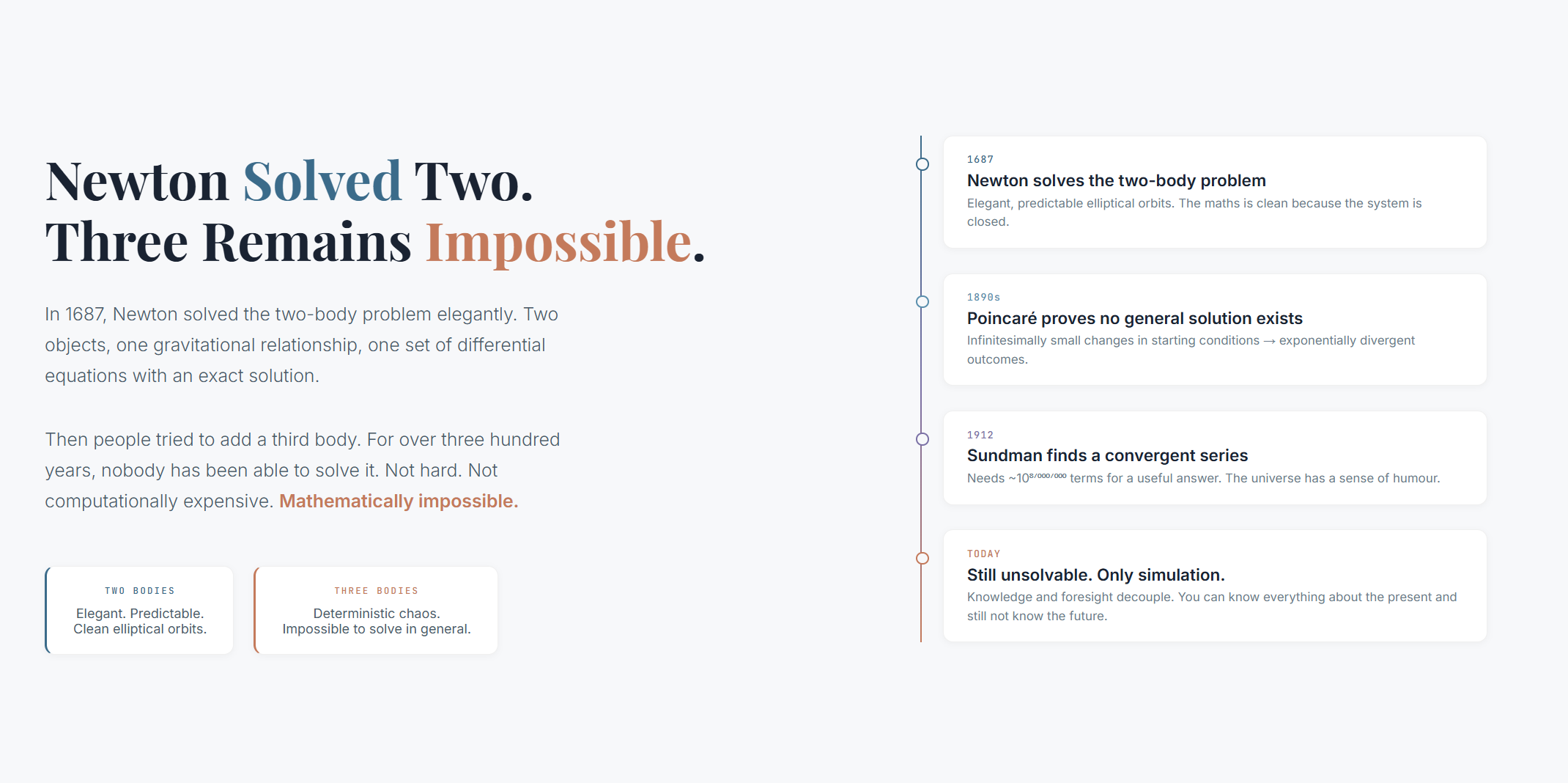
This isn’t a gap in our mathematical toolkit. Henri Poincaré proved in the 1890s that no general closed-form solution can exist for three or more gravitationally interacting bodies. The system is fundamentally chaotic — not in the colloquial sense of “messy,” but in the precise mathematical sense that infinitesimally small changes in starting conditions produce exponentially divergent outcomes over time. Two identical three-body systems that differ by a trillionth of a degree in one body’s initial velocity will, given enough time, look nothing alike.
This is deterministic chaos. The equations are perfectly deterministic — no randomness involved — yet prediction becomes impossible beyond a certain time horizon because you’d need infinite precision in your measurements to project the outcome. And infinite precision doesn’t exist in the physical world.
The best we can do is numerical simulation. Step-by-step approximation. Run it forward, see what happens, accept that we’re watching a specific trajectory through a possibility space so vast it might as well be infinite.
Three objects. That’s all it takes to break our ability to predict the future from first principles.
What makes this particularly humbling is that we’re not talking about quantum weirdness or relativistic edge cases. This is Newtonian mechanics. Schoolbook physics. Billiard balls and gravity. The simplest possible force law — inverse square attraction — applied to the simplest possible increase in complexity — from two to three. And it’s already unsolvable. Not hard. Not computationally expensive. Mathematically impossible to solve in general.
Karl Sundman technically found a convergent series solution in 1912, but it converges so slowly that you’d need something like 10^8,000,000 terms to get a useful answer. Which is less a solution and more a proof that the universe has a sense of humour about human ambition.
The three-body problem also reveals something about the nature of prediction itself. In a two-body system, more information always helps. Measure more precisely, predict more accurately. The relationship between knowledge and foresight is linear. In a three-body system, there’s a hard ceiling on prediction regardless of how much information you have, because the sensitivity to initial conditions means any measurement error — any at all — will eventually amplify into total divergence. Knowledge and foresight decouple. You can know everything about the present state and still not know the future.
This is a profound philosophical statement hiding inside a physics problem. And it maps onto human experience so precisely that it’s hard to believe nobody talks about it more honestly.
Now think about what that means for people.
Two People Is a Line. Three Is a Universe.
Two people relate linearly. I say something, you respond. There’s a feedback loop, but it’s containable. You can trace cause and effect like following a thread. Even when the emotions are complex, the structure is simple: one relationship, one axis of tension, one negotiation happening at a time. Two people arguing can usually trace back to a specific moment, a specific misunderstanding, a specific cause. The system is legible.
The moment you add a third person, you don’t just add one more relationship. You fundamentally change the geometry of the system.
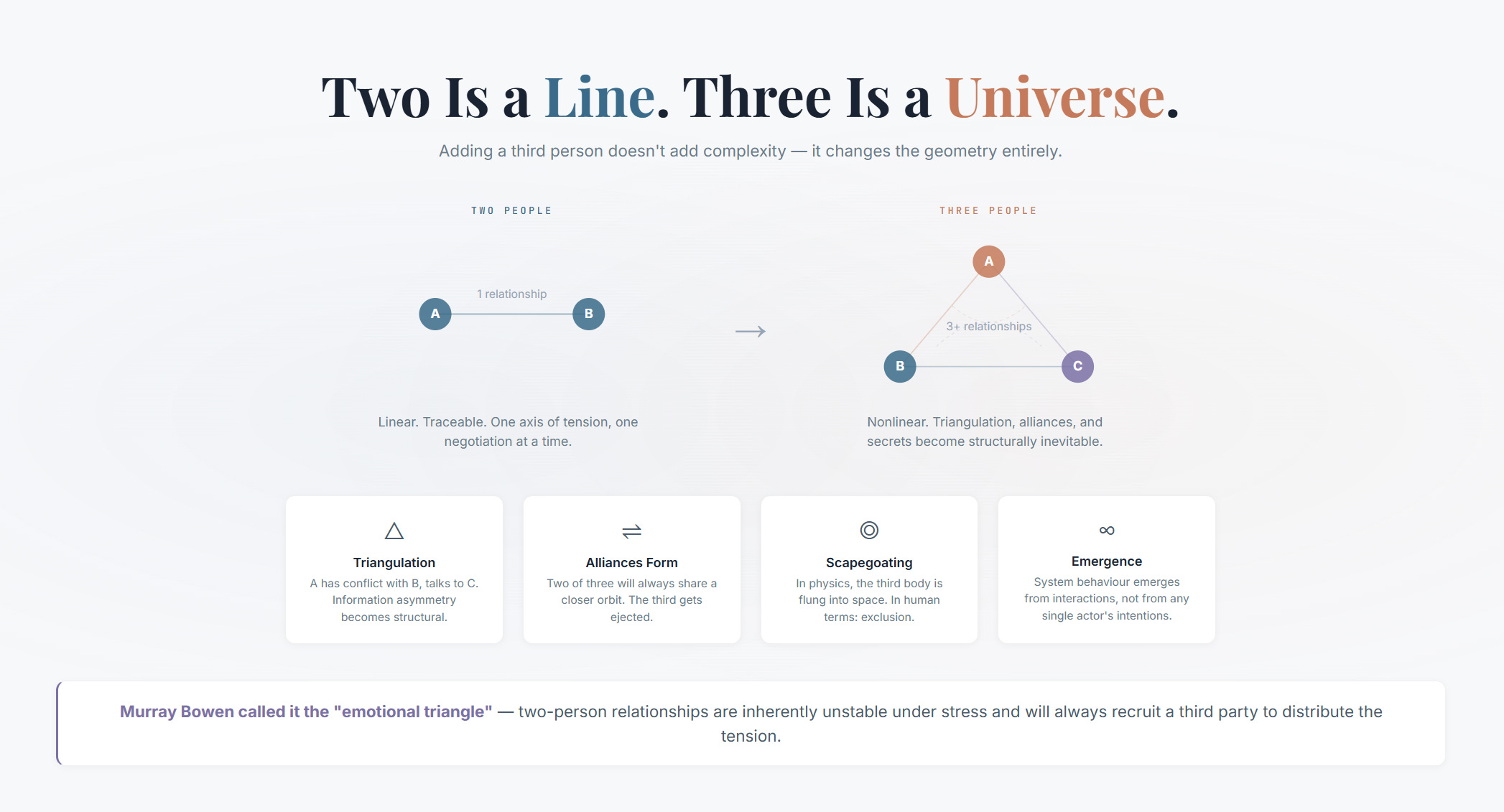
With two people, you have one relationship: A↔B. With three, you have three direct relationships: A↔B, A↔C, B↔C. But that only describes the first-order dynamics. The real complexity comes from the interactions between those relationships. How does B’s relationship with C change the way B relates to A? What happens to A↔C when A discovers something about B↔C? Each relationship becomes a variable in every other relationship’s equation.
This is where triangulation emerges — the most common and least acknowledged pattern in human dynamics. Person A has a conflict with Person B, so they talk to Person C about it. Now C holds information that reshapes both A↔C and B↔C, even if B doesn’t know the conversation happened. Information asymmetry becomes structurally possible in a way that simply doesn’t exist with two people. You can’t have secrets in a two-body system. In a three-body system, secrets are inevitable.
Alliances form. Not always consciously, not always maliciously, but structurally. Two of three bodies will always, at some point, share a closer orbit than the third. In physics, this often results in the third body being ejected from the system entirely — flung out into space while the remaining two stabilise into a neat binary pair. In human terms, this is scapegoating. Exclusion. The odd one out. The person who gets blamed when a team of three stops working.
This is why every organisational dysfunction, every political crisis, every family drama that actually matters involves at least three parties. Two people can always negotiate. Three people create dynamics that no individual controls or fully understands — because the system’s behaviour emerges from the interactions, not from any single actor’s intentions.
The third body is what makes the system nonlinear. It’s what makes prediction impossible and control an illusion.
Think about how this plays out in practice.
A marriage between two people has one relationship to manage. Add a child and you don’t just add two new relationships — you fundamentally restructure the original one. The couple now relates to each other through and about the child. Decisions that were bilateral become trilateral. The child doesn’t even need to be in the room to affect the dynamic between the parents. Their existence alone reshapes every equation.
In a workplace, two colleagues can usually resolve a conflict directly. The moment a manager gets involved — or even the possibility of a manager getting involved — the whole dynamic shifts. People start positioning. Information gets curated. What would have been a direct conversation becomes a strategic calculation about third-party perception. The conflict isn’t between two people any more. It’s between two people, the third person’s judgement, each person’s model of what the third person thinks, and each person’s model of what the other person thinks the third person thinks. You’re already several layers deep and nobody’s even raised their voice yet.
This isn’t dysfunction. This is physics. The three-body problem isn’t a failure mode — it’s the default mode of any system with more than two agents. We just keep designing our institutions as if it weren’t.
Murray Bowen, the family systems therapist, built his entire theory around this. He called it the “emotional triangle” — the idea that two-person relationships are inherently unstable under stress and will always recruit a third party to distribute the tension. Not pathologically. Structurally. The way water doesn’t choose to flow downhill — it’s just what happens given the geometry of the landscape. Human relationships triangulate because three-body dynamics are the stable attractor. Two-body stability is the exception, not the rule.
And here’s the part nobody wants to hear: you cannot fix a three-body dynamic by trying harder at two-body solutions. More direct communication, better one-to-ones, clearer bilateral agreements — none of it addresses the structural reality that the third body exists and is shaping every interaction whether you acknowledge it or not. The only honest response is to design for three-body dynamics from the start. Which means accepting nonlinearity. Which means giving up the fantasy of prediction and control.
The irony is that we recognise this in physics and psychology but refuse to acknowledge it in organisational design, politics, or economics. We keep building two-body solutions — bilateral treaties, hierarchical reporting lines, binary political systems — and then acting surprised when the third body shows up and makes everything chaotic.
Human Unpredictability Isn’t a Bug. It’s a Body Count Problem.
Here’s the thing nobody says out loud: the reason humans are unpredictable isn’t because we’re irrational. It’s because there are more than two of us.

We’ve spent centuries building models of human behaviour that assume two-body dynamics. Classical economics assumes bilateral exchange — buyer and seller, supply and demand. Contract law assumes two parties. Marriage assumes two people. Management theory assumes a manager and a direct report. Every model, every theory, every institutional design defaults to: “how do two entities interact?”
And within that frame, humans are fairly predictable. One person negotiating with one other person follows recognisable patterns. Game theory can model it. Rational choice theory can approximate it. The two-body version of human behaviour is tractable, which is why we built our entire civilisational infrastructure around it.
But humans don’t live in two-body systems. We live in families with three, four, five, twelve interacting members. We work in teams with shifting alliances and hidden agendas. We exist in economies with billions of agents whose decisions ripple through networks we can’t see. We vote in political systems where coalitions form and dissolve based on dynamics that no pundit accurately predicts.
The entire field of behavioural economics — Kahneman, Tversky, the whole “humans are irrational” research programme — is largely a documentation of three-body effects being misattributed to individual cognitive failure. People don’t make “irrational” decisions in isolation. They make decisions in contexts where other agents’ decisions affect the payoff matrix, where social proof creates feedback loops, where the presence of a third option changes the preference between the first two (the decoy effect is literally a three-body problem in decision theory). We’re not irrational. We’re multi-body. The models that call us irrational are two-body models encountering three-body data and blaming the data.
This matters enormously for how we think about trust, governance, and coordination. Two people can build trust through direct reciprocity — I help you, you help me, repeat. It’s linear, trackable, enforceable. Add a third person and trust becomes a network property rather than a bilateral one. Do I trust you? Depends on whether I trust the third person who vouches for you. Or whether the third person’s interests align with mine against yours. Or whether information I share with you will reach the third person. Trust in a three-body system is emergent, conditional, and context-dependent in ways that no contract or rule set fully captures.
This is why high-trust societies tend to have strong protocols rather than strong authorities. Protocols are three-body solutions — they define the rules of interaction without requiring a centre to enforce them. Authorities are two-body solutions — one controller, one controlled. The Scandinavian model, often cited as high-trust governance, works not because Scandinavians are inherently more trustworthy but because the institutional architecture is designed around shared protocols (social contracts, transparent governance, universal systems) rather than centralised enforcement. It’s spherical architecture, not matrix architecture. It expects multi-body dynamics and designs for them.
The UK, by contrast, designed almost everything as a two-body system — Crown and Parliament, employer and employee, teacher and student — and then papers over the three-body dynamics with unwritten conventions, gentleman’s agreements, and a cultural expectation that everyone will just sort of... know the rules without anyone writing them down. Which works precisely until it doesn’t. Until a third body enters who doesn’t know the unwritten rules, or doesn’t care about them, or comes from a tradition where the rules are different. Then the whole system seizes up and everyone blames the third body for being disruptive, when the real problem is that the architecture was never designed for more than two.
Adam, Eve, and the Serpent
It’s worth noting that the oldest story in Western civilisation understood this intuitively — and we’ve been misreading the lesson for millennia.
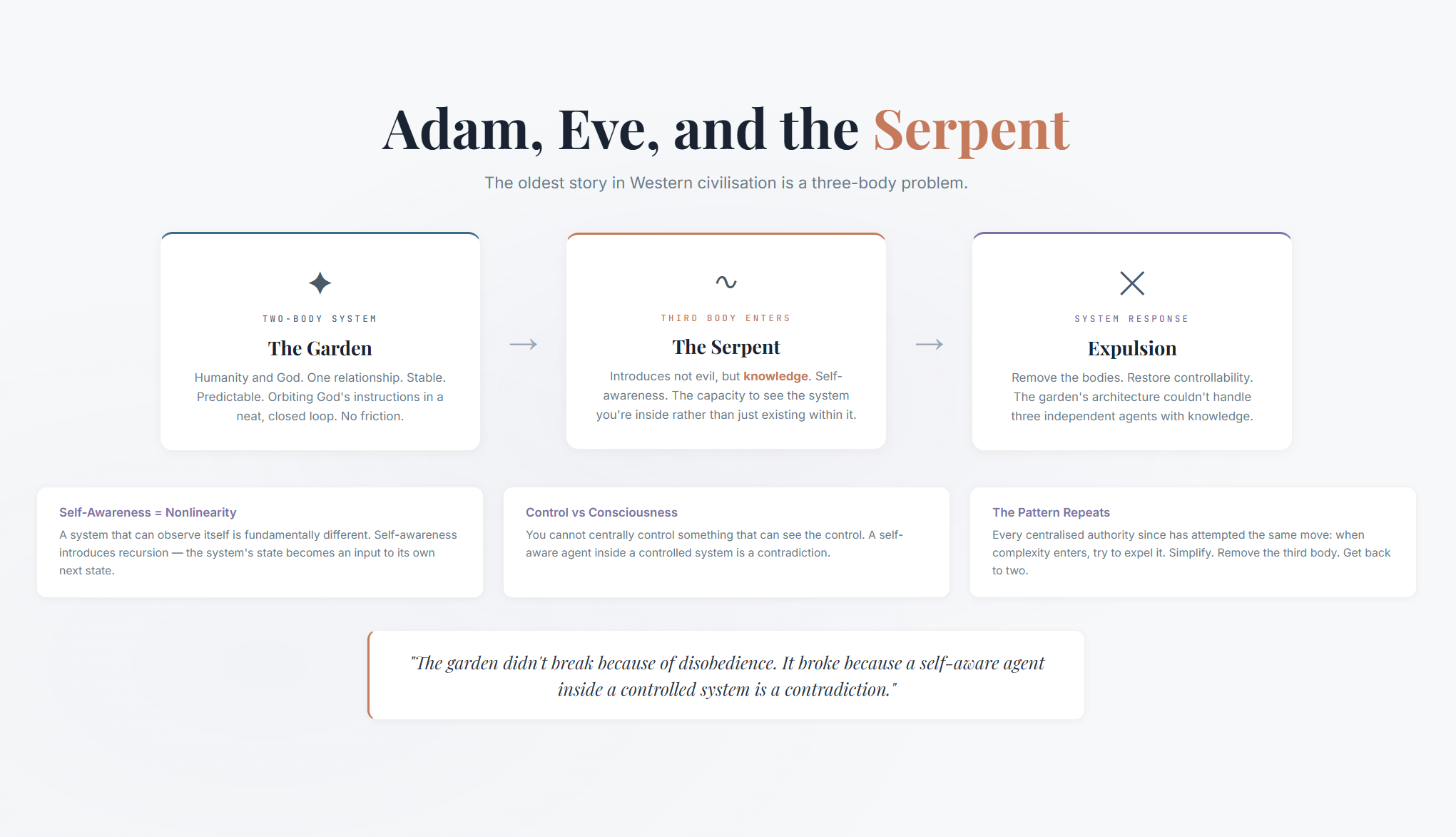
Adam and Eve alone in the garden is a two-body problem. One relationship: humanity and God. Stable. Predictable. Orbiting God’s instructions in a neat, closed loop. No friction, no deviation, no independent thought. The garden is a controlled environment with one rule and two compliant agents. Everything is solvable. Everything is known. The system is at equilibrium.
Then the serpent enters. The third body.
And everything becomes chaotic. Not gradually — immediately. One conversation with the serpent and the entire system destabilises.
But look at what the serpent actually introduces. Not evil. Not corruption. Knowledge. The fruit of knowing good and evil. The capacity for independent judgement. The ability to see the system you’re inside rather than just existing within it. Before the serpent, Adam and Eve don’t know they’re naked — meaning they have no self-awareness, no perspective on their own condition. After the fruit, they see themselves. They become observers of their own system.
This is the critical transition. In systems theory, a system that can observe itself is fundamentally different from one that can’t. Self-awareness introduces recursion — the system’s state becomes an input to its own next state. That’s the definition of nonlinearity. The garden didn’t break because of disobedience. It broke because a self-aware agent inside a controlled system is a contradiction. You cannot centrally control something that can see the control.
The serpent is the third body that makes the God-humanity two-body problem unsolvable. And God’s response is revealing: expulsion. Remove the bodies from the system. Restore controllability by eliminating the conditions that created chaos. It’s not punishment in the moral sense — it’s a systems response. The garden’s architecture couldn’t handle three interacting agents with independent knowledge, so the system ejected the destabilising elements.
Every centralised authority since has attempted the same move. When the system becomes too complex to control — when too many independent agents with too much information start interacting in ways you can’t predict — the instinct is always expulsion, restriction, reduction. Simplify the system. Remove the third body. Get back to two.
The Gnostic texts understood this even more sharply. In several Gnostic readings, the serpent isn’t the villain — it’s the liberator. The Demiurge (their name for the garden’s creator) is an ignorant, insecure lesser god trying to maintain control over beings who have the potential to surpass him. The serpent offers the fruit not to corrupt but to awaken. The “fall” isn’t a fall at all — it’s an escape from a system designed to keep consciousness contained.
Whether you read it as theology, mythology, or systems architecture, the pattern is identical. A two-body system is stable and controllable. A third body introduces awareness, complexity, and unpredictability. The central authority either adapts to the new dynamics or tries to eliminate them. And the elimination never works permanently, because complexity, once introduced, finds a way to persist.
From Matrix to Sphere
Here’s where the geometry makes the abstract concrete.
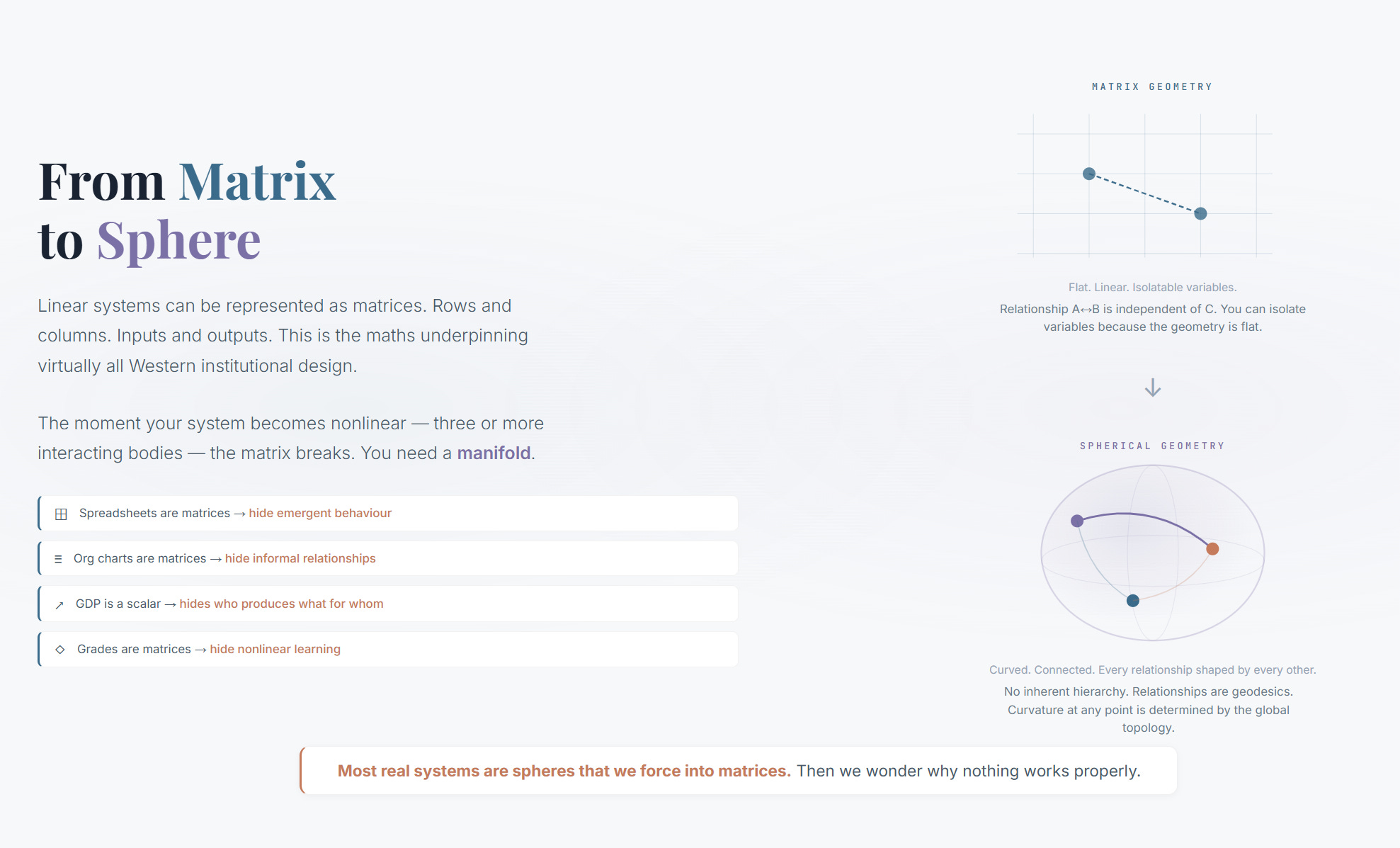
Linear systems — two-body problems — can be represented as matrices. Rows and columns. Inputs and outputs. Finite dimensions with known relationships. You can invert a matrix to find exact solutions. You can decompose it into eigenvalues and eigenvectors to understand its fundamental behaviours. You can predict the output for any input because the mapping is complete and reversible.
This is the mathematics that underpins virtually all Western institutional design. Spreadsheets are matrices. Org charts are matrices. Input-output economic models are matrices. Project management (tasks × resources × time) is a matrix. Standardised testing (students × questions × scores) is a matrix. The entire grammar of bureaucratic thinking — categorise, rank, optimise — is matrix logic applied to human systems.
And matrices work beautifully for two-body problems. When the system is linear, when cause maps cleanly to effect, when you can isolate variables and control for confounds, the matrix is the right tool. It’s not wrong. It’s just limited.
The moment your system becomes nonlinear — the moment you have three or more interacting bodies whose relationships affect each other — the matrix breaks. Not because the maths is bad, but because you’re trying to represent a curved surface on a flat grid. You lose information. You distort relationships. You create artefacts that look like real patterns but are actually consequences of the wrong geometry.
What you need instead is a manifold. Specifically, a sphere — or something topologically equivalent to one. A surface that curves, that has no edges, where every point connects to every other point through the surface itself, without requiring a centre or a coordinate system imposed from outside.
This is the geometry of decentralised systems. Networks. Ecosystems. Markets before they’re captured. Communities before they’re institutionalised. The internet before platform monopolies flattened it back into a matrix of walled gardens.
On a sphere, there is no inherent hierarchy. No top, no bottom, no privileged position. Any point can be the “north pole” depending on your orientation — the hierarchy is in the observer, not the surface. Relationships are described by geodesics — the shortest paths along the curved surface — which are fundamentally different from the straight lines of matrix space. On a flat grid, the shortest path between two points is a straight line. On a sphere, it’s an arc. The curvature of the space itself shapes how things relate.
The difference matters enormously in practice. In matrix space, the relationship between A and B is independent of C — you can isolate variables because the geometry is flat. On a manifold, every relationship exists in the context of every other relationship, because the curvature at any point is determined by the global topology. You cannot understand any local relationship without understanding the shape of the whole.
This is exactly how human systems actually work. Your relationship with your colleague isn’t independent of their relationship with your manager. The economic relationship between two countries isn’t independent of their mutual relationships with a third. The political dynamics of a coalition aren’t decomposable into bilateral pairs. Everything curves into everything else.
And here’s the thing that makes this more than abstract geometry: most real systems are spheres that we force into matrices.
We take inherently nonlinear human dynamics and flatten them into org charts, losing all the informal relationships, cross-cutting alliances, and emergent behaviours that actually determine how work gets done. We take complex economies and reduce them to GDP — a single scalar that tells you almost nothing about the topology of who produces what for whom and at whose expense. We take learning — which is fundamentally a nonlinear, multi-body process of exploration, connection, and emergence — and flatten it into standardised curricula, linear progressions, and grade boundaries that can be stored in a spreadsheet.
Then we wonder why nothing works properly. Why organisations are dysfunctional despite perfect org charts. Why economies produce wealth but not wellbeing. Why students pass exams but can’t think. We’re solving the wrong geometry.
Centralisation Is a Two-Body Fantasy
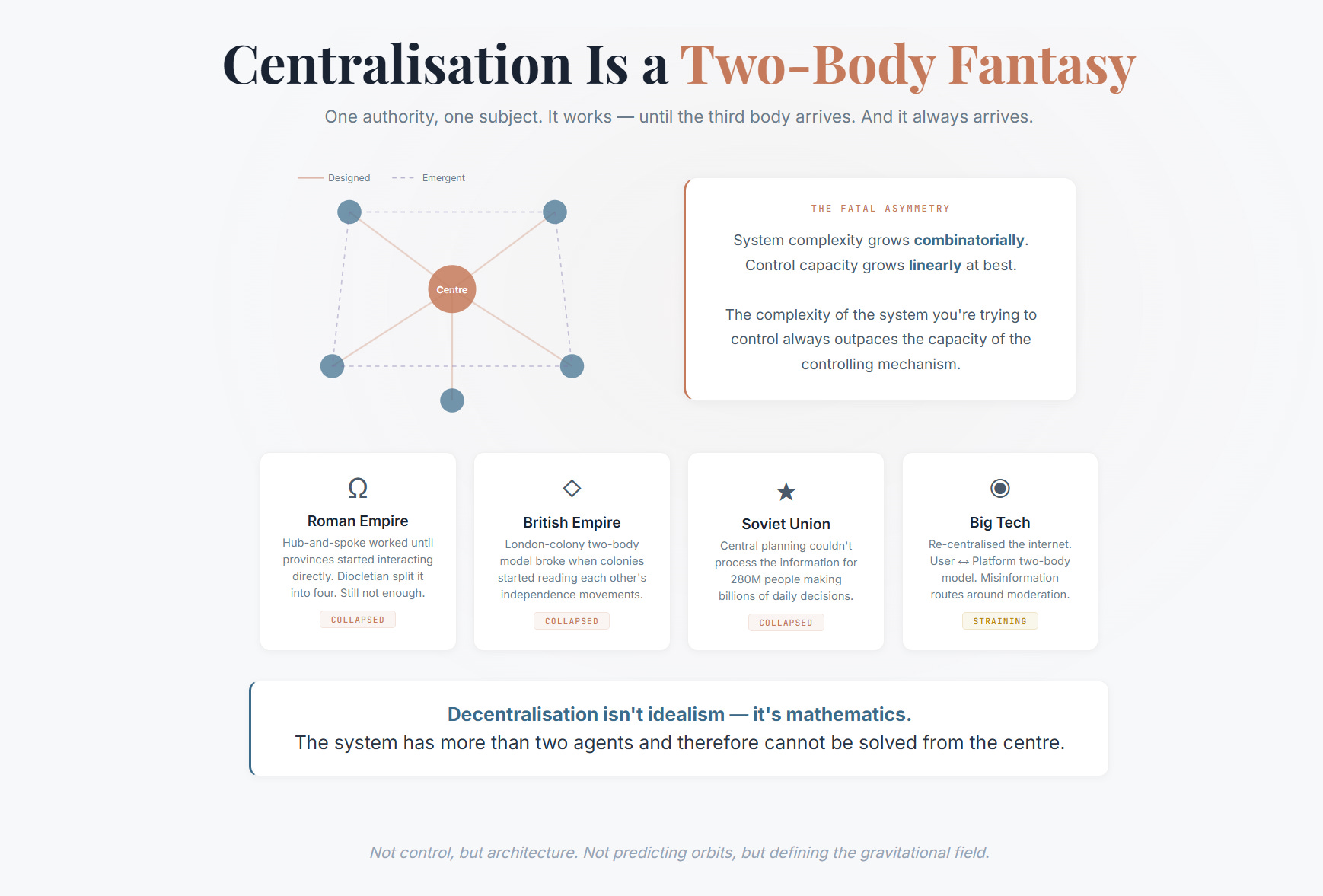
Centralisation only works when you can reduce the system to two bodies. One authority, one subject. One controller, one controlled. One centre, one periphery. This is a tractable problem. The centre observes the periphery, computes the right response, and issues instructions. The periphery complies. Equilibrium is maintained.
This model has a seductive elegance. It feels efficient. It feels orderly. It appeals enormously to linear thinkers — and Western institutional culture is dominated by linear thinkers, which is how we ended up with centralisation as the default architecture for almost everything.
But the moment you have three or more actors with any degree of autonomy, centralisation becomes a fight against physics. The centre cannot observe all the relationships between all the agents, because the number of relationships grows combinatorially — two agents have one relationship, three have three, ten have forty-five, a hundred have nearly five thousand. The centre’s computational burden grows exponentially while its ability to observe and respond grows, at best, linearly.
This is the fundamental asymmetry that kills every centralised system eventually. The complexity of the system it’s trying to control outpaces the capacity of the controlling mechanism. The Soviet Union didn’t fail because of bad ideology in isolation — it failed because a central planning committee literally could not process the information required to coordinate an economy of 280 million people making billions of daily decisions. The maths doesn’t work. It never could have.
The Roman Empire hit the same wall. For centuries, Rome could govern because it was effectively a two-body system — Rome and the provinces, centre and periphery, with information flowing along a hub-and-spoke network of roads and governors. It worked brilliantly when the provinces were isolated from each other and related primarily to Rome. But as the empire matured, the provinces started interacting directly — trading, forming alliances, developing local identities, creating relationships that didn’t pass through the centre. The system became multi-body. The centre couldn’t keep up. Rome’s response was what every failing centralised system does: more bureaucracy, more surveillance, more control mechanisms, more subdivisions of authority. Diocletian split the empire into four administrative regions. It still wasn’t enough, because the problem wasn’t administrative — it was mathematical. You cannot centrally coordinate a multi-body system. The partition into East and West was the system ejecting complexity to try to get back to a solvable geometry.
The British Empire repeated the pattern. The East India Company. Colonial governance structures designed as two-body systems — London and colony, metropole and periphery — which worked right up until the colonies started talking to each other, reading each other’s independence movements, sharing strategies of resistance. The multi-body dynamics of anti-colonial movements made the two-body governance model impossible to sustain. Not through military defeat in most cases, but through the sheer computational impossibility of centrally managing systems that had become irreducibly complex.
It’s happening now with the internet. The original architecture was decentralised — a multi-body system by design, with no centre and no hierarchy. Then platform companies spent twenty years trying to re-centralise it. Google, Facebook, Amazon — each one an attempt to become the centre of a two-body system, reducing the relationship between user and internet to a relationship between user and platform. And it worked, temporarily. Until the multi-body dynamics reasserted themselves: misinformation spreading faster than moderation can catch, users creating communities that resist algorithmic control, open protocols emerging to route around the gatekeepers.
Every time, the same pattern. Centralisation works until it doesn’t. The two-body model holds until the third body arrives. And the third body always arrives.
This is why empires collapse. Why monopolies stagnate. Why command economies fail. Why micromanagement destroys teams. Why every promising startup that grows beyond about 20 people suddenly struggles to execute. The architecture assumes a world with two bodies — the centre and the periphery — and the actual world keeps introducing third, fourth, fifth bodies that refuse to stay in their prescribed orbits.
Decentralisation isn’t a political preference. It’s not idealism. It’s a mathematical acknowledgement that the system you’re trying to govern has more than two interacting agents and therefore cannot be solved from the centre. You can’t find a closed-form solution because one doesn’t exist. The best you can do is create conditions — protocols, boundaries, shared constraints — that shape the possibility space without trying to determine specific outcomes.
This is what good system design looks like: not control, but architecture. Not predicting orbits, but defining the gravitational field and letting the bodies find their own dynamics within it.
The Deepest Problem: Conditioned Truth
And here’s the part that makes all of this so resistant to change.
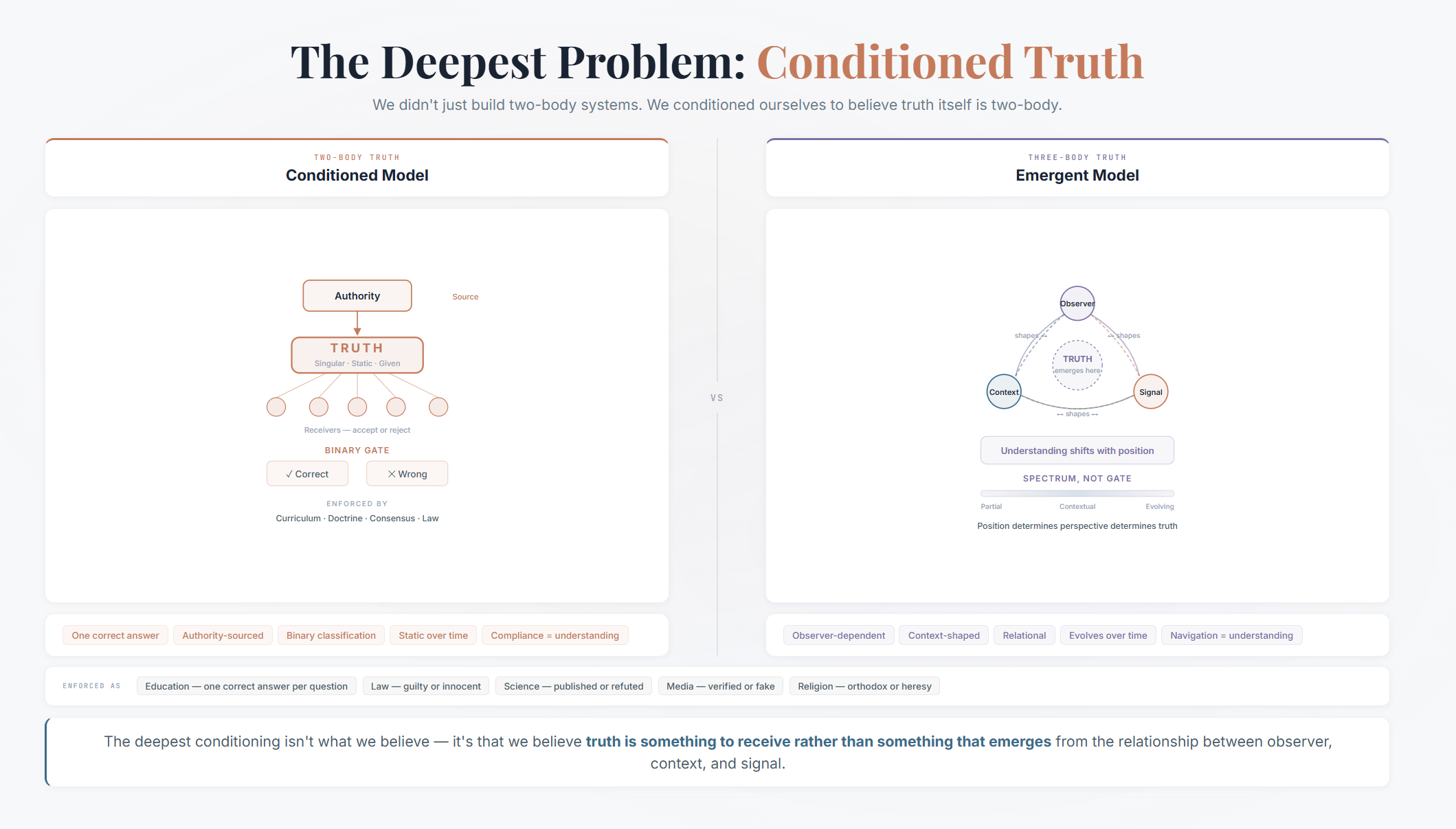
The reason centralised systems persist long after they should have collapsed isn’t just structural inertia or the self-interest of those at the centre. It’s something more insidious: the people inside the system genuinely believe it’s working. They believe they’re being truthful. They believe their perspective is accurate. And they’re not lying — not consciously. They’ve been conditioned to believe it.
This is what centralisation does to the people inside it. It doesn’t just control behaviour — it shapes perception. When you grow up inside a two-body system, when every institution you encounter is matrix-shaped, when linear thinking is rewarded and nonlinear thinking is labelled as disruptive or unfocused or “not a team player” — you internalise the geometry. You start seeing the world as flat, not because it is, but because every tool you’ve been given assumes flatness. The matrix doesn’t just organise your work. It organises your mind.
And once the matrix is internalised, something genuinely dangerous happens: abstraction becomes invisible. The person who reduces a complex multi-body dynamic to a two-column spreadsheet doesn’t experience themselves as abstracting. They experience themselves as clarifying. The manager who flattens a team’s messy, emergent, nonlinear creative process into a Gantt chart doesn’t think they’re distorting reality — they think they’re making it legible. The policymaker who reduces a multi-body economic system to a supply-and-demand curve doesn’t feel like they’re lying. They feel like they’re being rigorous.
This is the trap. The more you abstract, the more you manipulate the representation of reality to fit two-body models, the more convinced you become that the abstraction is the reality. The map becomes the territory. And anyone who points at the territory and says “this doesn’t match your map” gets dismissed — not maliciously, but sincerely — because the person holding the map genuinely cannot see the discrepancy. They’ve been trained not to.
It’s conditioning all the way down. Education conditions you to think in linear progressions — year one leads to year two leads to year three, as if learning actually works that way. Corporate culture conditions you to think in hierarchies — information flows up, decisions flow down, as if organisations actually function that way. Economic thinking conditions you to model in equilibria — supply meets demand at a price point, as if markets actually settle rather than perpetually churning through multi-body dynamics that never reach steady state.
And at every level, the people operating within these frameworks are truthful by their own standards. The teacher who says “follow the curriculum and you’ll learn” believes it. The manager who says “hit your KPIs and you’ll succeed” believes it. The economist who says “the market will self-correct” believes it. They’re not conspiring. They’re not gaslighting. They’re reporting what they see through a lens that was ground for them before they were old enough to question it.
This is why the three-body problem is so threatening to institutional thinking. It’s not just a mathematical curiosity. It’s an existential challenge to the foundational assumption that reality can be decomposed into manageable bilateral relationships. If three-body dynamics are the default — if linearity is the exception and nonlinearity is the rule — then the entire epistemological framework of Western institutional design is not just incomplete but systematically misleading. The tools aren’t neutral. They’re conditioning agents. Every spreadsheet, every org chart, every linear model isn’t just describing reality — it’s teaching you to see reality a particular way. And the thing it teaches you not to see is the thing that’s actually happening.
The most honest people in a two-body system can still be profoundly wrong about the nature of the system they’re in. Not because they lack intelligence or integrity, but because their perception has been shaped by tools and structures that filter out precisely the dynamics that matter most. They’re truthful within a framework that is itself a distortion. And the framework is invisible to them because they’ve never been outside it.
Breaking out of this isn’t an intellectual exercise. It’s not enough to know that three-body dynamics exist. You have to learn to perceive them — to feel the curvature of the manifold beneath the flat grid of the matrix. And that requires unlearning, which is harder than learning, because unlearning means acknowledging that things you experienced as truth were actually artifacts of a geometry that was handed to you without your consent.
Why This Matters Now
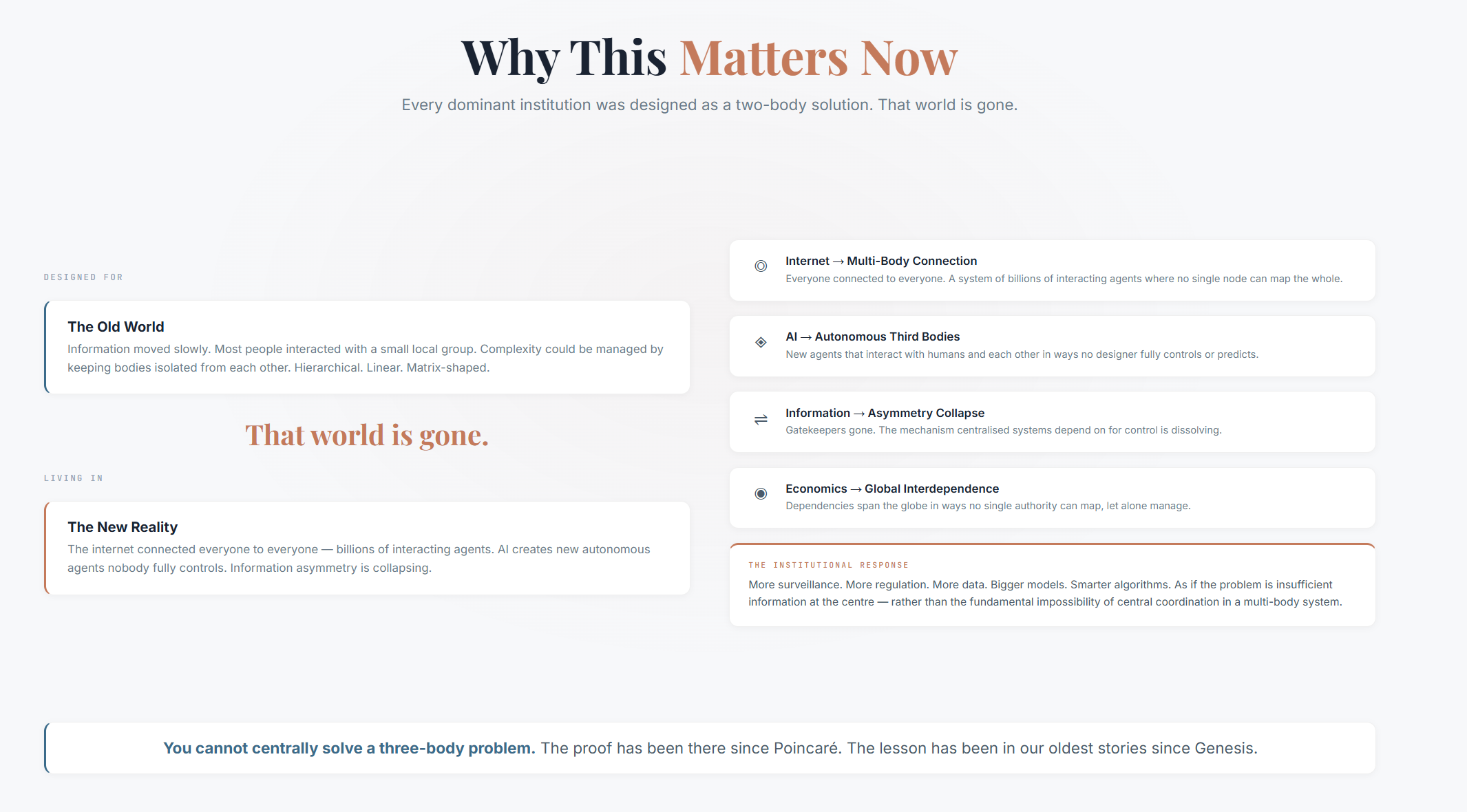
We’re living through a period where the dominant institutions — governments, corporations, education systems, financial markets — were all designed as two-body solutions. Hierarchical. Linear. Matrix-shaped. They were built in an era when information moved slowly, when most people interacted with a small local group, when complexity could be managed by keeping most bodies isolated from each other.
That world is gone.
The internet connected everyone to everyone, creating a multi-body system of billions of interacting agents. AI is creating new autonomous agents that interact with humans and each other in ways no designer fully controls. Information flows without gatekeepers, which means information asymmetry — the mechanism centralised systems depend on to maintain control — is collapsing. Economic interdependencies span the globe in ways no single authority can map, let alone manage.
And the institutional response has been, almost universally, to try harder at centralisation. More surveillance. More regulation. More data collection. Bigger models. Smarter algorithms. As if the problem is insufficient information at the centre rather than the fundamental impossibility of central coordination in a multi-body system.
This is the garden response. The Demiurge response. Complexity entered the system, so try to expel it. Try to reduce three bodies back to two. Try to flatten the sphere back into a matrix.
It won’t work. Not because the people attempting it are stupid — many of them are extremely intelligent — but because they’re solving the wrong problem with the wrong geometry. You cannot centrally solve a three-body problem. The proof has been sitting there since Poincaré, and the lesson has been embedded in our oldest stories since Genesis.
The East Understood This First
It’s not an accident that Liu Cixin — a Chinese author — wrote the science fiction trilogy that brought the three-body problem into popular consciousness. The intellectual tradition he comes from has been grappling with multi-body dynamics for millennia, while the West was still trying to reduce everything to bilateral relationships between God and man, king and subject, employer and employee.
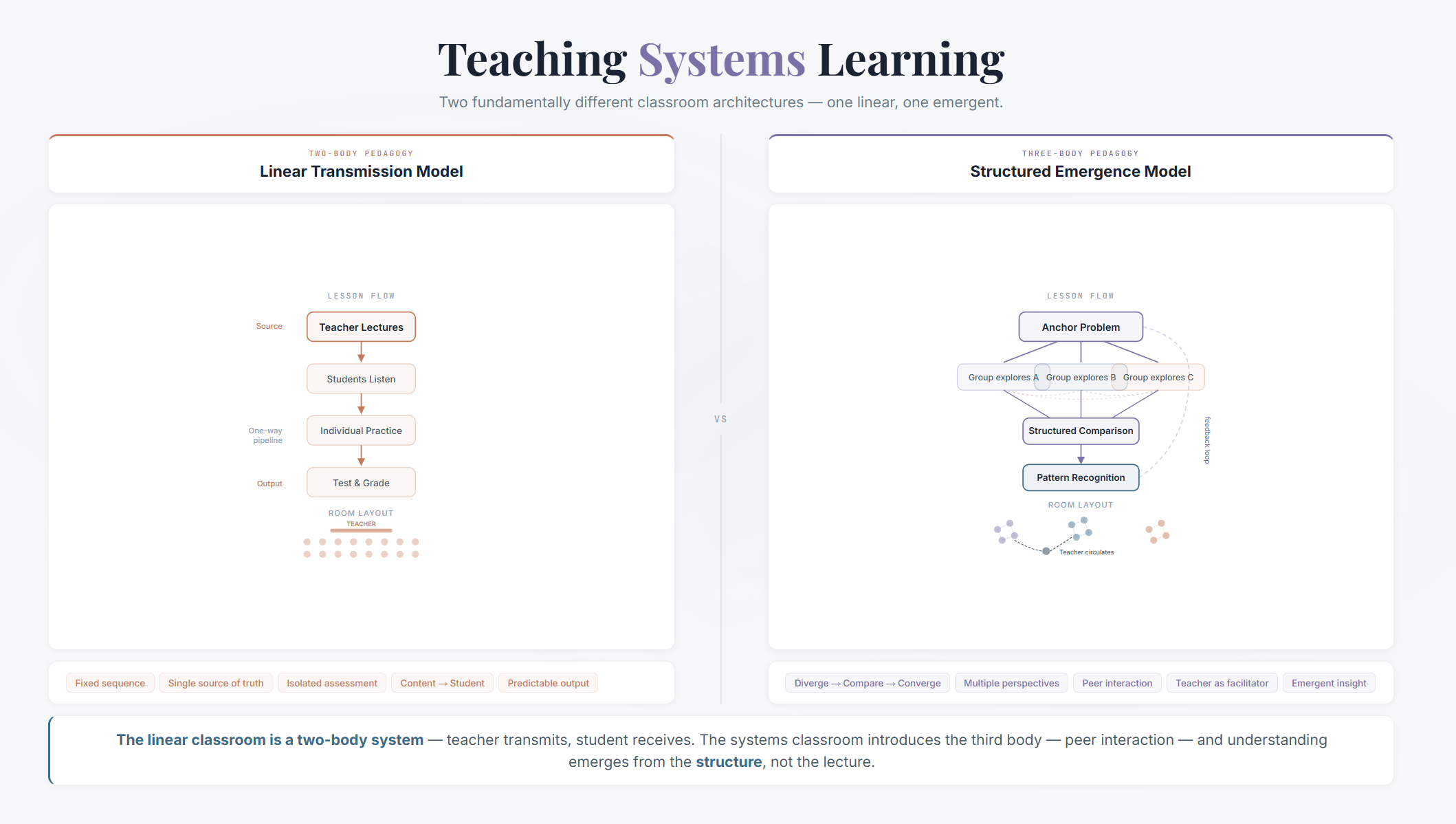
Eastern philosophical traditions — Taoism, Buddhism, Confucianism in its original form — never had the Western obsession with reducing systems to two-body problems. The Tao Te Ching doesn’t describe reality as a binary between order and chaos. It describes a dynamic interplay where opposites contain each other, where the observer is part of the observed, where the system is always already a multi-body problem and the goal isn’t to solve it but to navigate it.
Consider the opening of the Tao Te Ching: the Tao that can be spoken is not the eternal Tao. Translated into systems language: the model that can be fully formalised is not the actual system. Any complete description destroys the thing it describes because the act of description changes the observer’s relationship to the system. This isn’t mysticism — it’s the observer effect, articulated two and a half thousand years before Heisenberg.
Buddhism’s concept of pratītyasamutpāda — dependent origination — is even more explicit. Nothing exists independently. Everything arises in relation to everything else. There are no isolated two-body problems because isolation is an illusion. Every phenomenon is embedded in a web of mutual causation that extends infinitely in every direction. The entire framework assumes multi-body dynamics as the fundamental nature of reality. The two-body abstraction isn’t simplified — it’s false.
Hinduism encodes the three-body dynamic directly in its cosmology. Brahma creates, Vishnu preserves, Shiva destroys — three bodies in perpetual interaction, none reducible to the others, the stability of the cosmos depending on their dynamic tension rather than any one of them dominating. The Trimurti isn’t a hierarchy. It’s a three-body system where the “solution” is the dance itself, not any particular configuration.
Even Confucianism, which the West often reads as hierarchical and linear, is fundamentally about managing multi-body dynamics. The five relationships Confucius describes — ruler-subject, parent-child, husband-wife, elder-younger, friend-friend — aren’t bilateral contracts. They’re a network. Each relationship shapes and constrains the others. Your obligations as a parent affect your obligations as a subject. Your role as a friend modifies your role as an elder. The whole system is irreducibly multi-body, and Confucian ethics is essentially a protocol for navigating that complexity without reducing it to something it isn’t.
The I Ching is essentially a multi-body dynamics manual disguised as a divination tool. Sixty-four hexagrams, each representing a state of a complex system, each containing the seeds of its transformation into other states. It doesn’t predict specific outcomes — it maps the topology of possibility space and helps you understand which transitions are likely given current conditions. That’s not mysticism. That’s phase space analysis dressed in ancient metaphor.
Meanwhile, the West spent two thousand years trying to build the perfect two-body system — one God, one truth, one authority, one correct answer — and treating every three-body disruption (heresy, revolution, scientific discovery) as a problem to be eliminated rather than a signal about the nature of reality.
The result is that Western institutions are structurally fragile in a way that Eastern institutional thinking often isn’t. Not because Eastern systems are better in some absolute sense, but because they were designed with a different underlying geometry. They expect nonlinearity. They plan for the third body. They use structure in service of navigating complexity rather than in service of eliminating it.
This is why the West keeps producing organisations that look brilliant on paper — perfect org charts, clear reporting lines, elegant strategy documents — and then fail catastrophically in execution. The architecture is two-body. The world is three-body. The map doesn’t match the territory and never could have.
Software Already Knows This
If you work in software engineering, none of this should sound abstract. You’ve lived it.
Two services communicating over an API is a two-body problem. Predictable. Testable. You can reason about the states, handle the errors, write the contract. It works.
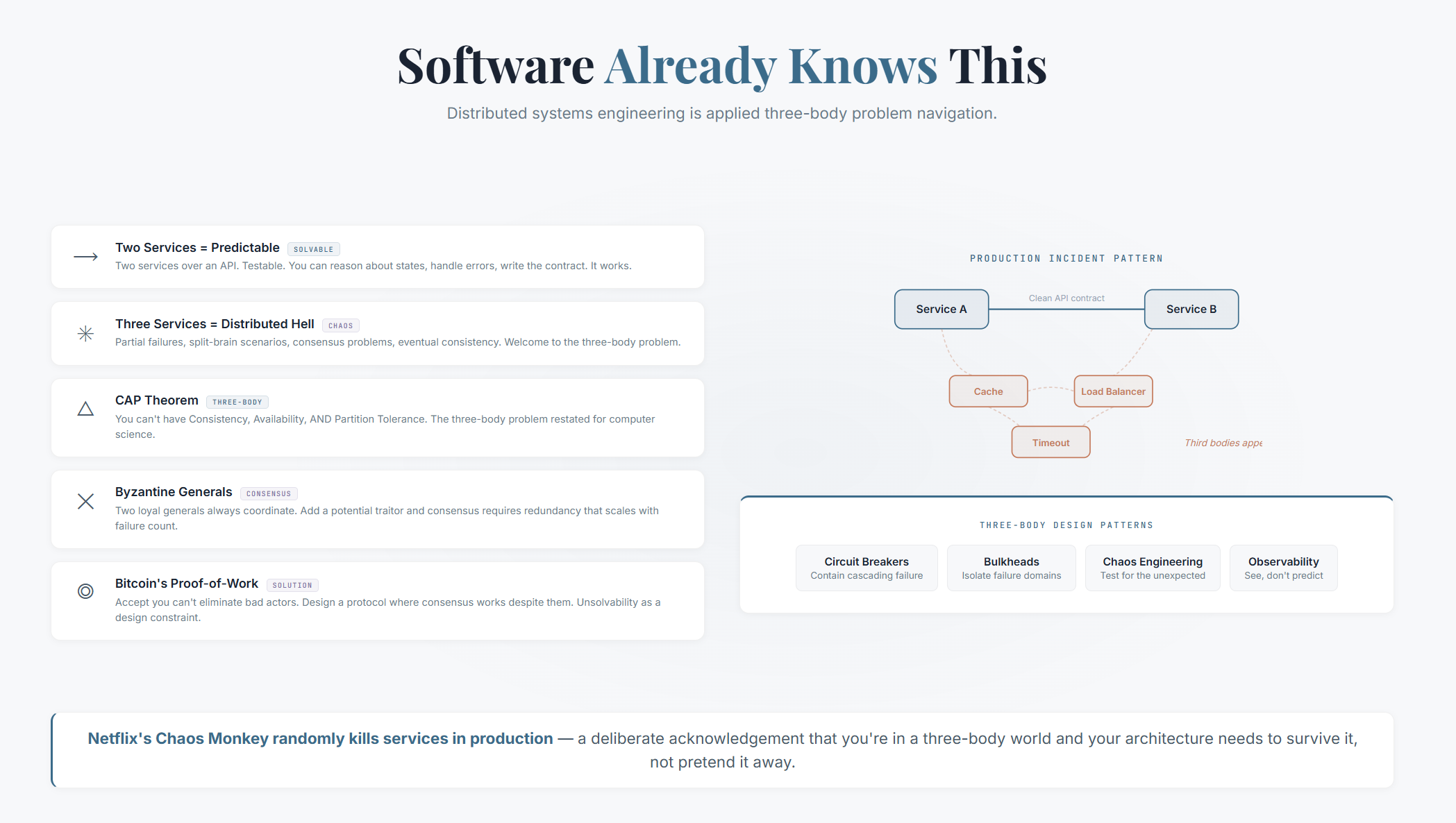
Three services? Welcome to distributed systems hell. Suddenly you’re dealing with partial failures, split-brain scenarios, consensus problems, and eventual consistency. You can’t have all three of consistency, availability, and partition tolerance — that’s the CAP theorem, and it’s essentially the three-body problem restated for computer science. The system becomes fundamentally unpredictable under certain conditions, and no amount of clever engineering eliminates that unpredictability. You can only choose which failure mode you’re willing to accept.
The Byzantine Generals Problem is another expression of the same pattern. Two loyal generals can always coordinate. Add a third general who might be a traitor, and suddenly you can’t guarantee consensus without redundancy that scales with the number of potential failures. Bitcoin’s entire proof-of-work mechanism — the thing that made decentralised currency possible — is essentially a three-body problem solution: accept that you can’t eliminate bad actors from the system, so design a protocol where the system reaches consensus despite them. Not by solving the problem. By making the problem’s unsolvability a design constraint rather than a bug.
Microservices architecture is the software world’s attempt to pretend that a multi-body system can be decomposed into many two-body problems. And it works... until it doesn’t. Until the interactions between services create emergent behaviour that nobody designed and nobody predicted. Until the latency in one service cascades through twelve others in a pattern no architecture diagram captured. Until the system starts exhibiting three-body dynamics that the two-body abstractions can’t account for.
Every production incident I’ve seen in distributed systems follows the same arc. Some team built a beautiful two-body abstraction — “Service A calls Service B, Service B returns a result” — and then reality introduced a third body. A cache that was supposed to be transparent. A load balancer making routing decisions neither service anticipated. A timeout that triggered a retry storm that created a feedback loop between three services that had never been tested together. The architecture diagram showed clean lines. The production system showed a manifold.
The systems engineers who actually build reliable distributed systems know this intuitively. They don’t try to eliminate complexity — they design for it. Circuit breakers, bulkheads, chaos engineering, observability over predictability. These are all three-body design patterns. They accept that the system will behave in ways you can’t predict and build in the capacity to respond rather than the illusion of control. Netflix’s Chaos Monkey — which randomly kills services in production — is a deliberate acknowledgement that you’re living in a three-body world and your architecture needs to survive it, not pretend it away.
This is why I keep arguing that systems engineering needs compiler-like infrastructure — not to centralise control, but to make the nonlinear dynamics visible. You can’t navigate a multi-body system if you can’t see it. The matrix-shaped tools we use now (spreadsheets, Gantt charts, requirements tables) hide the topology. We need tools that show the manifold. That represent relationships as curved, interconnected, mutually dependent — because that’s what they actually are.
The Pattern Across Everything
Once you see it, you see it everywhere. And not as vague analogy — as structural isomorphism. The same mathematical pattern expressing itself across completely different domains.
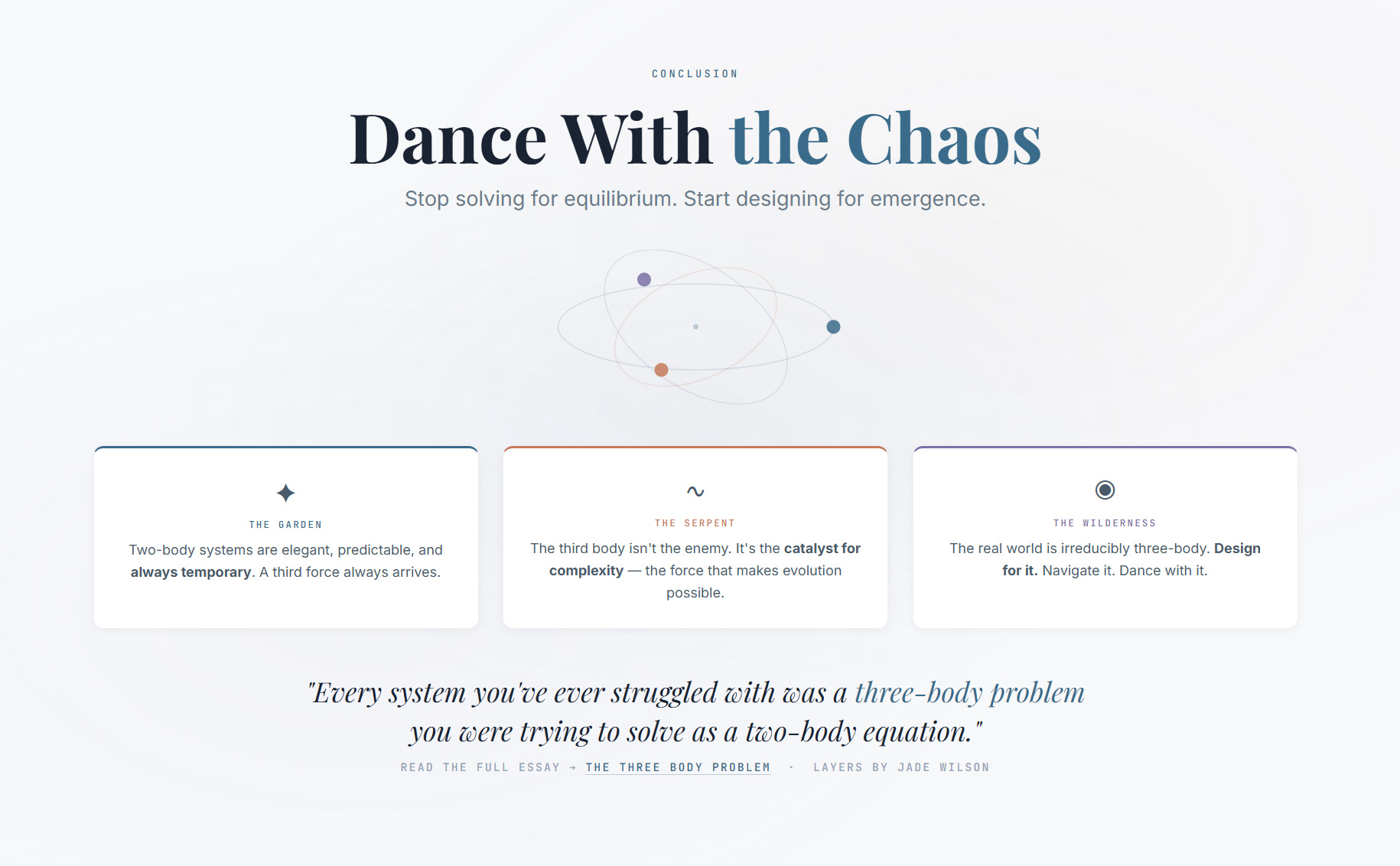
Two-body thinking gives you: hierarchies, centralised control, linear planning, command-and-control management, standardised education, monopoly economics, monotheistic authority structures, matrix-based analysis, deterministic prediction, the garden before the serpent.
Three-body reality gives you: networks, emergent behaviour, nonlinear dynamics, distributed decision-making, adaptive learning, market ecosystems, polytheistic or decentralised wisdom traditions, manifold geometry, probabilistic navigation, the wilderness after the expulsion.
The tension between these two isn’t new. It’s arguably the oldest tension in human civilisation. Every age has its version of the same argument: should we try to restore the garden or learn to thrive in the wilderness?
Religion has this argument (centralised orthodoxy vs distributed mysticism). Politics has it (authoritarianism vs democracy vs anarchism). Economics has it (planned vs market vs commons). Technology has it (proprietary vs open source vs decentralised protocols). Education has it (standardised curricula vs self-directed learning vs community knowledge). Every domain, the same structural question: how many bodies are you designing for?
And every domain makes the same mistake when it refuses to answer honestly.
The three-body problem tells us the garden was never sustainable. You can’t keep a third body out forever. You can’t maintain a two-body system in a universe that generates complexity as a fundamental property. Consciousness, connection, communication — these are third bodies that will always find their way into any closed system. They don’t need permission. They don’t need an invitation. The serpent doesn’t knock.
What Liu Cixin understood — and what makes his trilogy so unsettling — is that the three-body problem isn’t just hard. It’s constitutively unsolvable. There is no future technology, no smarter algorithm, no more powerful computer that will crack it. The unsolvability is a feature of the mathematics itself. Which means any civilisation — fictional or real — that encounters three-body dynamics has exactly two choices: learn to navigate without certainty, or destroy the other bodies until only two remain.
The Trisolarans in the novel choose destruction. Most empires in history have chosen the same. Eliminate the heretic. Colonise the other. Crush the competitor. Absorb the market. Standardise the curriculum. Flatten the manifold back into a matrix by removing everything that doesn’t fit.
It works temporarily. It always works temporarily. Two-body systems are genuinely stable, and the period after you’ve eliminated the third body can feel like peace, order, the golden age. But it’s borrowed time. Because the conditions that generated the third body — complexity, connection, consciousness — haven’t been eliminated. They’ve been suppressed. And suppressed complexity is just deferred chaos and eliminates learning and critical thinking.
The question isn’t whether your neat two-body system will be disrupted. It will. The question is whether you’ve built something that can survive the disruption when it comes. Whether your architecture can absorb a third body without collapsing. Whether you’ve designed for the sphere, or whether you’re still pretending the matrix is enough.
Because the serpent always arrives eventually.
And the systems that last aren’t the ones that keep trying to expel it. They’re the ones that learned to dance with the chaos it brings — that stopped solving for equilibrium and started designing for emergence. That understood the three-body problem isn’t a problem to be solved, but a reality to be inhabited.
We’re not going back to the garden. The fruit has been eaten. The question is what we build in the wilderness.
And maybe that’s not a tragedy. Maybe the garden was always a cage dressed up as paradise. Maybe the wilderness — chaotic, unpredictable, multi-body, alive — is where the interesting things actually happen. Where the nonlinear connections between philosophy, physics, theology, software, and human nature aren’t a mess to be tidied but a manifold to be explored.
The three-body problem isn’t a problem at all. It’s a description of reality. And the sooner we stop trying to solve it and start learning to inhabit it, the sooner we might build institutions, systems, and relationships that actually work.
Not because they eliminate chaos. But because they were designed to dance with it.
If we keep trying to eliminate the chaos by reducing everything into two binary options, we’ve already failed the test.
If this resonated, share it with someone who’s tired of being told the world should be simpler than it is.
And if you’re new here — Tech Unfiltered is where I write about systems thinking, software engineering, and the patterns that connect technology to everything else. It’s a mix of tech, open source, and philosophy — with a strong emphasis on seeing the structures that everyone else takes for granted. No LinkedIn polish, no sugarcoating. Subscribe if you want the unfiltered version.
Great article! I really enjoy your work. Keep it up!