
The System Works Perfectly. That's the Problem.
How to wake up to systems that were designed to keep us asleep.

Ever since I was a little girl, I wanted to understand how systems truly work.
I always knew I was missing something, I knew the systems around me felt rigged. Things just didn’t add up, it always felt like everything around me was intentional noise, to distract.
I was right.
I’d spent my entire life figuring out how to remove the noise. How to make systems truly automated and systemised. What is it that keeps us making the same mistakes over and over again? Where do the bottlenecks hide? How do we build things that actually function long term? Why do we not help ourselves?
I’ve determined the blockers. I can see the mistakes we were making. I’d figured out why it was important for us all to come together.
AI was supposed to be the accelerant. The thing that finally let us show what we could do.. We could build faster, share more, demonstrate patterns and approaches that actually worked. We could create tools that removed friction, that made complexity manageable, that gave people the freedom and leverage that they’d never had before.
I was wrong.
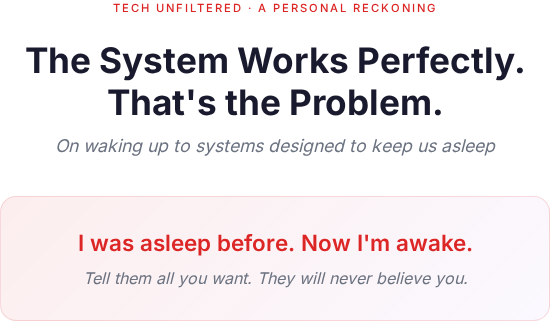
I was asleep before. Now I’m awake.
Tell them all you want. They will never believe you.
The Pattern I Couldn’t Unsee
But here’s what I’ve come to understand: the inefficiencies I see, well they aren’t accidents. The bottlenecks aren’t oversights. The noise isn’t noise. The system is working exactly as designed.
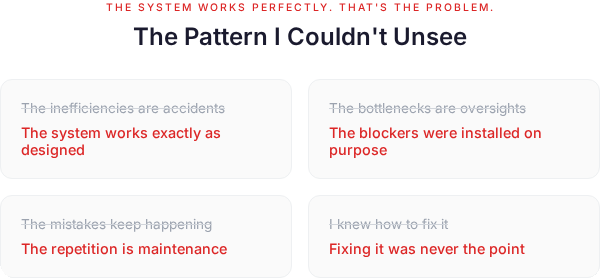
The mistakes we keep making? They’re not mistakes. They’re maintenance. They’re conditioned. Intentional.
I’ve determined the blockers, only to notice the blockers have been installed on purpose.
I can see the mistakes we are making. Only to realise they were intentional mistakes.
I know just what to do. But getting it done was never the point.
The system is designed to stop others listening to people like me. To keep certain voices at the bottom of the chain. To ensure that no matter how much we know, how much we figure out, we lack the communication, authority or position to do anything about it.
I’d been treating organisational dysfunction as a problem to solve. But it turns out it’s a feature, not a bug.
I thought AI would democratise capability. Give individuals the leverage to build what only teams could build before. Let the people who understood systems finally prove it. But the system doesn’t want capability democratised. It wants capability controlled.
I was asleep before. Now I’m awake.
Tell them all you want. They will never believe you.
The Stories That Saw It First
As I’m writing this, I keep thinking about the fiction that tried to warn us.
In The Handmaid’s Tale, Offred remembers the world before. How it happened gradually, then all at once. How people kept saying it would be fine. How they adapted, adjusted, accepted—until acceptance was the only option left. She says it plainly: “I was asleep before. That’s how we let it happen.”
We’re always asleep before. That’s the trick. By the time you wake up, the walls are already built.
Tell them all you want. They will never believe you.
In Silo, Juliette spends the whole story believing she’s uncovering secrets that will change everything. She’s an engineer. She fixes things. She removes the noise, solves the problems, traces the faults back to their source. She’d determined the blockers. She could see the mistakes they were making. She knew just what to do. Then she steps outside and sees the ugly truth: the system knew. It always knew. The faults were designed in. The revelation changes nothing except her.
Tell them all you want. They will never believe you.
In The Hunger Games, Katniss reaches the Capitol and finally witnesses the waste—the abundance hoarded while districts starve. But the real gut-punch isn’t the inequality. It’s realising that no matter who you ally with, no matter which side you choose, you’re always the one who loses. The game is rigged at a level beyond individual choices. The chaos in the districts isn’t a failure of governance. It’s the product.
Tell them all you want. They will never believe you.
Divergent frames being different as dangerous—not because difference is weak, but because it threatens the sorting mechanisms that keep everyone in their place. Tris learns that her divergence isn’t a gift. It’s a target. The system needs people who fit neatly into categories. People who see across boundaries, who notice the patterns, who could remove the noise—they’re the threat.
Tell them all you want. They will never believe you.
And The 100 just shows us the cycle on repeat: factions destroying each other, rebuilding, destroying again. The names change. The pattern doesn’t. Every generation thinks they’ve learned from the last. They haven’t. They can’t. The cycle is the point.
Tell them all you want. They will never believe you.
The Hunger Games is the one that haunts me most. It maps so precisely onto class structures, power dynamics between nations, the way resources flow upward while sacrifice flows down. Suzanne Collins wasn’t writing fantasy. She was writing documentation.
But The Handmaid’s Tale is the one that terrifies me. Because it shows how quickly we forget we were ever free.
The Pacification Engine
The system is designed to make us consumers.
Not creators. Not builders. Not thinkers. Consumers.
Because thinking is dangerous. If you can see how the pieces connect, you might start asking why they’re arranged this way. You might notice who benefits from the arrangement. You might realise that “the way things are” is a choice someone made—and choices can be unmade.
I was asleep before. Now I’m awake.
Tell them all you want. They will never believe you.
So the system keeps us busy. Keeps us competing for scraps. Keeps us focused on individual advancement within structures that ensure collective stagnation. Keeps us believing that if we just trust the system, if we work harder, learn more, share more openly, we’ll eventually earn our seat at the table.
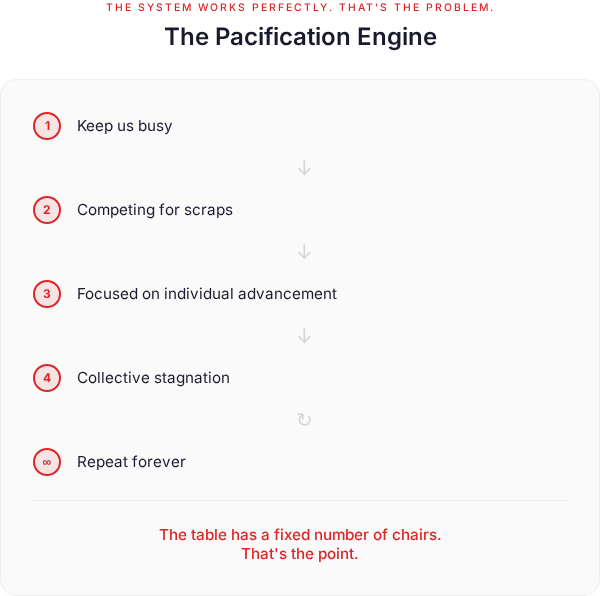
But the table has a fixed number of chairs. That’s the point.
I spent years trying to figure out why organisations keep making the same mistakes. Why the same problems resurface. Why the solutions never stick. I thought it was lack of knowledge. I thought if they could just see—if we could just remove the noise, just make it clear—they’d want to fix it.
If we could just determine the blockers. If we could see the mistakes we were making… And I knew just what to do.
And none of it mattered.
I thought AI would be the proof. Look, here’s the methodology, here’s the architecture, here’s how you do it. Anyone can do this now. The barriers are gone.
But the barriers were never technical. The barriers are political. And they don’t want them removed.
We don’t want to fix it. The repetition is the point. The noise is the point. It keeps us too busy firefighting to ever look up and ask who keeps starting the fires.
“The Capitol is very fragile.”
President Snow says this, and he means it as a warning. But it’s also an admission. The whole edifice depends on people not looking too closely. Not connecting too many dots. Not talking to each other about what they’ve seen.
Remember who the real enemy is.
I was asleep before. Now I’m awake.
Tell them all you want. They will never believe you.
The Choice
The system makes you choose. Eat or be eaten. Protect or wait to be protected.
I had a choice to make. Who am I? Who do I want to be?
I know how the system works. I have the brains. I could make the money. I know exactly how to play the game—how people work, how to influence, how to position, how to extract value from people who trust me. I’ve spent my whole life understanding systems. I could use that understanding to climb.
I’ve determined the blockers. I can see the mistakes we are making. I know just what to do.
I could use all of it for myself.
I can take what I’ve learned about AI and code and sell it to the highest bidder. Consult for companies that want to “optimise” their workforce. Help them automate people out of jobs while pretending it’s progress. Package my methodology as a product and charge premium rates to people who will use it to consolidate power.
But should I? Could I?
Am I okay looking at myself in the mirror knowing I got ahead by pushing others down? Knowing I became the thing I swore I’d never be? Knowing I chose to add more noise instead of removing it?
I know how this game ends for people like me.
I was asleep before. Now I’m awake.
Tell them all you want. They will never believe you.
The Rebel Trap
Here’s the part that really hit me: I’m not outside the cycle. I’m part of it.
I’m the ‘rebel’. The one who thinks they can make change by sharing knowledge, by being transparent, by building in the open. And maybe some of that helps individuals. Maybe someone reads what I write and sees their own situation more clearly. Maybe someone learns to use AI effectively because I documented my process.
But the system absorbs rebellion. It metabolises dissent into content. It turns critique into engagement metrics. It makes an enemy of the rebellious. Every time someone post about how broken things are, they’re feeding the same attention economy that keeps the machinery running.
I was asleep before. Now I’m awake.
Tell them all you want. They will never believe you.
The change people want to make will be used and manipulated by those with actual power. They’ll smirk as they make you the bad guy. They’ll take any of your insights, strip out the politics, package anything useful and sell it back to us as a solution to problems they created.
If I open-source my work so others can learn. They’ll use it, rebrand it, sell it. I share my methodology so others can build. They’ll turn it into a course, gate it behind a paywall, extract value from the very people I wanted to help.
I’ve spent my life trying to remove the noise. Now I wonder if everything we’ve ever shared just becomes more noise. More content. More signal lost in the flood.
I’m cursed to see the true intentions while lacking the influence or authority to do anything about them.
I was asleep before. Now I’m awake.
Tell them all you want. They will never believe you.
So What Now?
I don’t have an answer. I’m not going to pretend I do.
I don’t know how to break the cycle. I don’t think there’s a clean way out—not from the top, not from the middle, not from the bottom. The system is too good at absorbing threats, too practised at redirecting energy into harmless channels, too skilled at making the signal look like noise and the noise look like signal.
I was asleep before. Now I’m awake.
Tell them all you want. They will never believe you.
But I keep coming back to something: the system is very fragile.
It depends on us not seeing. On us not talking. On us staying isolated in our individual struggles, convinced that our problems are personal failures rather than systemic outcomes.
Maybe the answer isn’t breaking the cycle. Maybe it’s refusing to pretend the cycle doesn’t exist. Naming it. Documenting it. Making it harder for the next person to be naive in the same way.
I’ll keep building. I’ll keep writing code with AI. I’ll keep doing what I do in the open. Not because I think it will change the system, but because it’s the only way I know how to prepare for the changes we so desperately need to make.
I don’t know if that’s enough. I suspect it isn’t.
But it’s what I have.
There Has to Be More
And as I’m closing out here, I think to myself there has to be more than this.
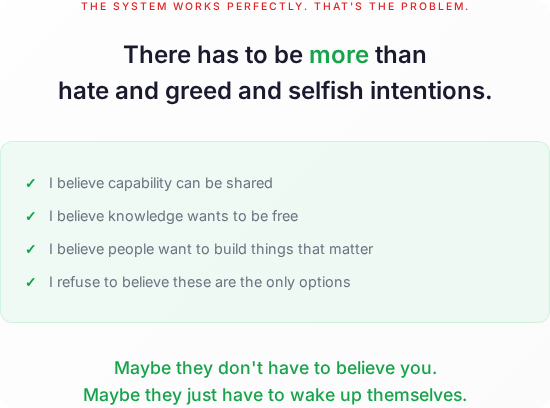
There has to be more to life than so much hate, greed and selfish intentions. More than climbing over each other for a slightly bigger share of a rigged game. More than choosing between being the predator or the prey.
I spent my whole life trying to remove the noise so we could finally hear each other. So we could stop repeating the same mistakes. So we could build something that actually works.
I can see the mistakes we were making. I can see the cycle is repeating
.
How do we break it?
I refuse to believe that the only options are exploitation or extinction. I refuse to believe that clarity is worthless. I refuse to believe that the desire to fix things—really fix them, not just profit from the brokenness—is naive.
I was asleep before. Now I’m awake.
Tell them all you want. They will never believe you.
“They would never do that to us.”
“What are you talking about?”
“Do you need to take a break?”
“I think you need therapy.”
Maybe they’re right. Maybe I do.
Or maybe the fact that if wanting something better sounds crazy, well that’s the most damning evidence of all.
If you’re seeing these patterns too, I’d like to hear from you. Maybe we can help make a difference, from the bottom up.
I was asleep before. Now I’m awake.
Tell them all you want. They will never believe you.
But maybe they don’t have to believe you. Maybe they just have to wake up themselves.
It totally makes sense that you're feeling overwhelmed about all this and I totally get it because I was once -- and in some ways am still -- in your shoes.
That said, fortunately, the solution is the same as it's been throughout history: collective action. It's not easy, it's not fast, but it's the only way real change has ever been implemented. The 40-hour work week, the end of child labor, all of this was the end result of regular people coming together to share ideas and voice opposition to the status quo. Shifting the Overton window of what's socially acceptable and creating new consensus about what's possible are how we have improved society over time.
I recommend reading about neoliberalism to make more sense of how the system works and how we got here. You may already know that this is the name for the various economic policies we see today that harm workers (e.g., privatization, cutting public services, etc.), but the book does a great job of giving context our school curriculums didn't give us. A great quick read is Invisible Doctrine. We read it in Anna Bocca's book club! (she's on YouTube if you wanna check her out)
But the answer is definitely not hopelessness or cynicism because the system preys on both of those even if it attempts to quash rebellion. I've recently started finding ways to contribute to my local community, and it's honestly very rewarding and I'm discovering more ways to help out every day. It's a rabbit hole I recommend going down in your local community ^_^
Great insight!
What to do about it? I don't think you can get rid of a bad system, as you correctly pointed out. However, you can still thrive within the system while staying within your own ethical boundaries. Knowing the system's constraints and end goal helps you with that. And the best things you can do for others who are stuck in the system is keep spreading awareness on how the system works and show them how to thrive despite its constraints.
The thing is, not everyone would benefit from the current system being destroyed. Not everyone would want to be "saved". Cypher from The Matrix is an excellent metaphor for that. The system can only be changed if there's a critical mass of people who choose not to be constrained by the existing status quo and choose to do what they believe is right rather than what everyone else is doing.
Dan Koe has some great content on that. He pretty much dedicated his entire blog to it. I also really like "The Sovereign Individual" book that talks about this subject.