

Why brilliant teams still fail — and the cognitive profiles that prevent stack collapse.
High-performing teams can still implode. Not from lack of talent. Not from lack of funding. From something much simpler:
They were all the same kind of smart. They just didn’t appreciate each other’s uniqueness.
The Hard Part Nobody Talks About
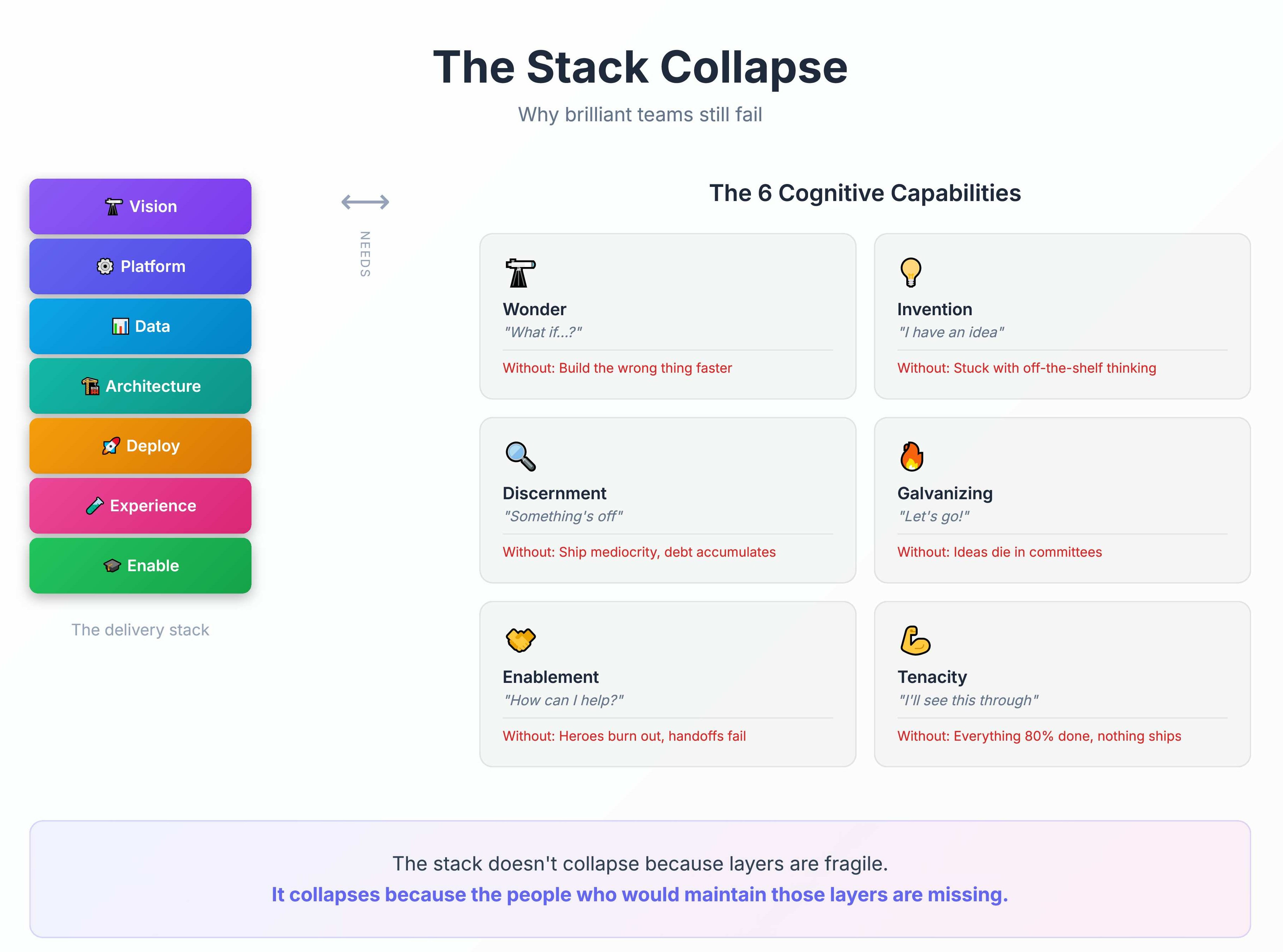
Every complex system needs to flow through these layers:
Vision → Platform → Data → Architecture → Deploy → Experience → Enable
Skip a layer, do it badly, and the whole stack collapses. We’ve all seen it:
The startup with amazing tech that never ships
The enterprise with perfect processes that can’t innovate
The team that builds beautiful things nobody uses
The constant workarounds to deal with
Here’s what I’ve learned: The layers don’t collapse because they’re fragile. They collapse because the team doesn’t have the right cognitive mix to maintain them.
The 6 Working Geniuses (And Why You Need All of Them)
Patrick Lencioni’s framework nails this. There are six types of cognitive contribution. Most people are strong in two, competent in two, and actively drained by two.
The problem? We hire people who think like us.
🔭 Wonder
“What if...?”
These people sit with questions. They notice what’s missing. They’re energized by possibility, not certainty.
What they bring: The problems nobody else sees. The opportunities hiding in plain sight.
Stack collapse without them: You optimize a local maximum. You build the wrong thing faster.
💡 Invention
“I have an idea.”
Give them a problem, they generate solutions. They don’t need permission to create. They can’t help it.
What they bring: Novel approaches. Creative leaps. The thing that didn’t exist before.
Stack collapse without them: You’re stuck with off-the-shelf thinking. Competitors out-innovate you.
🔍 Discernment
“Something’s off.”
They have taste. They know good from great. They can’t always explain it, but they’re almost always right.
What they bring: Quality. Judgment. The subtle improvements that compound.
Stack collapse without them: You ship mediocrity. Technical debt accumulates. The foundation cracks.
🔥 Galvanizing
“Let’s go!”
They rally people. They create momentum. They make the abstract feel urgent and possible.
What they bring: Energy. Buy-in. The push that gets things moving.
Stack collapse without them: Great ideas die in committees. Nobody takes the first step.
🤝 Enablement
“How can I help?”
They remove blockers. They ask what people need. They make others successful.
What they bring: The glue between people. The support that prevents burnout.
Stack collapse without them: Heroes burn out. Knowledge stays siloed. Handoffs fail.
💪 Tenacity
“I’ll see this through.”
They finish. Not glamorously. They push through the boring middle, the edge cases, the documentation nobody wants to write.
What they bring: Completion. The last 20% that represents 80% of the value.
Stack collapse without them: Everything is 80% done. Nothing actually ships.
The Uncomfortable Truth
Here’s what most teams get wrong:
We think hiring more of their best people will scale. It doesn’t.
If your team is full of Inventors, you’ll have infinite ideas and nothing shipped.
If your team is all Tenacity, you’ll execute perfectly on the wrong thing.
If you’re heavy on Wonder but light on Discernment, you’ll chase every shiny object.
The stack collapse isn’t a process problem. It’s a cognitive diversity problem.
Where AI Fits In
This is where it gets amplified...
AI can amplify each of these profiles:
Wonder - Explore possibility spaces faster
Ideation - Generate more variations to evaluate
Discernment - Surface patterns and anomalies
Galvanizing - Create compelling narratives and visuals
Enablement - Automate support, answer questions
Tenacity - Handle the tedious completion tasks
But here’s the catch:
AI without domain context and user capability just amplifies noise. It hallucinates. It creates plausible-sounding nonsense.
You don’t know what good looks like.
Because you’re not the user.
The Question to Ask Your Team
Look around your current project. Ask:
- Who’s holding the Wonder? Who’s asking “what if?”
- Who’s doing the Invention? Who’s generating solutions?
- Who’s applying Discernment? Who’s calling out when something’s off?
- Who’s providing Galvanizing energy? Who’s creating momentum?
- Who’s in Enablement mode? Who’s removing blockers?
- Who’s bringing Tenacity? Who’s finishing the hard parts?
If any of those questions make you pause... you’ve found your collapse point.
The Takeaway
Brilliant teams don’t fail from lack of intelligence. They fail from cognitive homogeneity.
The stack collapses not because layers are missing — but because the people who would maintain those layers are missing.
Build cognitively diverse teams. Make them aware of their strengths. Then give them a domain layer that captures their collective intelligence.
That’s how you scale without collapse.
The capabilities are the amplifier. Everything else is a distraction.
There is so much good in here.
This made me smile:
Vision → Platform → Data → Architecture → Deploy → Experience → Enable
It reminds me that I explain things similarly, but that the vision step is just expanded.
I use similar processes for talking to people, to understand their problem:
Decide to meet > brainstorm (mind dump) > ideation > problem/outcome definition > scoping > tasking > doing > etc
I fell off at the end but wanted to share the first few. I extend the imagination work to get as much useful information as I can, so that I have a good chance at success.
Nice article. I really like this.