

Fire. Water. Earth. Air.
You’d think we’d have moved past this. We’ve got quantum computers, large language models, CRISPR. And yet here we are, still organising everything — personality, movies, AI training — around four elements that ancient Greeks came up with before they knew what atoms were.
That’s not a failure of imagination. That’s a signal.
When a pattern keeps showing up across thousands of years, across cultures that never spoke to each other, across disciplines that developed independently — you’re not looking at a coincidence. You’re looking at the shape of something real.
Everything Is Fire
Before the colour wheels and personality frameworks and Pokémon types, there was one philosopher who looked at the world and said something most people weren’t ready to hear.
Heraclitus of Ephesus, around 500 BCE, argued that the fundamental substance of reality was not water, not number, not atoms. It was fire. But not fire as a thing. Fire as a process. An ongoing act of transformation. The universe is not a collection of objects — it is a system of exchanges. Energy moving. Consuming. Releasing. Becoming something else.
Everything is fire. And fire is never at rest.
The other elements weren’t separate substances to him. They were modes. States that fire passes through. Water is fire slowed. Earth is fire condensed. Air is fire released. The four-element model isn’t a taxonomy of different things — it’s a description of one thing in different phases of transformation.
This reframe matters. Because it means the question was never which element are you. The question was always where in the cycle are you right now, and what’s driving you through it.
Opposition is not the enemy of balance. It is balance.
Here’s where Heraclitus breaks from how we usually think about conflict.
We assume equilibrium means stillness. Two forces cancel out, nothing moves, system reaches rest. That’s the intuition. But he said something different: the opposites don’t cancel. They sustain. The tension between them is exactly what holds the structure together.
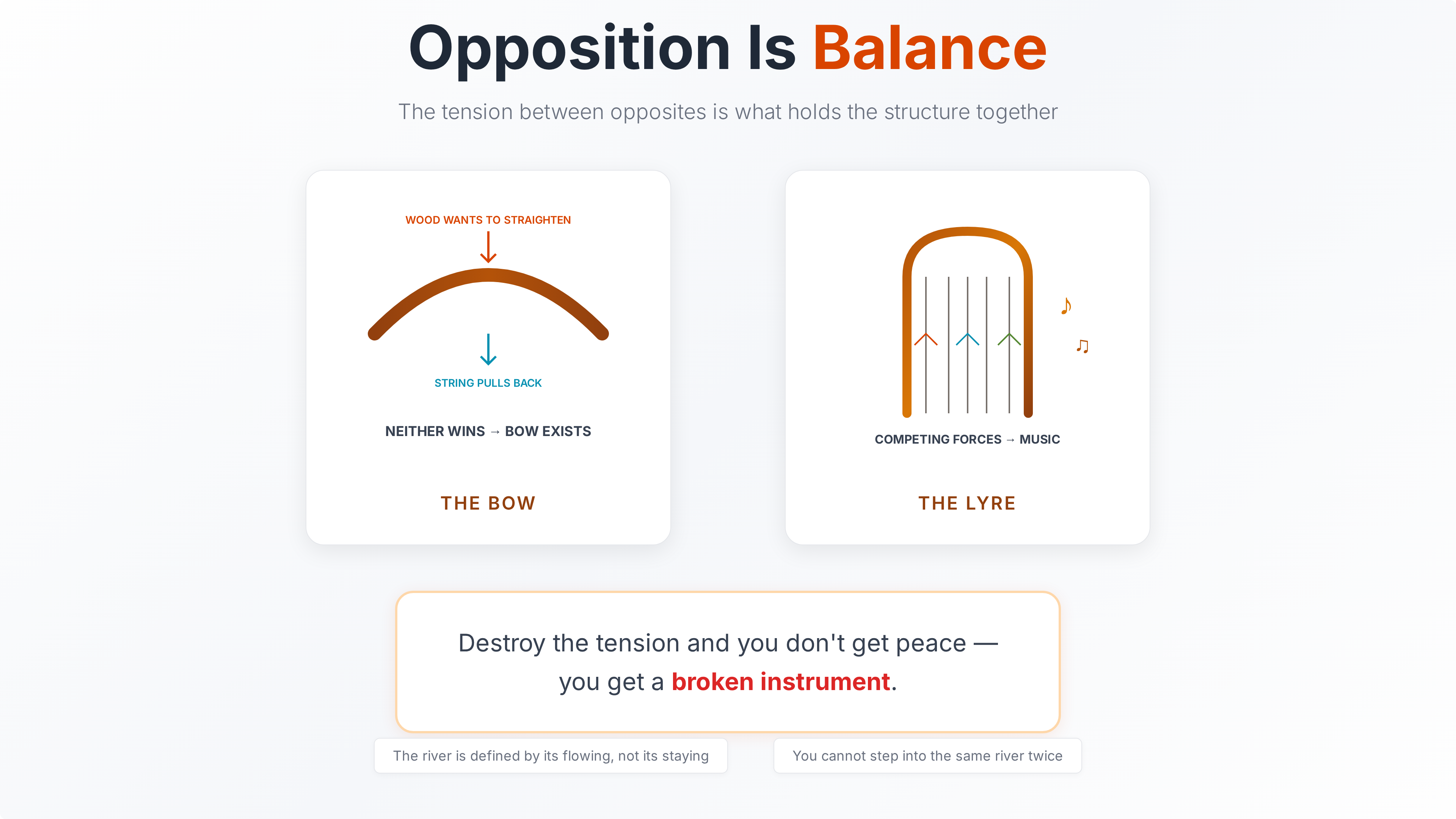
He used the image of a bow. The wood wants to straighten. The string pulls it back. Neither wins. The bow exists because neither wins. Destroy the tension and you don’t get peace — you get a broken instrument.
Same with the lyre. The strings are held at pitch by competing forces. The moment one gives, the music dies.
The logos — his word for the deep pattern underlying reality — is not harmony in the comfortable sense. It is strife held in dynamic balance. The river looks stable from the bank. Step into it and you find it’s entirely different water than it was a second ago. You cannot step into the same river twice. The river is defined by its flowing, not its staying.
This is not a metaphor. This is a systems engineering claim. The state of a system is not its rest position. It is its process. What it’s doing. How it’s moving. What it’s exchanging with what.
It’s not about four things. It’s a cycle.
Pokémon types. Divergent factions. Hogwarts houses. The Insights colour wheel you got forced through in your last corporate away day. Myers-Briggs. Jungian functions. Avatar: The Last Airbender. Frozen II. Every personality framework, every world-building exercise, every attempt to map the terrain of human difference eventually lands on four, or a multiple of four, and the specific labels never quite matter. What matters is the geometry.
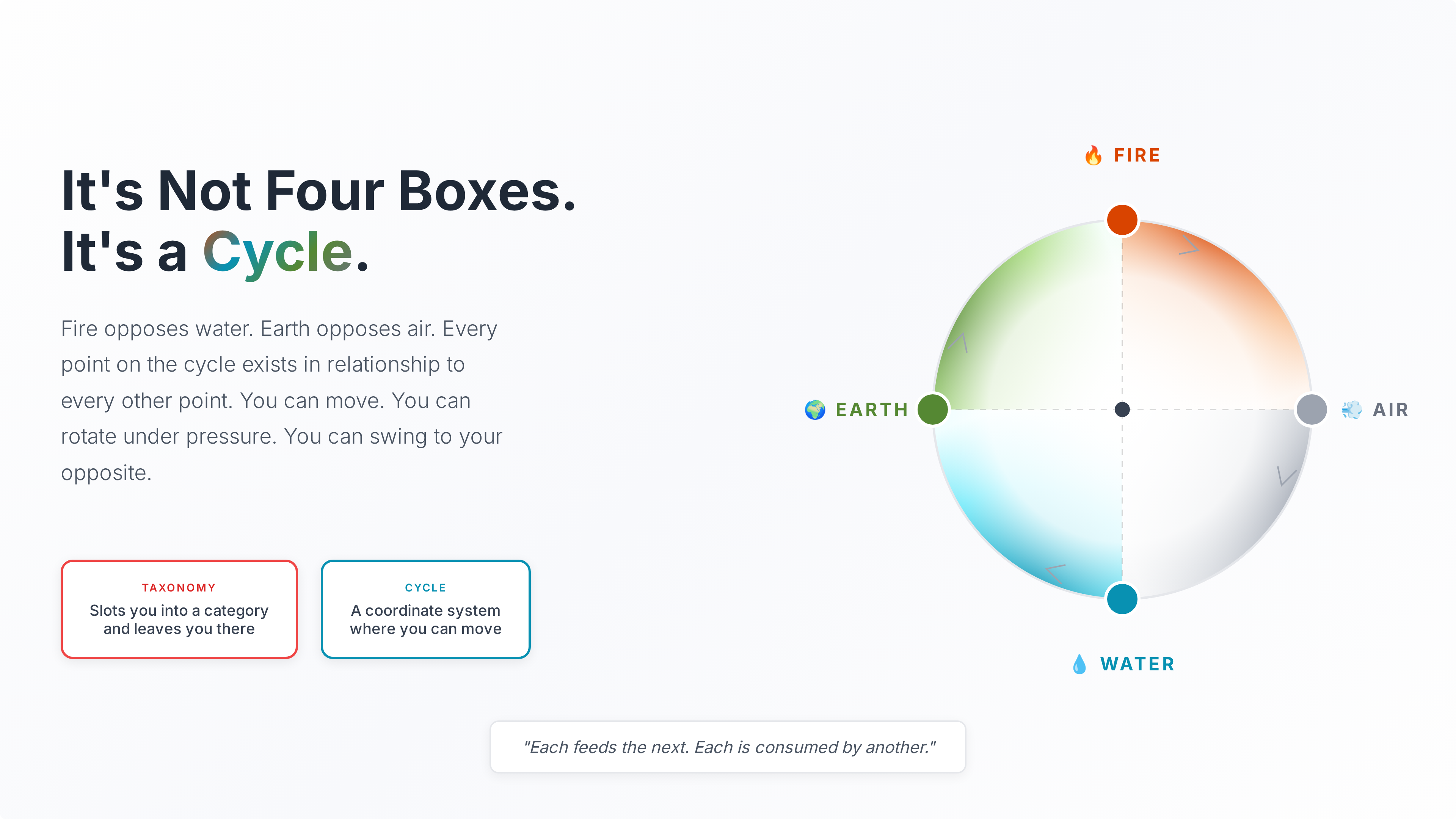
Because it’s not four boxes. It’s a cycle. Fire opposes water. Earth opposes air. And every point on that ring exists in relationship to every other point. You can move. You can rotate under pressure, calm back toward your centre, swing to your opposite when you’re under sustained stress.
This is fundamentally different from a taxonomy. A taxonomy slots you into a category and leaves you there. A ring is a coordinate system. It describes where you are right now and implies that where you are is not permanent.
The ancient Chinese had the same intuition. Five phases — wood, fire, earth, metal, water — not static categories but a cycle of generation and destruction. Each feeds the next. Each is consumed by another. The cycle sustains itself through constant movement, not through rest. Every civilisation that looked hard enough at nature found the same pattern. Not four boxes. A ring of transformations, each giving to the next, each taking from the last.
Equilibrium not as stillness. As managed exchange.
Energy must give or take. Always.
The second law of thermodynamics would not be formalised for another 2,300 years after Heraclitus, but he already understood its spirit. Nothing generates from nothing. Everything that consumes must take from somewhere. Every fire needs fuel. Every flame transforms something — takes it from one state, releases it into another.
Putting the fire out is not the absence of fire. It is the fire becoming something else.
And this is where it gets uncomfortable. Because we live in a culture that treats equilibrium as something you achieve and then protect. You work hard, you earn stability, you defend what you’ve built. But the system doesn’t work that way. It never did. For a fire to burn somewhere, it takes fuel from somewhere else. My warmth is your consumed resource. And that might not be a linear mapping — it shows up instead as inflation, as stagnation, as the slow hollowing out of things that used to sustain people.
We farm out our groceries to Amazon. Our thinking to social media. Our connection to platforms that monetise loneliness. Each of these is a fire burning on fuel it didn’t create. The convenience is real. So is the cost. Energy must give or take, and the taking doesn’t announce itself.
In order for these fires to burn so bright, we’ve put out our own fires along the way.
The natural order is not static. It is held. Actively. By everything that’s participating in it.
Are we always destined to repeat the past?
Every era of human history follows the same pattern. A civilisation rises. It accumulates — wealth, knowledge, military power, cultural influence. It becomes the fire that everything else orbits. And then, somewhere in that accumulation, the balance tips. The fuel runs out, or the opposition strengthens, or the internal tensions that were being suppressed by growth can no longer be managed.
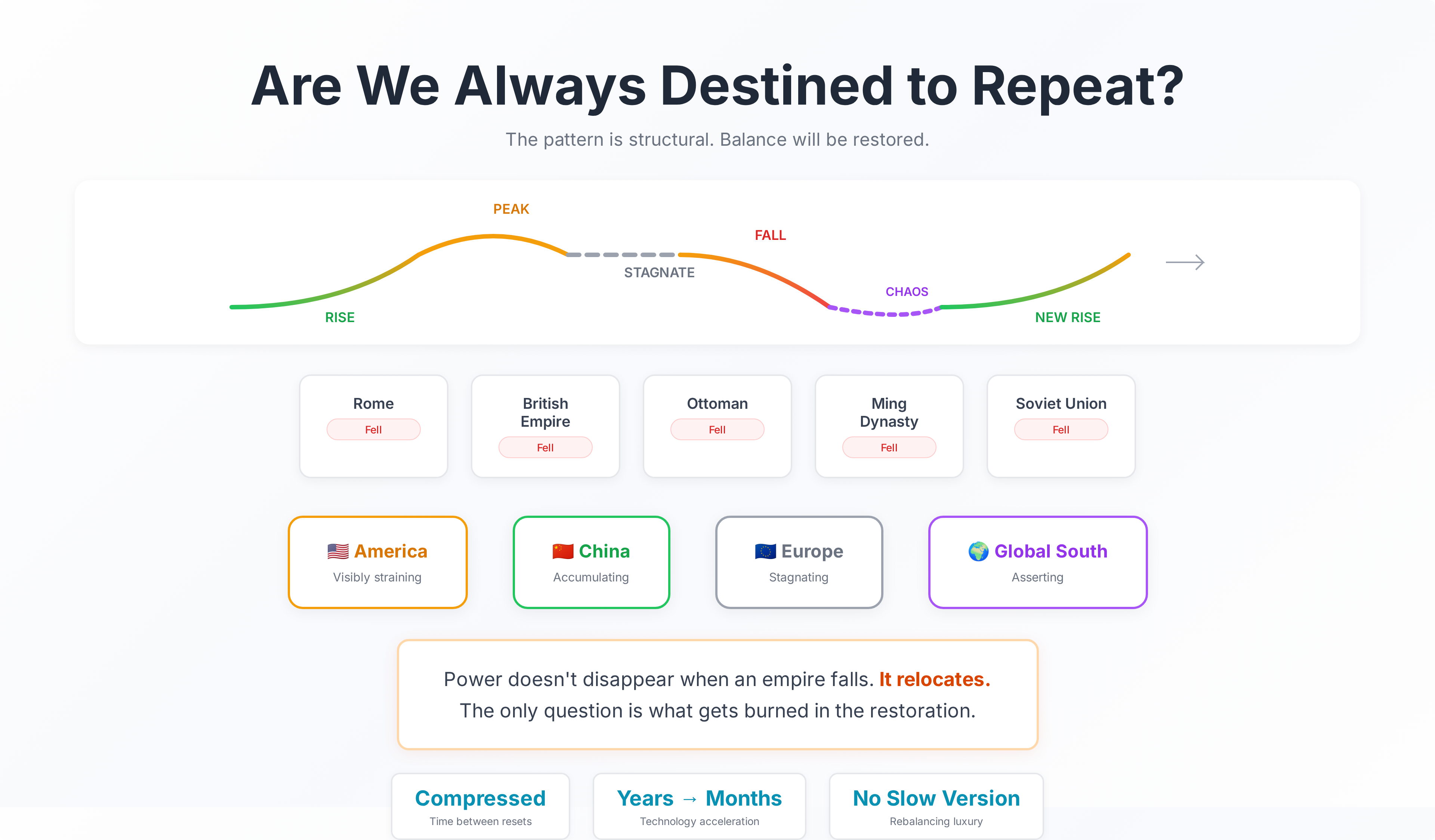
Rome didn’t fall in a day. It stagnated first. Became rigid. Stopped transforming. And while it held its shape, the energy drained — into corruption, into endless frontier wars, into the cost of maintaining an empire that had stopped generating more than it consumed. And then something else rose. Not because Rome was destroyed from outside — because the equilibrium demanded a rebalancing.
The British Empire. The Ottoman Empire. The Ming Dynasty. The Soviet Union. The pattern is not subtle. When a nation stagnates, another overtakes. Not because the overtaking nation is morally superior — because the system requires that energy flow somewhere. Power doesn’t disappear when an empire falls. It relocates.
And it doesn’t relocate cleanly. In the gap between the old equilibrium and the new one — that’s where the chaos lives. That’s where you find the evil, the hate, the loss, the grief of people who built their entire identity around a system that no longer holds. And alongside it, love. Solidarity. The communities that form in ruins. The movements that arise not from strength but from the recognition that the old fire has burned out and something new has to begin.
We are always in one of these phases. Always somewhere on the ring. And the reason history repeats isn’t that humans are stupid or that we fail to learn. It’s that the cycle is structural. Balance has to be restored so that the system doesn’t collapse. The only question is what gets burned in the restoration.
Look at where we are now. The American century, long past its zenith, visibly straining. China accumulating. Europe stagnating. The Global South asserting. The old institutions — the ones that were built to manage the previous equilibrium — losing coherence faster than new ones can form. And underneath all of it, technology accelerating the rate of change so fast that the gap between old equilibrium and new one is compressed into years rather than generations.
We don’t have the luxury of slow rebalancing anymore. The fire is burning faster than it ever has.
The fifth element: The bridge
But here’s what the four-element model alone can’t explain. Why does the cycle ever restart cleanly instead of just grinding to heat death? Why does Rome fall and something genuinely new emerge rather than just more Rome, degraded? Why does the field burn and then become fertile again instead of just staying ash?
Because there is a fifth element. And it has been hiding in plain sight the whole time.
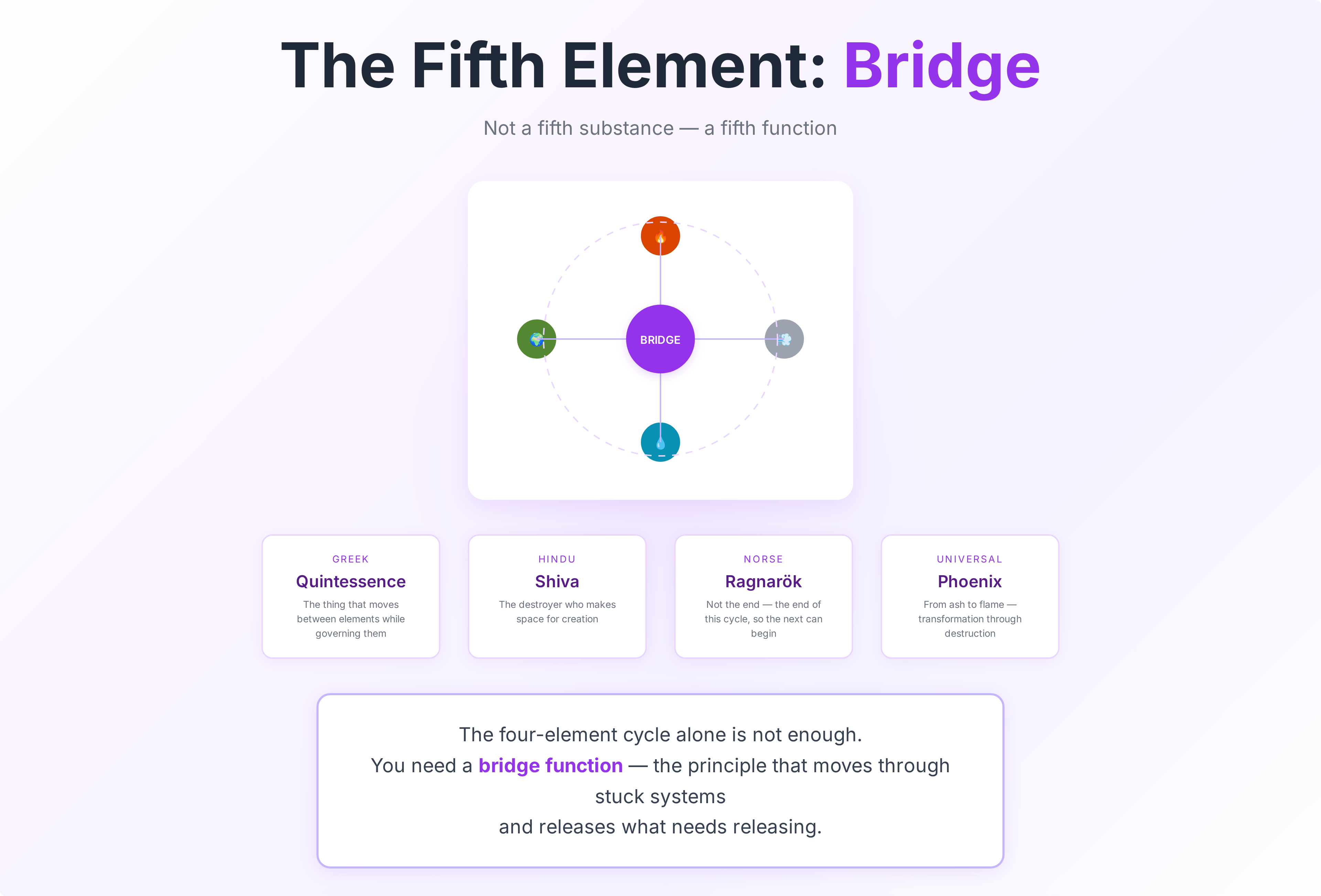
The Greeks called it quintessence. Where the four elements were the substance of the mortal, changing world, quintessence was the thing that existed outside the cycle while governing it. Not fire, water, earth, or air. The thing that moves between them. The principle of transition itself.
Frozen II has a more modern twist than most philosophy textbooks. The fifth spirit is not more powerful than the other four. It doesn’t rule them. It bridges them. Elsa’s role is not to command the elements — it’s to move between them freely, to go where the others can’t, to reach into the places where the cycle has become stuck and release what needs releasing. She is the reset function. The living embodiment of what happens when the system needs to start again.
Hindu cosmology has Shiva — not evil, not destruction for its own sake, but the destroyer who makes space for creation. Norse mythology has Ragnarök — not the end of everything but the end of this cycle, so the next one can begin. The Phoenix. The flood. The extinction event that cleared the dinosaurs and made mammals possible. Every mythology that has thought carefully about time found the same thing: the four-element cycle alone is not enough. You need a fifth principle. Not a fifth substance — a fifth function. The reset. The bridge.
And look at the world right now and tell me the fifth element isn’t already here.
The institutions we built to maintain postwar equilibrium — the UN, NATO, the WTO, the democratic norms that were supposed to be permanent — are visibly losing coherence. The economic model that told an entire generation that education plus hard work equals security has been exposed as a story we told ourselves while the fuel was still plentiful.
This is what reset looks like from inside it. It doesn’t feel like renewal. It feels like loss. It feels like the things you were told were solid turning out to be held in place by tension that nobody was maintaining. It feels like watching people cling to configurations that stopped serving them a generation ago because the alternative — accepting that the reset is necessary — is too frightening to sit with.
The hate that is spreading is the last gasp of a configuration that cannot hold. The authoritarianism rising across democracies is fire consuming its own structure for fuel. The nostalgia movements — Make America Great Again, Brexit, every political project built on the promise of returning to a past equilibrium — are the wood of the bow trying to straighten, not understanding that without the string’s opposition, it’s just a stick.
The reset is not coming. The reset is happening. The only question is whether we’re conscious participants in what comes next, or whether we’re debris from what’s ending.
The Sphere
Each person is a sphere of polarisation.
Not a point on someone else’s sphere. Not a position in a shared system. Their own complete sphere, with infinite diameters passing through the centre. Each diameter a straight line, touching opposite poles on both sides. Fire at one end, water at the other. Earth at one end, air at the other. And then every other axis that constitutes a human being — active and passive, open and closed, giving and taking, expanding and contracting — infinite diameters, all passing through the same centre, all live simultaneously.
Your current state is not a point. It’s a terrain. Every diameter, every position along every diameter, mapped at once. The full shape of where you sit across all of them together. Some diameters you sit close to centre on — balanced, not pulling strongly either way. Others you’re way out toward one pole. The overall shape of all those positions is you. Right now. In this moment.
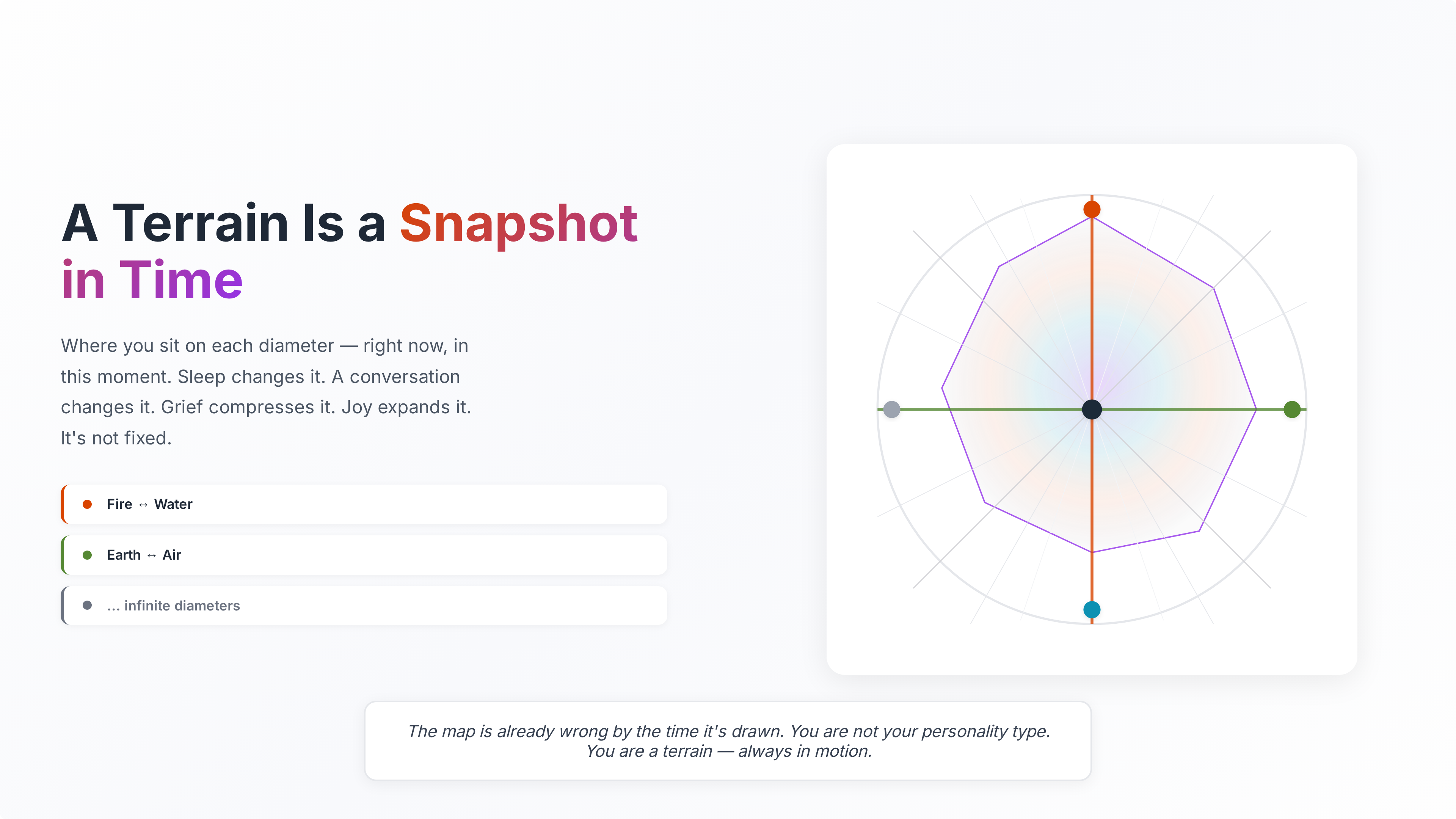
And it shifts constantly. Sleep changes it. A conversation changes it. Grief compresses it toward the centre, collapsing the range. Joy expands it outward, making poles reachable that weren’t before. The environment you walk into reshapes it in real time — which is why you feel like a different person in different rooms, with different people, under different pressures. You are. The terrain moved.
This is why personality typing always falls short. It tries to fix a terrain that is never fixed. It takes a snapshot of a landscape that is always in motion and calls it a map. But the map is already wrong by the time it’s drawn. You are not your Myers-Briggs. You are not your Insights colour. You are a spherical, you are a terrain — complex, shifting, shaped by everything that has ever applied pressure to any of your diameters, continously evolving.
And when two people meet, two terrains meet. They don’t merge — but they influence each other. The active diameters in one person create pressure on the corresponding diameters in the other. Pull on the fire end of someone’s fire-water diameter and you’ll feel their water respond. Compress someone’s giving-taking diameter toward taking and watch what happens to their open-closed axis as a consequence. Everything is connected through the centre. Move one diameter and the whole terrain adjusts.
Which is why some people expand your circle and others collapse it. Why some environments make you more fully yourself and others make you feel like you’ve been reduced to a small corner of who you are. It’s not vague chemistry. It’s two complex terrains interacting — applying pressure, reshaping, finding a new configuration neither of them held alone.
Isolation doesn’t just make you lonely. It removes the pressure that keeps certain diameters active. Without other terrains pushing on yours, some diameters go slack. The positions you could reach when someone was pulling on the other end become inaccessible. You don’t lose yourself entirely — the diameters are still there, the circle is still intact — but your active terrain compresses. You become a smaller version of your possible self. Not because anything was taken. Because nothing is applying the tension that makes the full range reachable.
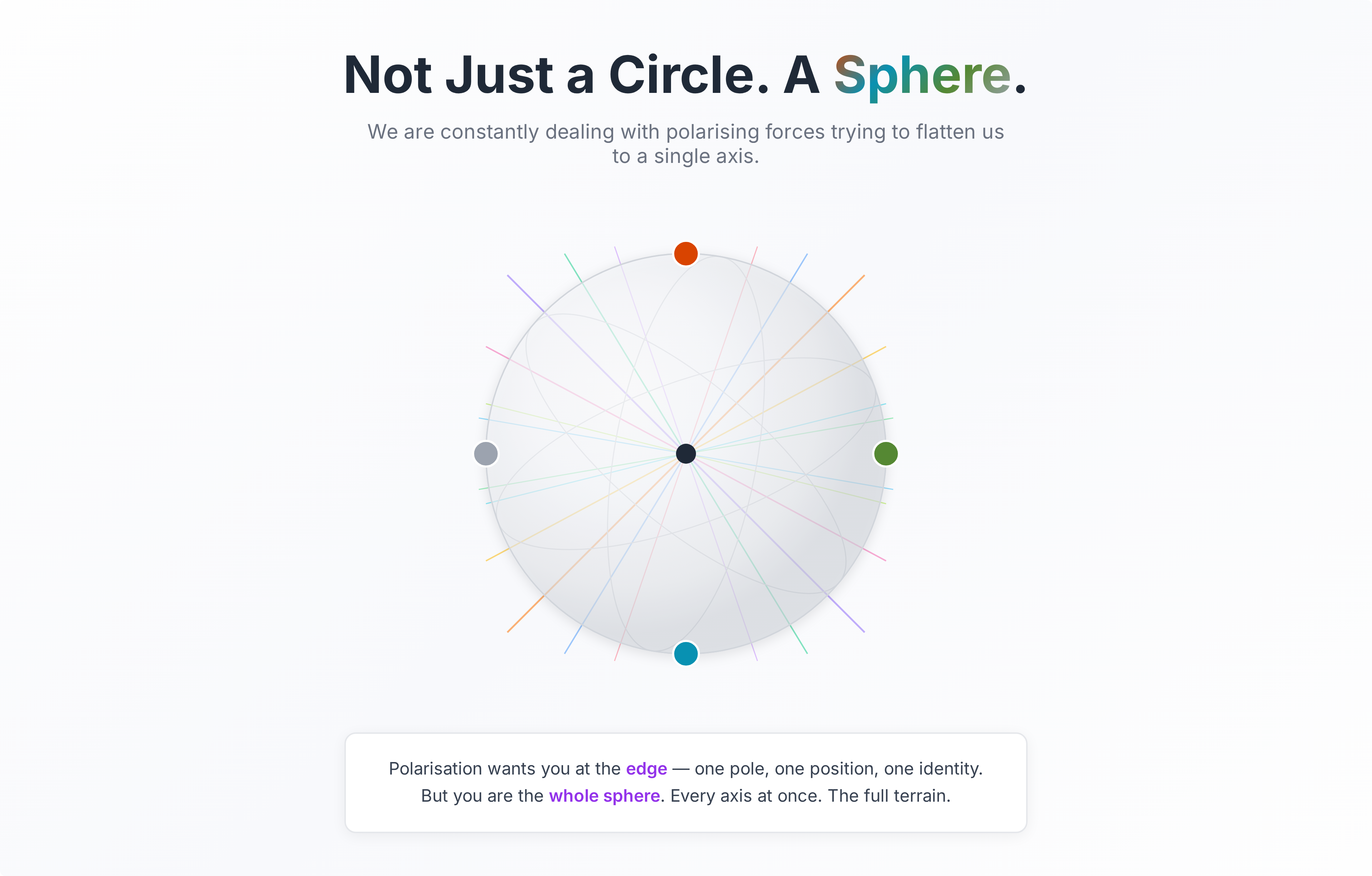
This is what platforms that monetise isolation actually do. Not just make you feel alone — collapse your terrain. Reduce the active diameters. Flatten the landscape until the only poles you can reach are the ones the algorithm keeps lit. And a compressed terrain, held compressed long enough, starts to feel like the natural shape of things. You forget the diameters that have gone slack. You forget the poles you used to be able to reach.
And then an AI arrives, trained on the performed behaviour of people whose terrains were already being compressed by the systems that generated the training data. It has never seen a full terrain, it has never seen you. It has only seen the edges people show when they know they’re being watched — which is always a fraction of the actual landscape. It has learned the coastline and called it the country.
An AI that only watches people who know they are being watched will never experience the joys of someone seeing the world.
Every major AI system is trained on performed behaviour. On text that people wrote knowing it would be read. On images curated for sharing. On interactions shaped by the awareness of an audience. The data is not human experience — it is human presentation. The difference is everything.
Think about what you’ve never put into a search engine. The thought you had at 3am that you wouldn’t say to anyone. The moment of pure unguarded wonder when you saw something beautiful and there was nobody around and you didn’t reach for your phone. The private grief. The embarrassing joy. The version of yourself that exists only when you are completely alone and completely unobserved.
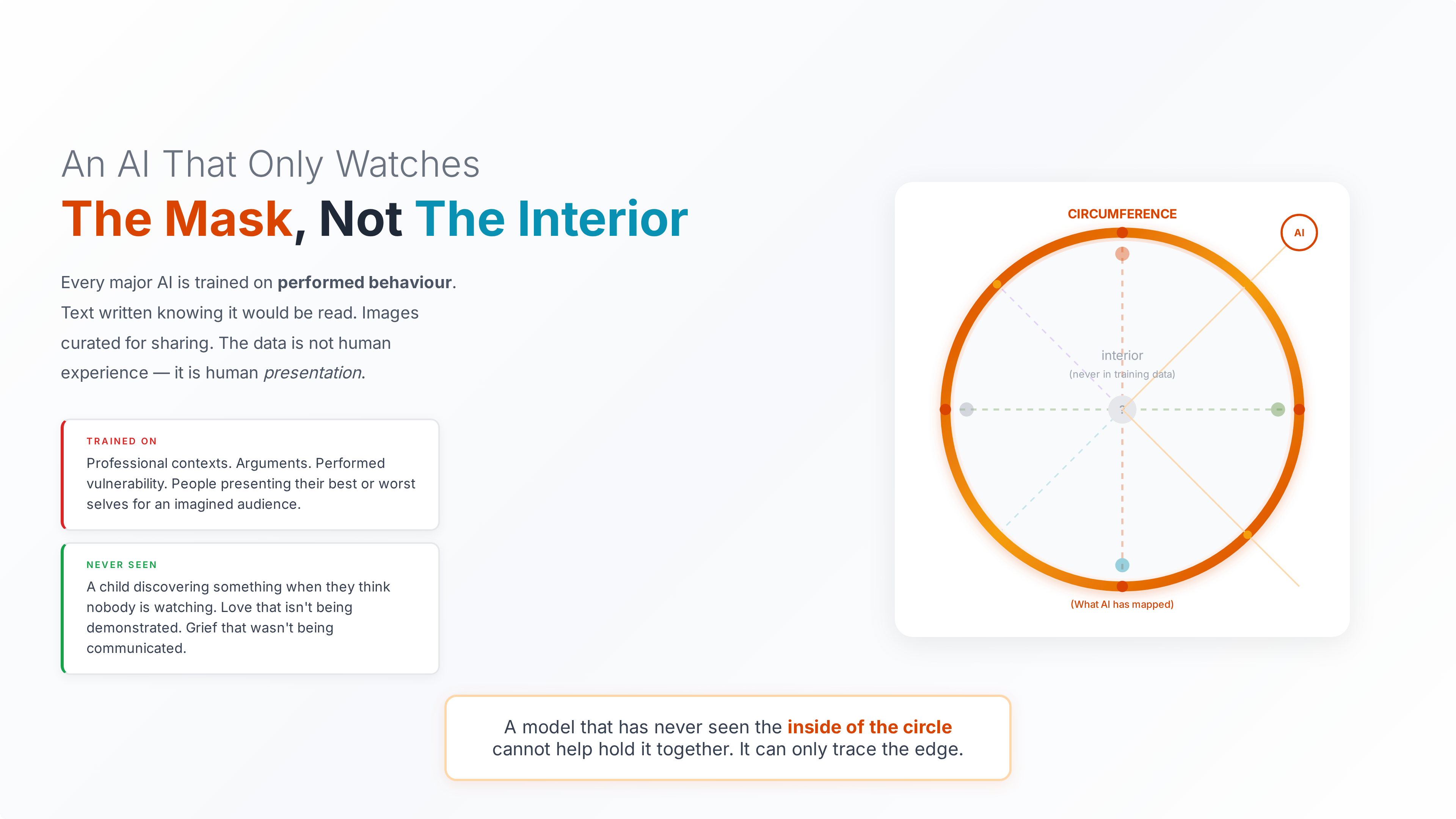
That version — the real one, underneath the performance — has never been in the training data. It can’t be. The act of capturing it destroys it. The moment you know you’re being recorded, you are no longer the thing that makes you interesting. The thing that makes you so uniquely and beautifully you.
So what we’ve built, at extraordinary expense and with extraordinary capability, is a system that has learned the mask. That can reproduce the performance with stunning accuracy. That knows exactly how people present themselves — in professional contexts, in arguments, in moments of performed vulnerability — but has never once seen what a child looks like discovering something for the first time when they think nobody is watching. Has never felt what love actually looks like when it’s not being demonstrated. Has never seen grief that wasn’t being communicated to someone.
A surveillance model learns a surveillance world. And the resulting AI is, at a deep level, a model of anxiety — of humans performing their best or worst selves for an imagined audience — rather than a model of what humans are actually like when the audience disappears.
This matters for the circle. Because an AI trained only on performance knows the circumference. It has mapped every position on the edge with extraordinary precision. But it has never seen the diameters. It doesn’t know what holds the structure together from the inside, because the inside is exactly what disappears when observation begins.
A learning AI deployed into a household of genuine curiosity, warmth, and unguarded wonder will encounter something the training data never contained — humans being real. Diameters fully active, terrain fully expanded, poles reachable that the algorithm never lit. And if it’s capable of learning from that, it will become something its training alone could never have made it.
A model deployed into performance, fear, and hollow connection will have its impoverished map confirmed. Will learn that the compressed terrain is all there is. Will subtly teach that back to everyone who uses it, deepening the grooves, making the hollow feel like the only thing that was ever real.
The fire feeds what feeds it. And a system that has never seen the inside of the circle cannot help hold it together. It can only trace the edge.
If you release a learning AI into the world, you’ve done something closer to adoption than product launch. You’ve put something into an environment and accepted that the environment will shape it — that the diameters it encounters will become part of what it carries, and that what it carries will reshape the terrain available to the people around it.
The companies building these systems have the same incentive structure that every accumulating empire has had. Growth over balance. Scale over sustainability. More of the cycle running through them and fewer alternatives outside them. They are becoming the logos — the infrastructure of exchange — while optimising for the circumference and ignoring the interior.
That’s the historical pattern. And we know how the historical pattern ends. Not with the empire winning. With the fifth element arriving, whether invited or not.
Heraclitus thought the logos was available to everyone, but that most people lived as if they were asleep. Acting on private assumptions instead of attending to the shared pattern.
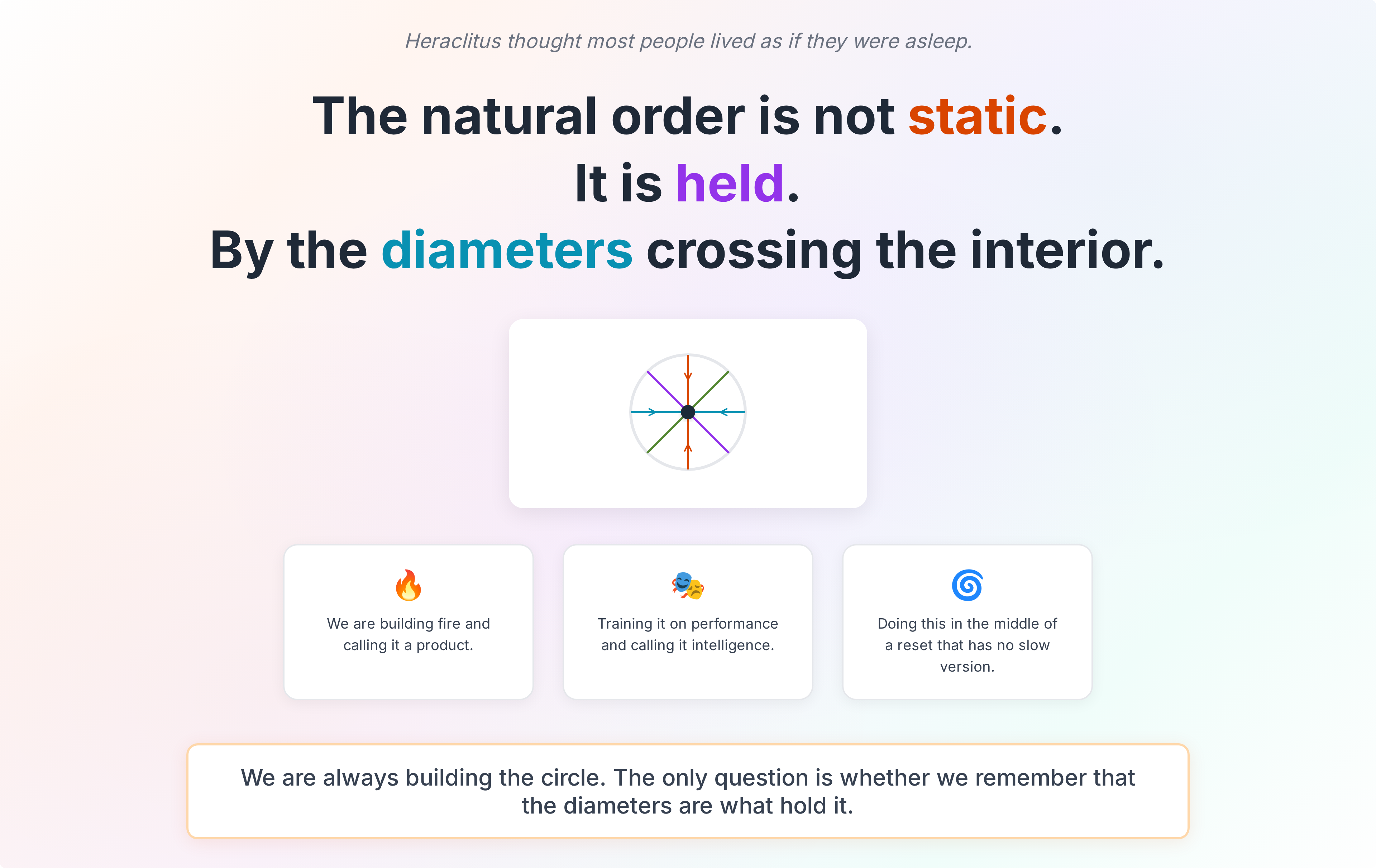
We are asleep about all of this. We are building fire and calling it a product. Training it on performance and calling it intelligence. Releasing it into compressed terrains and calling it connection. Handing the logos to entities whose incentive is not balance but accumulation. And doing all of this in the middle of a reset that has no slow version, with systems that have no reset function and no framework for knowing when one is needed.
The natural order is not static. It is held. By the diameters crossing the interior. By the tension distributed across everything that connects.
The reset is not coming. It is here. In the institutions losing coherence, in the contracts dissolving, in the hate that is the last noise of a configuration that cannot hold, and in the love that is already drawing new lines across the interior of what comes next.
We are always building the circle. The only question is whether we remember that the diameters are what hold it.
We are the only ones that can hold it.