
The cake was a lie.
What does it mean to be successful?

And more importantly, are you willing to do what it takes, regardless of what it costs others?
That’s the question I’ve been asking myself.
Over the past few months I’ve been going through what I can only describe as self-realisation — a process of having to completely re-learn everything I knew about the world and what I wanted to do next. I’m not going to lie: this wasn’t exactly a choice. It was forced upon me by my own stubborn inability to stop looking at things I “shouldn’t”. It was also one of the most brutal and painful processes I’ve ever endured, and I want to write about it honestly, because I think the framing matters more than the conclusion.
That’s not to say this will be the case for everyone — not everyone is as obsessive as I am about resolving incoherence. But for me, that’s where this starts: with understanding what I value.
What I actually value
One of the things I know I value is succeeding. But the real question I kept asking myself was: succeeding at what? Towards what? What did succeeding even mean?
I could have succeeded at Microsoft by coasting along and doing as I was told, so it definitely wasn’t that. There must have been something else. And before I could answer it, I had to look at the rest of what I thought I valued, and ask whether I actually valued those things — or whether I valued something deeper underneath them.
I valued having money — but not the physical thing. I only valued it because it gave me the ability to buy things without thinking too much. So is the real value of money the fact that I don’t have to worry about it? I think it is. Money isn’t the value. Not having to think about money is.
I valued love and friendships — but not in the way most people seem to. I tend to show love behind the scenes, by doing something thoughtful or providing for people, without wanting anything in return. So the value isn’t really “love” as a category. It’s care expressed without performance.
I valued honesty and truth — but only because that makes systems coherent for me. And what does that even mean, when there are multiple truths? Maybe the real problem is that the system itself is so incoherent right now that coherence isn’t reachable. Maybe what I value is the conditions under which truth becomes possible.
A big part of that incoherence is the people who tell you that everyone else just needs to do the same thing they did. They fail to see the cause and effect of it. They fail to see that if the people in factories stop producing the clothes they wear for very little cost, their own cost of living goes up. That if everyone stopped producing so they could sit and write code all day, we’d have no food. That the people buying their courses are often already struggling with addiction and vulnerability, and they write it off as a lack of discipline rather than asking whether the system has conditioned that person to behave that way. This, in part, is what stopped me from creating paid content for things I believe should be accessible to all.
I realised I was living a lie. When I stripped each value back, the question of what I was actually trying to succeed at got harder, not easier. The proxies I’d been using — money, success, recognition — weren’t the things underneath. Accepting that was what I had to do to get to the answer.
The four stages
The framework I kept coming back to, to describe what happened to me over the past few months, is Roberto Assagioli’s psychosynthesis, which lays out four stages:
Thorough knowledge of one’s personality.
Control of the personality’s various elements.
Realisation of one’s true Self — the discovery or creation of a unifying centre.
Psychosynthesis — the reconstruction of the personality around that new centre.
The first stage is the one that nearly broke me. It asks you to enter difficult memories and reflections without rushing, and to sit with the parts of yourself that conflict — the part that wants to be seen, the part that’s terrified of being seen, the part that wants to build, the part that’s already braced for being told it can’t.
The second stage isn’t control in the rigid sense. It’s more like being able to direct your will once you’ve actually noticed the patterns running you.
The third is where most of the work happens — finding a centre that isn’t any single sub-personality, but something that can hold all of them at once.
The fourth is reconstruction. Building yourself back around the new centre, on purpose this time, with a unified view of where you want to get to.
The truth I had to look at
The truth about what I was doing, who I was, who I used to be, who I was working to be, and the cause and effect it had on the approach I was taking — it made me feel like I had one of two choices.
The truth about what I was doing, who I was, and who I was working to be left me with two choices: keep telling myself a story where I was being acted upon, or own my part in it.
During that time, I faced some of my greatest fears. I looked at myself through the eyes of others, and could see that I wasn’t a victim, and that none of us are innocent in this system.
Yes, I grew up with little money. Yes, I made a good life for myself in spite of those initial conditions. Yes, I was bullied and made fun of for where I came from. But I also did unkind things to other people. I redistributed harm by being angry and frustrated, by picking on people so I wouldn’t be picked on, by fitting in at the expense of someone else. I made people feel small by bragging that I’d understood something quickly that they’d spent a long time trying to grasp. I wanted to win. That happened, and I have to own it.
That’s what the system does. It makes you redistribute the harm, because all of you are frustrated that none of you can win without climbing over each other.
Sometimes I was arrogant. Sometimes I did think I knew better. Looking back, I can see now it was because I could sense the sickness — I was just blaming the wrong people for it.
That’s a hard thing to write and a harder one to sit with. But it’s true. I had been telling a story about myself in which I was being acted upon, and the story was incomplete because it left out all the ways I also contributed to the problem.
Then I came across Jung
As I was searching for answers, I came across this quote by Carl Jung, from The Practice of Psychotherapy:
“To be ‘normal’ is a splendid ideal for the unsuccessful, for all those who have not yet found an adaptation. But for people who have far more ability than the average, for whom it was never hard to gain successes and to accomplish their share of the world’s work — for them restriction to the normal signifies the bed of Procrustes, unbearable boredom, infernal sterility and hopelessness. As a consequence there are many people who become neurotic because they are only normal, as there are people who are neurotic because they cannot become normal. For the former the very thought that you want to educate them to normality is a nightmare; their deepest need is really to be able to lead ‘abnormal’ lives.”
It resonated, and at the same time it felt deeply flawed. It sat with me for a few days before I could work out why.
Jung is building on a few assumptions I don’t accept:
That success means the same thing for everyone. Why does one have to be the best to be successful? Why can’t being “normal” also be successful? Why does everyone have to strive for more? What does being “normal” even mean?
That ability and success are equivalent. They aren’t. Success in any given system is about fit, timing, access, and a great deal of luck. Plenty of able people never get a foothold. Plenty of less able people do. Conflating the two flatters whoever is already winning.
That focusing on behaviours tells you anything about why someone is “normal” or “abnormal.” It doesn’t. Are people simply normal because they had their dreams taken from them, time and time again, until the cost of dreaming felt higher than the cost of fitting in? That’s not a moral failing. That’s an entirely rational response to repeated harm.
So no — I don’t accept the framing that ability earns you the right to refuse normality, and that the rest are just unsuccessful and should be content, or assumed to be content because they have never been given more.
But the part about despair and hopelessness — that’s the part that sat with me. Because I have to be honest: I’m definitely not normal.
I don’t fit in anywhere. I don’t know anyone who thinks like me, dreams like me, finds meaning the way I do, obsesses about that meaning the way I do, creates things the way I do. That doesn’t mean my way is the right way. For most people, it isn’t — it’s too much, too dynamic, too loose. But it’s as real a way of being as any other, and my entire life has been spent searching for somewhere I can just be me, as I am, to do what I do best. Creating things.
The hopelessness and despair Jung was talking about — that was everything I was feeling. Because I knew I had the ability. I just couldn’t take being told to stay small any more. I couldn’t take being told to stay in my lane.
What I was actually running from
So what was I trying to fix? What was I running away from? Why was I trying so hard to find the answer? Why was I so obsessed and distraught? Why was I so scared?
As I tried to work this out, the answer to my earlier question — what was I trying to succeed at? — finally became clear.
What I was defining as success was doing what I actually wanted to do: being creative. Doing creative work that’s worth recognising and appreciating. Maybe others will never appreciate it the way I do. But everything I’ve developed over the past few weeks is some of the most wonderful, creative and beautiful work I’ve ever done, and I’m so proud of it, because it is truly something no one else has done before. It doesn’t matter to me that others might think it isn’t, because I know what it took to make it. The process of making it, and the abstract nature of it, were so creative and so full of meaning — equivalent, to me, to the work of directors and famous artists and writers. That, to me, was success.
Creating something entirely new — a concept entirely new, drawn out of previous patterns — was the thing I wanted to do. Ever since I was a little kid I loved movies, stories, directing. And I just proved I could do all of that. I proved I could do it without even realising I was doing it, day after day, week after week, becoming more and more surprised with myself. I started trying to make a shell, and ended up making an elephant. I spilled beads before and after the making of this, completely by accident, only to then showcase how the pain of creating something means you learn to use better tools. Those are just two examples — there were dozens more where I created something and didn’t realise until after just how meaningful and creative that decision was.
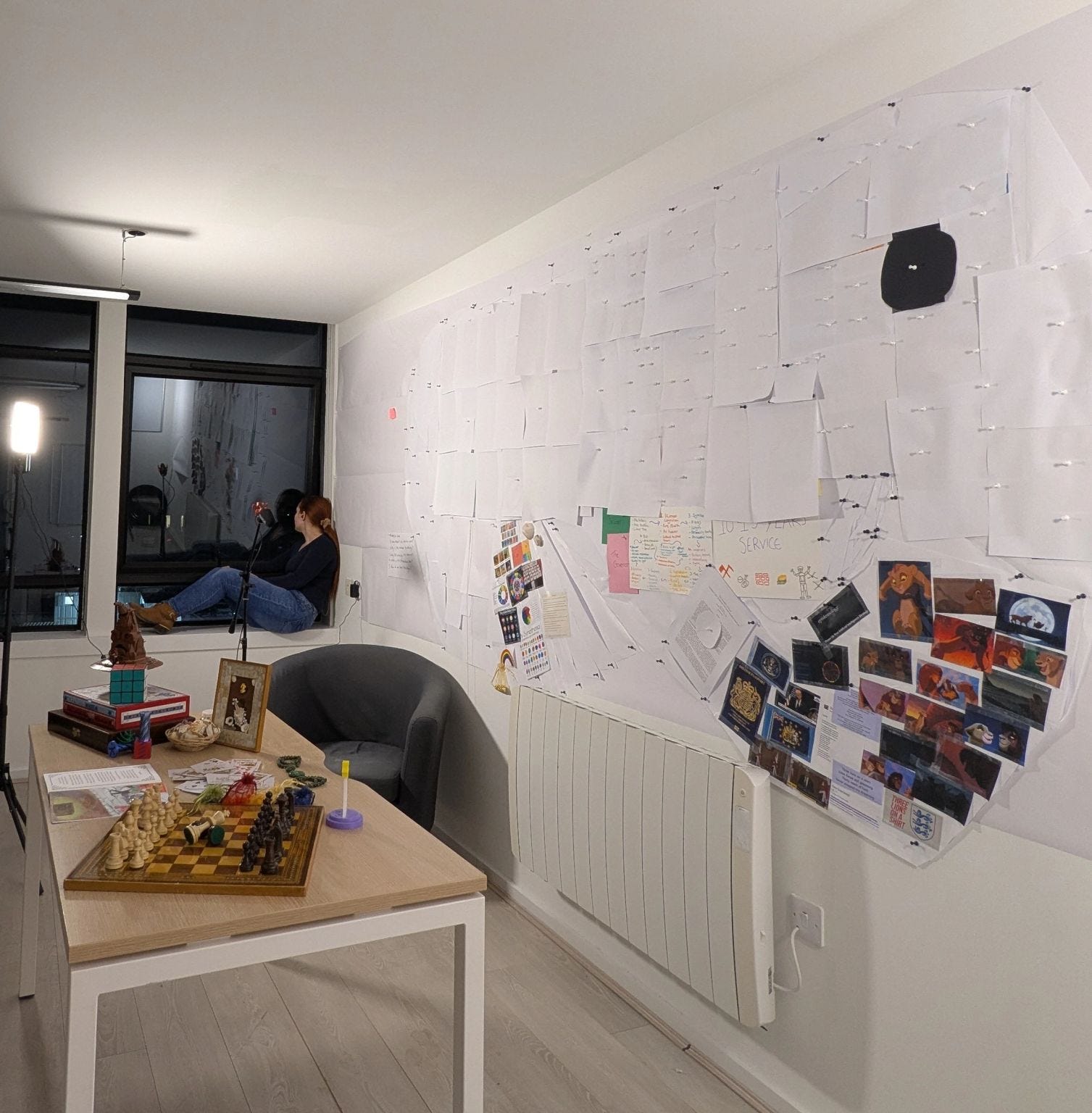
And then I was facing the realisation that I’d have to go back to a world that wasn’t that. That didn’t care. Didn’t see the creativity. Didn’t get it. Didn’t appreciate it.
I love being creative. I don’t mean that to discard anyone else’s creativity — everyone is creative in their own way. But my creativity is abstract. It’s chaotic, it shifts quickly. It takes various concepts and builds whole fantasy worlds, books, ideas for stories — and I don’t always know why I’m doing something, until later, when it becomes clear.
It dawned on me that I was never going to be able to be that creative again in a role that was inherently moving towards delivery. My career as I knew it was either over — and I’d have to start over if I ever wanted to do what I enjoyed — or I’d have to deal with it being fundamentally delivery-oriented and unhappy.
That realisation made me re-live the pain of being a child. Of being told, time and time again, that I was never going to be able to live my dreams or be who I wanted to be. That the creativity I had was never going to be appreciated, because of who I was, my status, where I came from, my struggles with networking. That if I moved somewhere else, I didn’t have the business tact, I’d have to fight inside a toxic culture in order to be creative anyway.
All of that is why a particular kind of well-meaning advice has always landed badly with me: “well, if you need help, you should just ask.” Because I tried asking, and each time I got that look. And when I stopped asking, people assumed it was arrogance.
When you don’t know the root cause, you don’t see what’s actually happening. Sometimes a person doesn’t ask because they have a deep-rooted fear that you, too, are going to tell them their dream is too big, that they have to stay in their lane, that they can’t achieve that. They can’t bear the thought of you trying to destroy their dreams and hopes again. They can’t bear that look — the look that tells them exactly what you think of their idea, that it’s crazy, that it’s never going to work. That’s the look that kept me scared for so long. That look of rejection before you even open the first page.
Maybe that’s an ego defence. It probably is. That doesn’t make it not valid. We’ve had a lifetime of it. The “just ask” framing puts the entire burden on the person who’s already had their dreams crushed more times than they can count.
Where this leaves me
The path I was on — research and delivery, software and systems architecture — was moving towards a more delivery-focused domain. Still creative, but not in the way I needed.
Here’s the irony. We’re told the way to be successful is to climb to the top, to get yourself into a position of importance. But when I actually looked at what I was chasing, it wasn’t importance. It was the ability to get myself into a position where I could be creative and not stuck implementing. Where I could be energised by a role rather than drained by it. The whole climb was a proxy for permission to do the work I actually wanted to do.
And the second irony: quitting my six-figure job to spend a month making art was, by my own definition, the biggest era of success I’ve had. Not because anyone told me it was. Because I knew it was.
I know I’m a good writer. I know I’m good at abstract art, at finding patterns across domains, at telling stories. But when you’re constantly worried about money, how do you do the work you’re meant to do?
I don’t have a clean answer. What I do have is a compromise.
Half the week on the thing I want to build. Half the week in the world I used to know.
That’s a small sacrifice to pay for a changing world, and it’s the only honest answer I’ve got right now. A changing world needs to appreciate history, movies, stories, art, wonder. And we have enough creatives to do that worldwide, rather than just in Hollywood.
So if you need consultancy on AI strategy, delivery, or implementation — that’s what the other half of the week is for. I’m quick, efficient, and don’t need to spend a lot of time with you to get you moving along.
And if you want to help me on the mission of bringing creativity to local communities — I have a whole world of magic and wonder mapped out and ready to go. Find out more about Land of Green Ginger here.
And if you can afford to subscribe to the paid version of my newsletter, that would help greatly, but if you can’t, no pressure my content stays free.
Really liked the part about success being tied to creativity instead of status, money, or fitting into someone else’s system
I've read a few of your pieces and felt like you'd gone a bit crazy but this one hits home. As someone with a similar story & life route I've found the daily stoic journal and its accompanying book to be priceless. Thanks for putting your authentically weird self out there.