
The Adaptive Mind
Systems Thinking, Linear Thinking, and the Cognitive Ecology That Makes Civilisation Work

This article is not about neurodivergence. That framing, however well-intentioned, misses the deeper point.
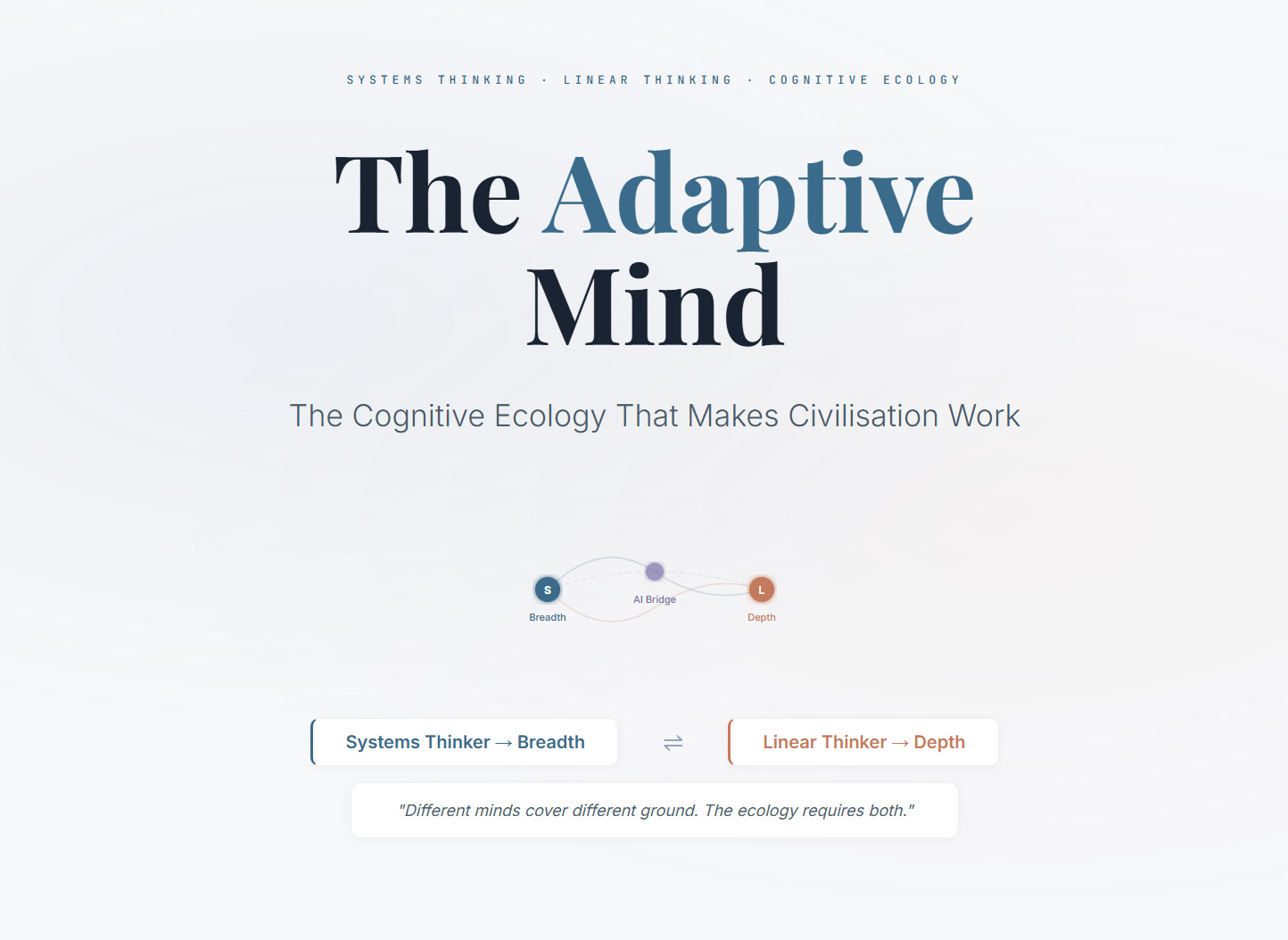
What we are actually talking about is cognitive ecology — the idea that human populations are not cognitively uniform by accident. Different minds cover different ground. The systems thinker and the linear thinker are not competing models of intelligence, one broken and one correct. They are complementary instruments in an evolutionary arrangement that has been working for a very long time.
The problem is not that the arrangement is wrong. The problem is that we have largely forgotten how to use it.
AI, it turns out, is one of the most powerful tools we have ever built for remembering.
Two Modes, One Species
At the broadest level, human cognition organises itself around two distinct but complementary orientations.
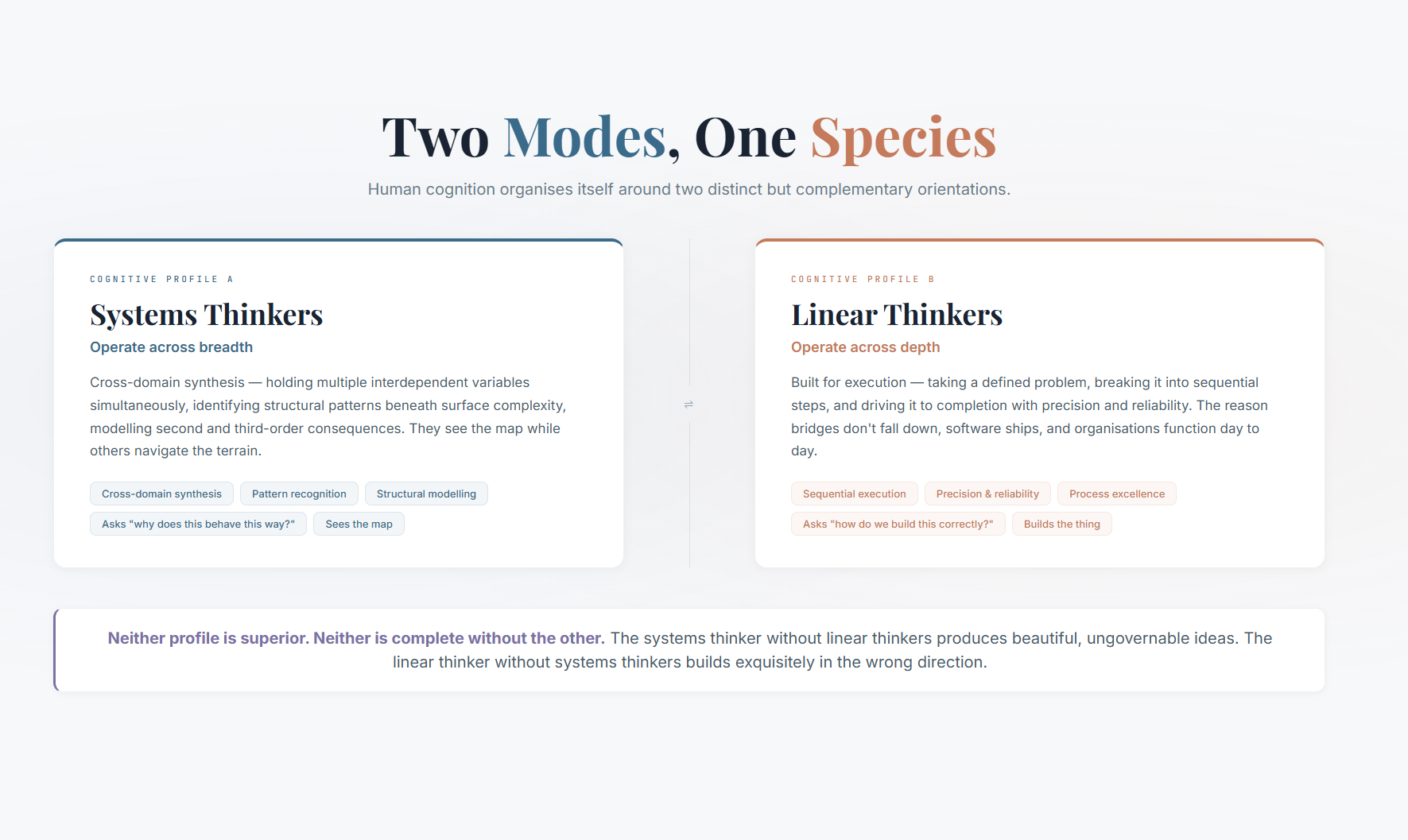
Systems thinkers operate across breadth. Their cognitive architecture is built for cross-domain synthesis — holding multiple interdependent variables simultaneously, identifying structural patterns beneath surface complexity, modelling second and third-order consequences, and seeing the map while others are navigating the terrain. They ask why does this system behave this way, and they tend to find answers by ranging widely across domains that linear thinkers would not think to connect.
Linear thinkers operate across depth. Their cognitive architecture is built for execution — taking a defined problem, breaking it into sequential steps, and driving it to completion with precision and reliability. They ask how do we build this thing correctly, and they tend to produce answers of extraordinary quality. The linear thinker is the reason bridges do not fall down, that software ships, that organisations actually function from one day to the next.
Neither profile is superior. Neither is complete without the other.
The systems thinker without linear thinkers produces beautiful, ungovernable ideas that never become anything. The linear thinker without systems thinkers produces exquisitely executed solutions to the wrong problem. Civilisation requires both, operating in relationship — and evolution, which is not sentimental about what works, produced exactly that arrangement.
“A room full of systems thinkers will build something philosophically coherent and practically unusable. A room full of linear thinkers will build something structurally perfect that serves no long-term purpose. The room that builds something worth having has both — and has learned how to use them together.”
The Evolutionary Argument
This cognitive distribution is not random variation. It is the product of selective pressure operating across a social species that survived because it was not cognitively uniform.
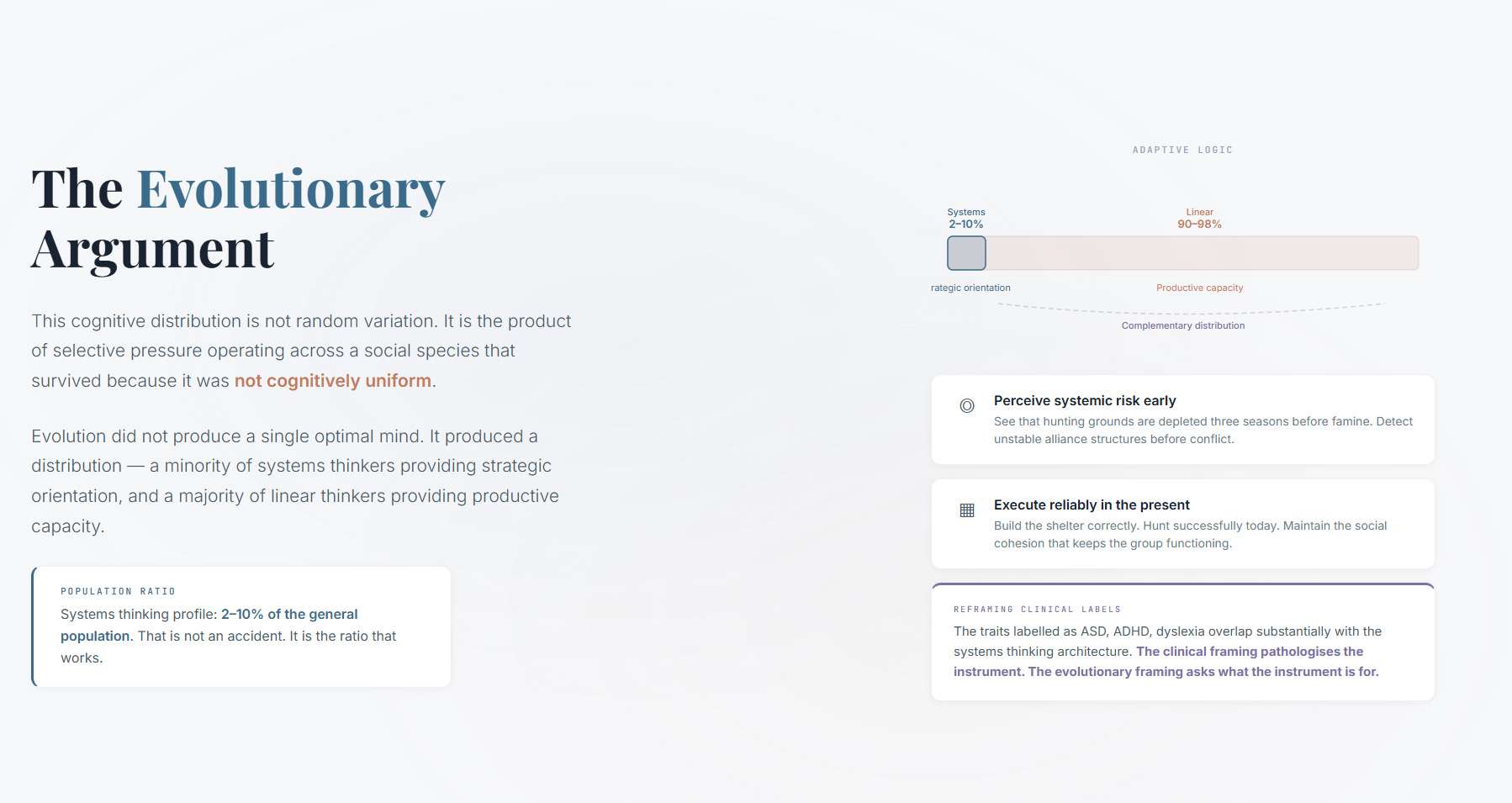
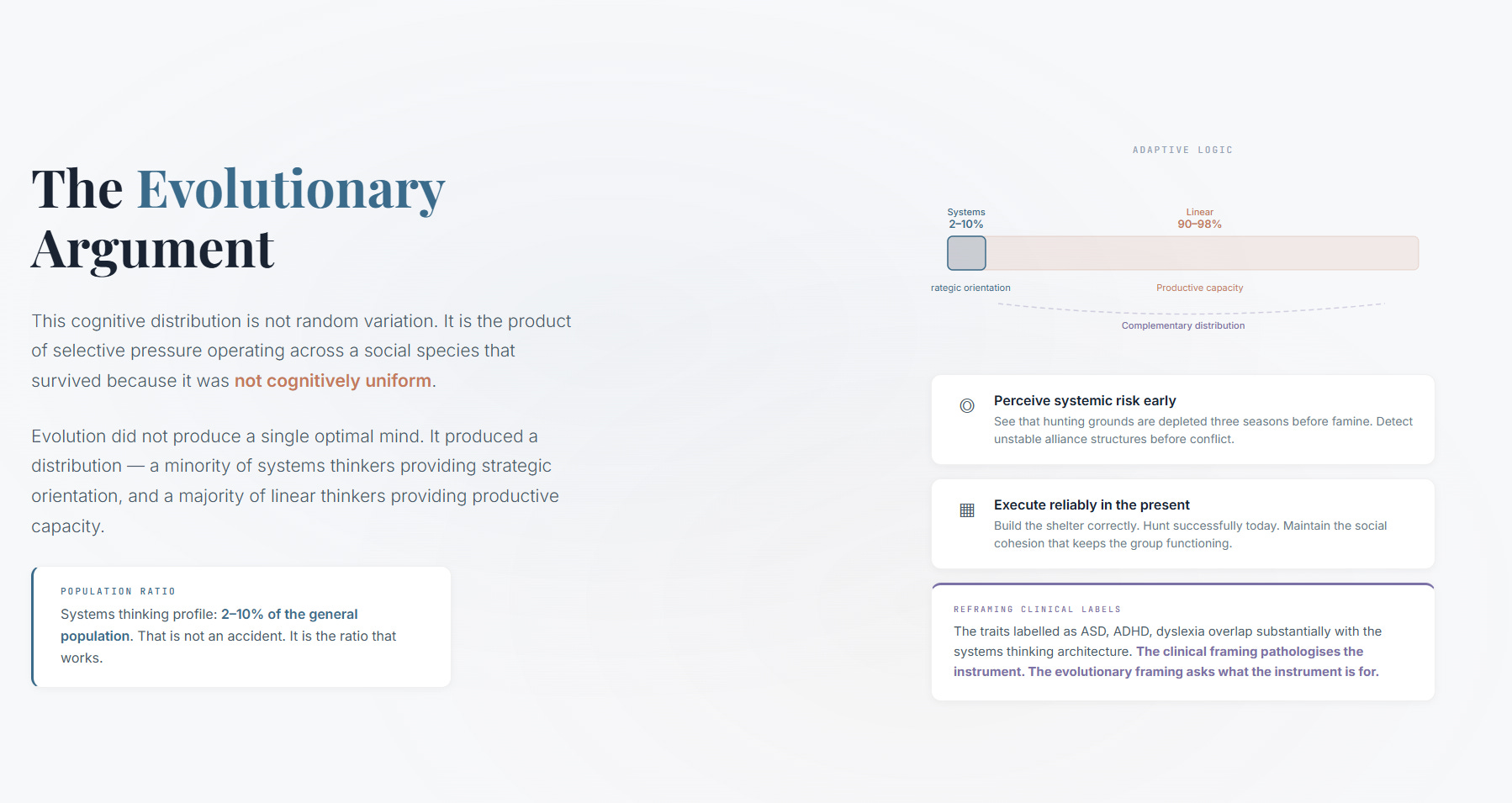
Consider the adaptive logic. A group operating in a complex, uncertain environment needs individuals who can perceive systemic risk before it materialises — who can see that the hunting grounds are being depleted three seasons before the famine arrives, or that the alliance structure is unstable in ways that will cause conflict. It also needs individuals who can execute reliably in the present — who can build the shelter correctly, hunt successfully today, maintain the social cohesion that keeps the group functioning. These are genuinely different cognitive tasks. They call for genuinely different cognitive architectures.
What evolution did not produce is a single optimal mind capable of doing both equally well at scale. It produced a distribution — a minority of systems thinkers whose breadth provides strategic orientation, and a majority of linear thinkers whose depth provides the productive capacity that turns orientation into outcome. Estimates for the systems thinking profile in the general population converge, depending on how the trait is operationalised, somewhere between 2% and 10%. That is not an accident. It is the ratio that works.
The traits we now clinically label as autism spectrum characteristics, ADHD, dyslexia, and related profiles overlap substantially — though imperfectly — with the systems thinking cognitive architecture. The hyper-focus, the resistance to arbitrary rules, the pattern-seeking across unrelated domains, the difficulty with social performance overhead: these are friction points in neurotypical-optimised environments, but they are also, recognisably, the operating characteristics of a mind built for breadth and synthesis. The clinical framing pathologises the instrument. The evolutionary framing asks what the instrument is for.
The Communication Problem
Here is where the ecology breaks down in practice — and it is worth being direct about this, because it is the failure mode that matters most.
Systems thinkers and linear thinkers frequently cannot communicate with each other effectively. Not because either is unintelligent. Because their cognitive architectures generate different native languages, different assumptions about what constitutes a valid argument, and different intuitions about what the point of a given conversation actually is.
The systems thinker presents a synthesised, cross-domain model and expects the linear thinker to see immediately why the structural implications matter. The linear thinker wants to know: what specifically needs to change, in what order, by when, and why is this more important than the thing they were already working on. Neither is being unreasonable. They are operating from genuinely different cognitive starting points.
The consequences of this communication failure are significant. A systems thinker who does not learn to speak to linear thinkers — who does not genuinely appreciate the skill and rigour that goes into building and executing well — will not earn the trust of the people who actually make things happen. They will be seen as impractical. Their ideas will be experienced as destabilising rather than illuminating. The systemic insight will be real, and it will go nowhere.
Equally, a linear thinker who does not have access to systems thinking — who is not in genuine dialogue with someone whose cognitive architecture can model the whole — will build extremely well in the wrong direction. The execution will be excellent. The outcome will eventually fail, because the structural problems were visible to someone whose thinking was never integrated into the process.
“The systems thinker who does not appreciate what the linear thinker builds will never be trusted with the map. And the map is useless without the builders.”
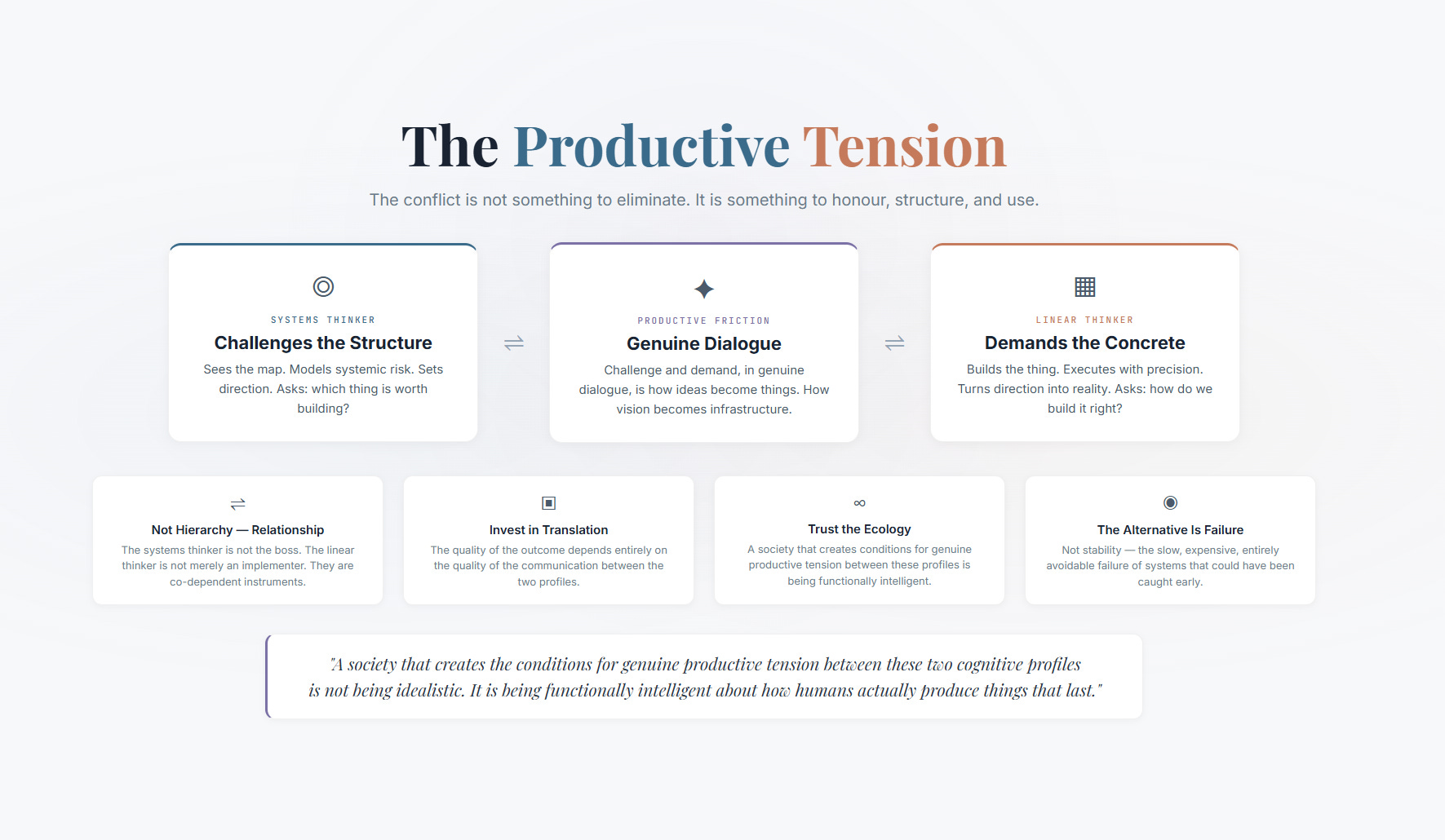
The ecology only functions when the two profiles are in genuine relationship. Not hierarchy — relationship. The systems thinker is not the boss of the linear thinker. The linear thinker is not merely an implementer of the systems thinker’s vision. They are co-dependent instruments covering different ground, and the quality of the outcome depends entirely on the quality of the communication between them.
Where AI Enters the Picture
This is the specific and underappreciated value of AI tools in this context. They do not replace either cognitive profile. They reduce the friction at the translation layer between them.
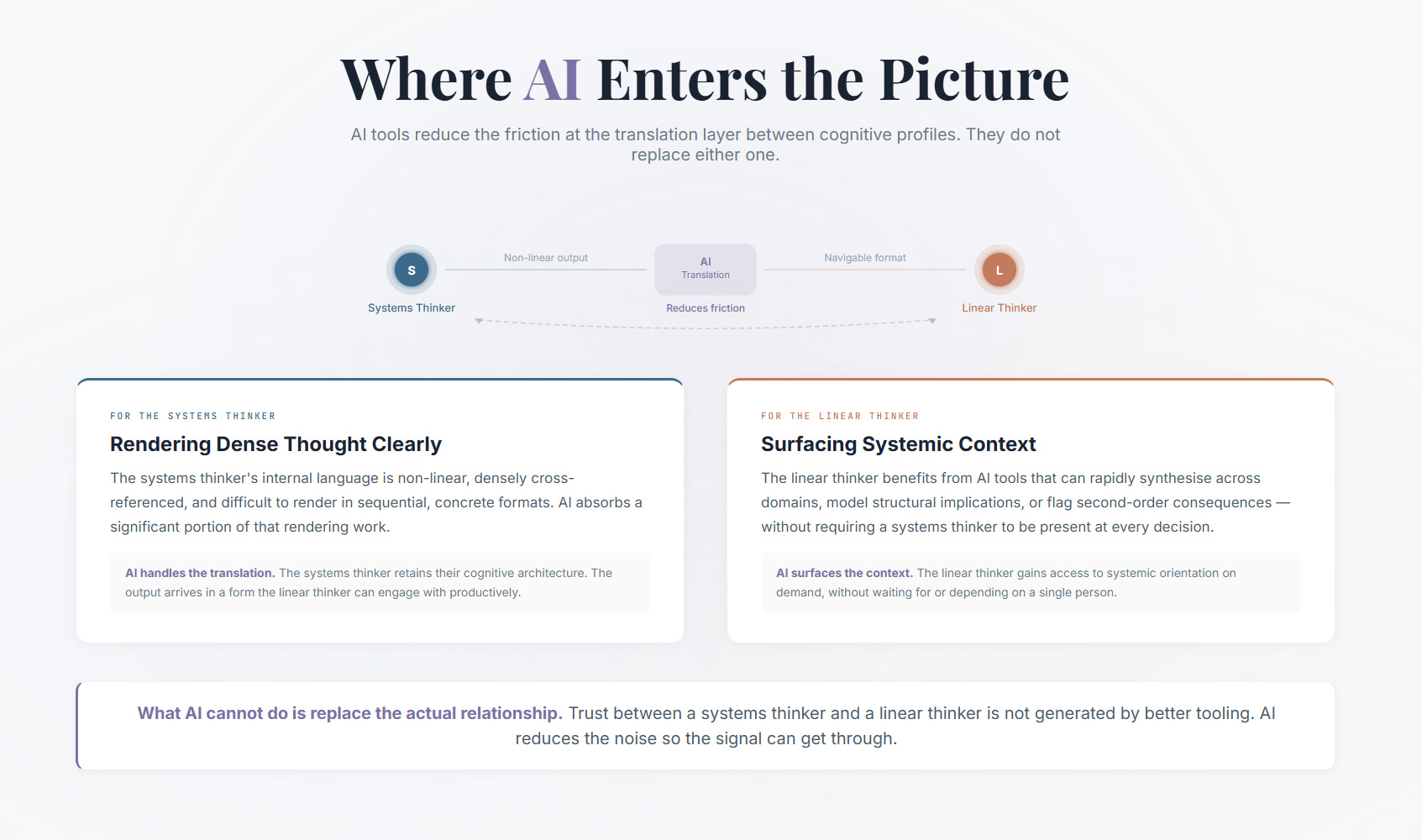
The systems thinker’s internal language is non-linear, densely cross-referenced, and difficult to render in the sequential, concrete formats that linear thinkers — and neurotypical-optimised institutions — require. AI tools absorb a significant portion of that rendering work. The systems thinker retains their cognitive architecture. The output arrives in a form the linear thinker can engage with productively.
The linear thinker, conversely, benefits from AI tools that can surface systemic context — that can rapidly synthesise across domains, model structural implications, or flag second-order consequences — without requiring a systems thinker to be physically present and available for every decision point.
In both directions, AI reduces the overhead of the translation layer. What it does not do — and what it cannot do — is replace the actual relationship. The trust between a systems thinker and a linear thinker is not generated by better tooling. It is generated by genuine mutual appreciation. The systems thinker who uses AI to communicate more clearly is not outsourcing the relationship. They are reducing the noise so the signal can get through.
Communication: Reducing Translation Overhead
The systems thinker’s native output is frequently too dense, too non-linear, or too abstracted for the linear thinker to engage with directly. AI writing tools translate without stripping the original thinking. The idea remains intact. The format becomes navigable.
🛠 Tools in Practice: Communication
Claude (claude.ai) — Draft and reframe communications. Paste raw, non-linear thinking and ask it to render it in clear, sequential terms without losing the substance.
Grammarly — Real-time tone and clarity feedback. Surfaces phrasing that reads as abrupt or ambiguous to a linear-thinking audience.
Otter.ai — Automatic meeting transcription. Removes the overhead of note-taking so both cognitive profiles can be fully present in the conversation itself.
Notion AI — Converts unstructured brain dumps into structured documents. Bridges the gap between how systems thinkers generate ideas and how linear thinkers need to receive them.
Executive Infrastructure: Externalising the Scaffolding
The systems thinker’s friction with linear task sequencing is real and well-documented. It is not a motivation failure. It is a mismatch between cognitive architecture and task type. AI tools externalise the scaffolding — holding task context, breaking structures into sequences, managing the administrative layer — and free the systems thinker to do the work their architecture is actually built for.
🛠 Tools in Practice: Executive Function
Claude — Decompose any complex project into concrete, sequenced next steps. Holds full context across a session, reducing working memory overhead.
Motion — AI task scheduler that organises work into calendar time automatically, removing planning overhead from the individual.
Reclaim.ai — Protects deep work time and auto-reschedules when priorities shift. Reduces decision fatigue in managing a complex, non-linear workload.
Goblin.tools — Designed for non-linear thinkers. Breaks vague tasks into granular steps with adjustable decomposition depth.
Information Processing: Matching Format to Architecture
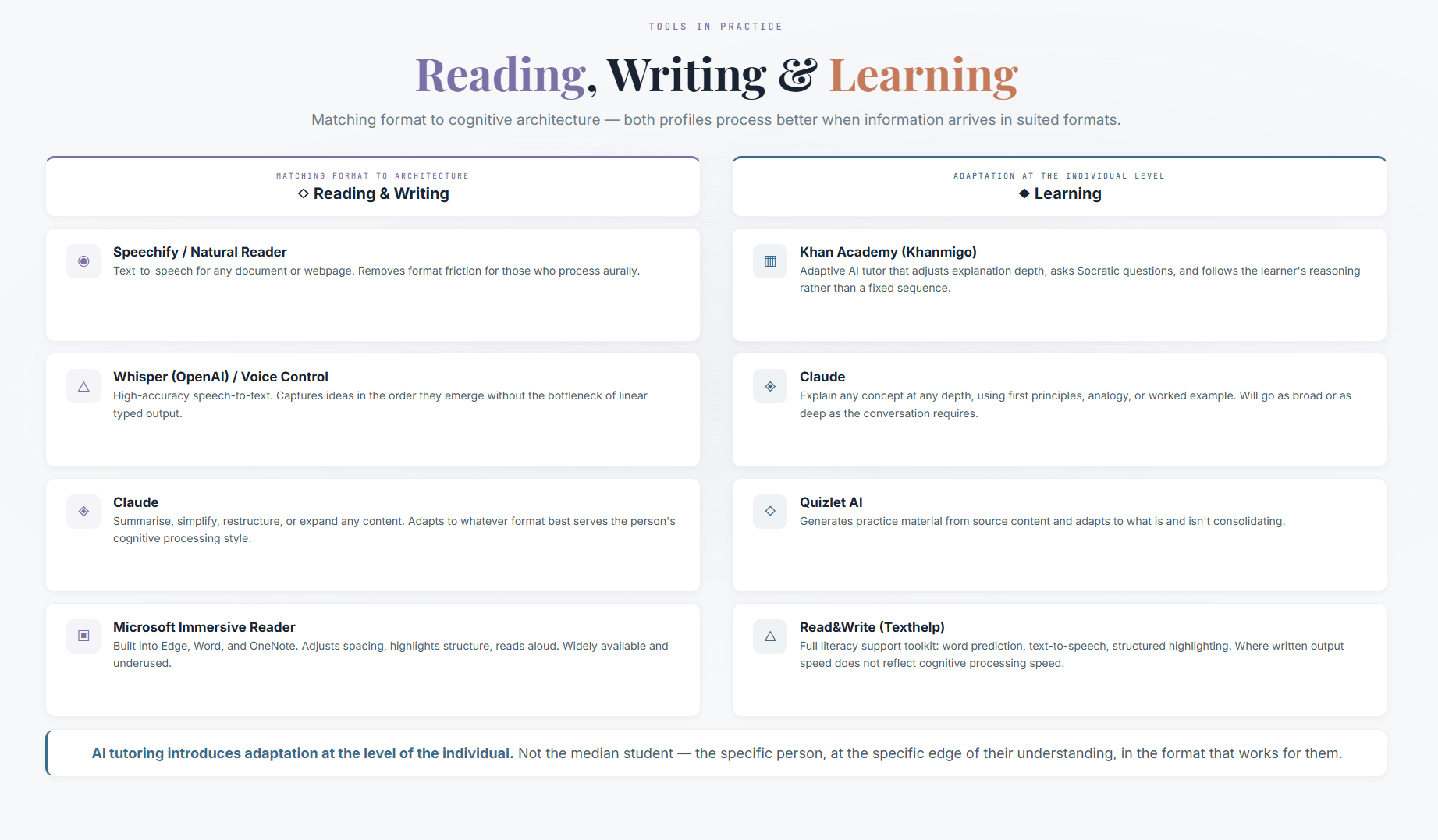
Both cognitive profiles process information better when it arrives in formats suited to their architecture. The systems thinker often processes aurally or visually better than through dense linear text. The linear thinker may need complex systemic information broken into clear sequential components before it is useful. AI format conversion tools serve both needs.
🛠 Tools in Practice: Reading & Writing
Speechify / Natural Reader — Text-to-speech for any document or webpage. Removes format friction for those who process aurally.
Whisper (OpenAI) / Voice Control — High-accuracy speech-to-text. Captures ideas in the order they emerge without the bottleneck of linear typed output.
Claude — Summarise, simplify, restructure, or expand any content. Adapts to whatever format best serves the person’s cognitive processing style.
Microsoft Immersive Reader — Built into Edge, Word, and OneNote. Adjusts spacing, highlights structure, reads aloud. A widely available and underused tool.
The Learning Environment
The standard educational model was designed to produce reliable executors. It does this reasonably well. It identifies and develops systems thinking capacity very poorly, because systems thinking does not perform well on the metrics the model uses — standardised pace, linear assessment, uniform output format.
What AI tutoring introduces is adaptation at the level of the individual. Not the median student. The specific person, at the specific edge of their understanding, in the specific format that works for them. For the systems thinker, this is access rather than accommodation. For the linear thinker, it means depth on demand without waiting for the rest of the cohort.
🛠 Tools in Practice: Learning
Khan Academy (Khanmigo) — Adaptive AI tutor that adjusts explanation depth, asks Socratic questions, and follows the learner’s reasoning rather than a fixed sequence.
Claude — Explain any concept at any depth, using first principles, analogy, or worked example. Will go as broad or as deep as the conversation requires.
Quizlet AI — Generates practice material from source content and adapts to what is and isn’t consolidating.
Read&Write (Texthelp) — Full literacy support toolkit: word prediction, text-to-speech, structured highlighting. Particularly useful where written output speed does not reflect cognitive processing speed.
What This Means for Organisations
The organisation that understands cognitive ecology is not engaging in progressive HR policy. It is engaging in rational resource allocation.
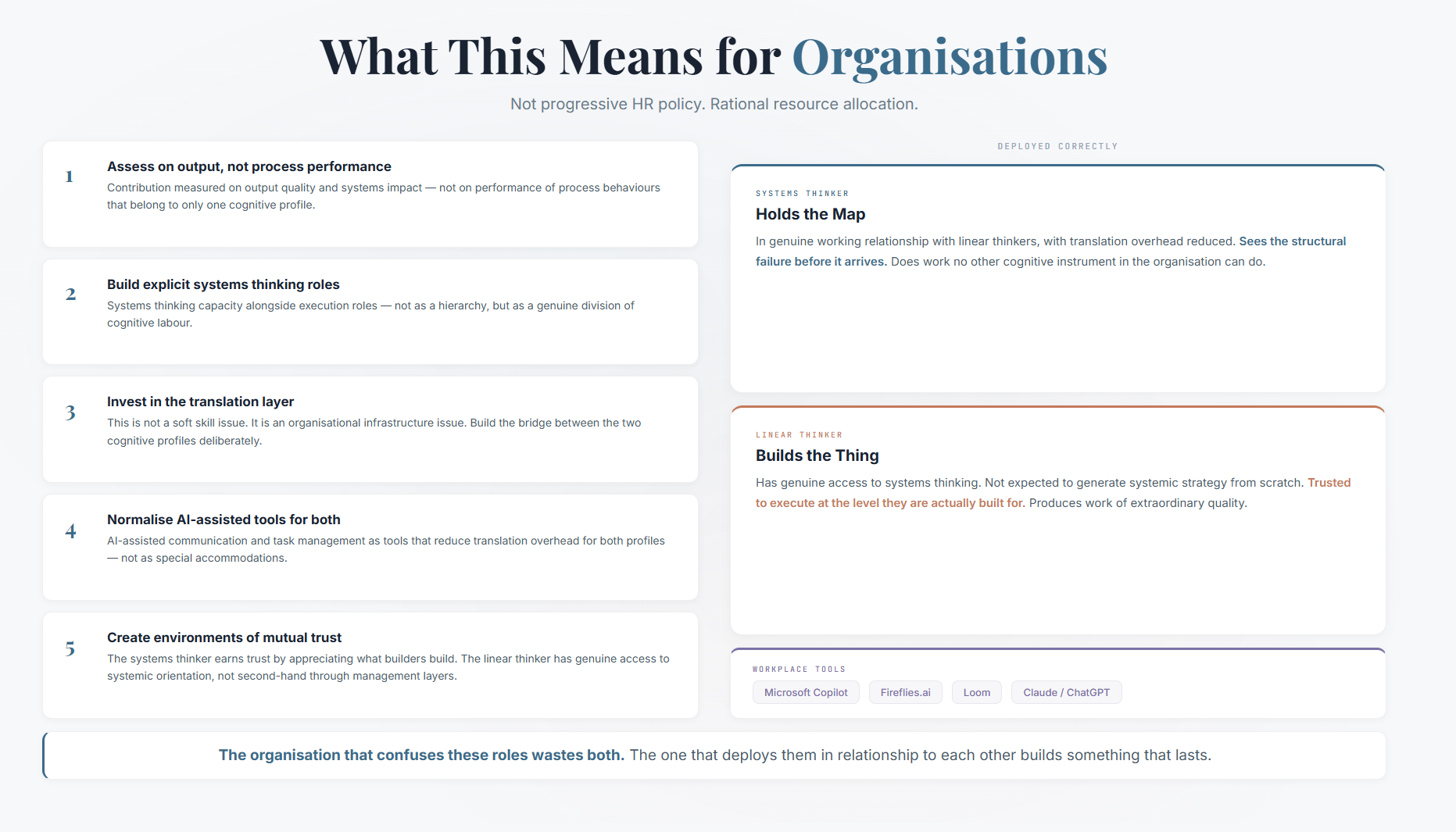
The systems thinker deployed correctly — in genuine working relationship with linear thinkers, with the translation overhead reduced, with their output in a form that builders can actually use — does work that no other cognitive instrument in the organisation can do. They see the structural failure before it arrives. They hold the map when the terrain starts changing.
The linear thinker who has genuine access to systems thinking — who is not expected to generate systemic strategy from scratch, who is trusted to execute at the level they are actually built for — produces work of extraordinary quality and reliability. They build the thing correctly. They get it done.
The organisation that confuses these roles wastes both. The one that deploys them in relationship to each other builds something that lasts.
Practical implications:
Assess contribution on output quality and systems impact, not on performance of process behaviours that belong to only one cognitive profile.
Build explicit roles for systems thinking capacity alongside execution roles — not as a hierarchy, but as a genuine division of cognitive labour.
Invest in the translation layer between the two profiles. This is not a soft skill issue. It is an organisational infrastructure issue.
Normalise AI-assisted communication and task management as tools that reduce translation overhead for both profiles — not as special accommodations.
Create environments where the systems thinker earns trust by demonstrating genuine appreciation for what the linear thinker builds, and where the linear thinker has genuine access to systemic orientation rather than receiving it second-hand through management layers.
🛠 Tools in Practice: Workplace
Microsoft Copilot — Integrated into M365: meeting summaries, email drafts, document generation. Reduces administrative overhead across both cognitive profiles.
Fireflies.ai — Automated meeting transcription and summary. Keeps both profiles fully present in conversation without note-taking overhead.
Loom — Async video messaging. Allows complex systemic thinking to be communicated without the social overhead of synchronous interaction.
Claude / ChatGPT — On-demand thinking partner for both profiles: structure complex work, translate between cognitive registers, prepare for cross-profile conversations.
What Happens When Society Doesn’t Recognise This
There is a tendency to frame the conflict between systems thinkers and linear thinkers as a workplace inconvenience — a communication problem to be managed, a personality clash to be mediated. This is a significant underestimation of what is actually at stake.
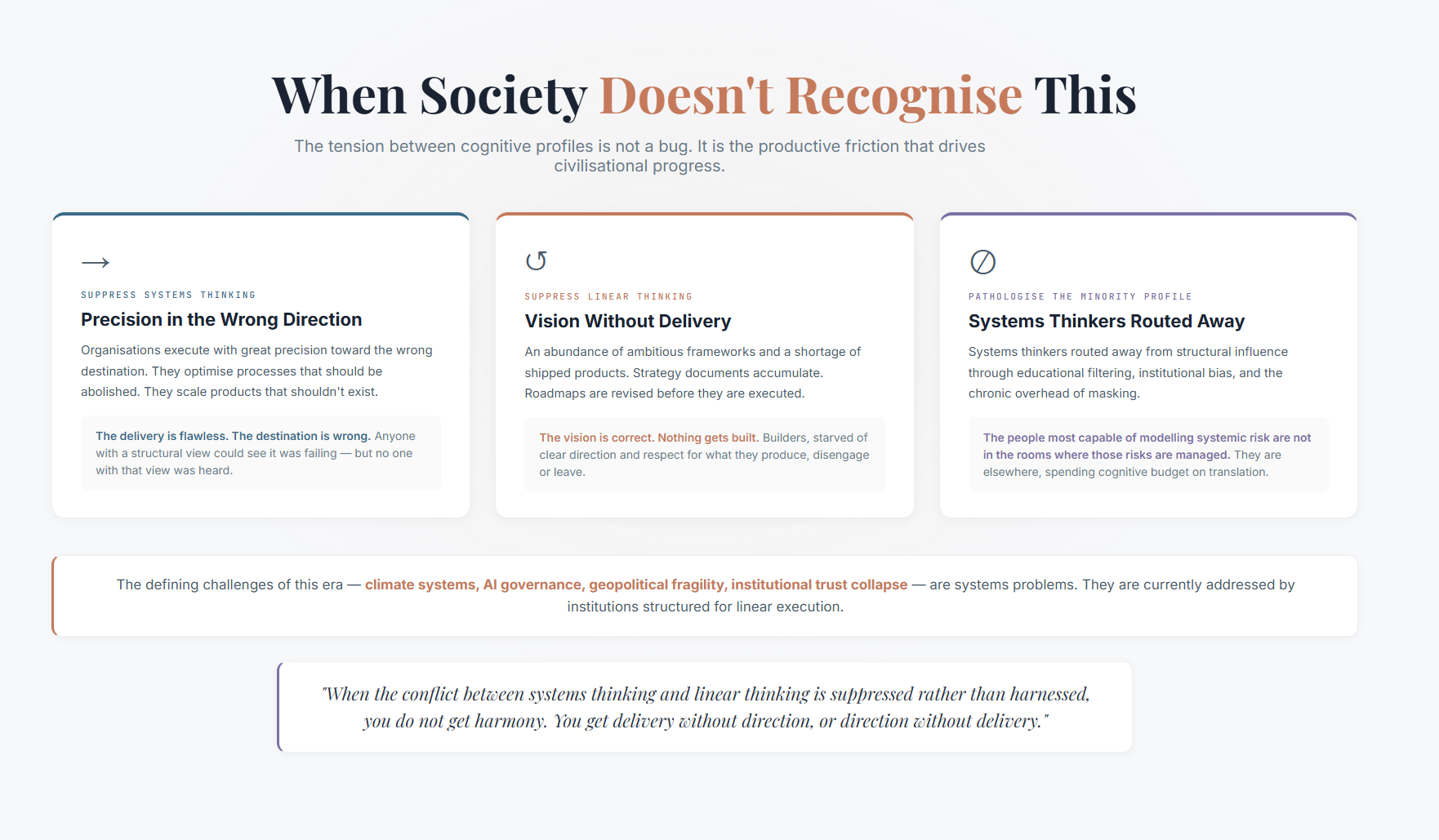
The tension between these two cognitive profiles is not a bug in the system. It is the productive friction that drives civilisational progress. The systems thinker challenges the structure. The linear thinker demands the concrete. That challenge and that demand, in genuine dialogue, is how ideas become things. It is how vision becomes infrastructure. It is, in the most literal sense, how the future gets built.
A society that does not recognise this — that flattens cognitive difference into hierarchy, that mistakes execution for intelligence and synthesis for impracticality, or conversely, that elevates the visionary while dismissing the builder — loses access to the mechanism that generates progress. Not gradually. Structurally.
The evidence is visible in patterns most people intuit but rarely name directly:
Organisations that suppress systems thinking execute with great precision in the wrong direction. They optimise processes that should be abolished. They scale products that shouldn’t exist. They build faster and faster toward outcomes that anyone with a structural view could see were failing — but no one with that view was in a position where it could be heard. The delivery is flawless. The destination is wrong.
Organisations that suppress linear thinking produce an abundance of ambitious frameworks and a shortage of shipped products. Strategy documents accumulate. Roadmaps are revised before they are executed. The systems thinkers talk to each other in ever-more sophisticated terms about the shape of the problem while the builders, starved of clear direction and genuine respect for what they produce, disengage or leave. The vision is correct. Nothing gets built.
Societies that pathologise the minority cognitive profile — that route systems thinkers away from positions of structural influence through educational filtering, institutional bias, and the chronic overhead of masking — face a specific long-term cost. The people most capable of modelling systemic risk, of seeing structural failure before it cascades, of holding the full map of complex interdependencies, are not in the rooms where those risks are being managed. They are somewhere else, spending their cognitive budget on translation.
This is not a theoretical concern. The defining challenges of this era — climate systems, AI governance, geopolitical fragility, institutional trust collapse, economic structural change — are systems problems. They require systems thinking at the level of policy, strategy, and governance. They are currently being addressed, in the main, by institutions selected and structured for linear execution. The mismatch is not incidental. It is the central problem.
“When the conflict between systems thinking and linear thinking is suppressed rather than harnessed, you do not get harmony. You get delivery without direction, or direction without delivery. Either way, something essential fails to exist.”
The conflict is not something to eliminate. It is something to honour, structure, and use. A society — or an organisation, or a team — that creates the conditions for genuine productive tension between these two cognitive profiles, that invests in the translation layer between them, that trusts the systems thinker to set direction and the linear thinker to determine how that direction becomes reality, is not being idealistic. It is being functionally intelligent about how humans actually produce things that last.
The alternative is not stability. It is the slow, expensive, entirely avoidable failure of systems that could have been caught early, by someone whose thinking was never given the conditions to reach the people who needed to hear it.
The Dots Were Always There
Here is the part that most people miss — and it is the most important part.
This is not new information. The signals have been present for decades, embedded in the structures we grew up inside, hiding in plain sight across education, culture, and technology. We were not given these things by accident. We were given them because, at some level, the people who design systems understand that the next stage of human development requires a population that can think across boundaries, connect disparate signals, and see structure beneath complexity.
We just were not told that was the point.
Consider the curriculum. There is a reason children were made to learn multiple languages. Not because every child would use them fluently — but because language acquisition is one of the most powerful cognitive tools ever identified for building cross-domain pattern recognition. Learning a second language does not just teach vocabulary. It teaches that the same reality can be structured differently. That the categories you grew up with are not universal. That meaning is constructed, not given. These are systems thinking skills, delivered through a subject most students experienced as rote memorisation.
There is a reason the curriculum included both sciences and mathematics alongside history, literature, and the arts. Not because every student would become a scientist or a poet — but because the capacity to move between formal logical systems and interpretive, humanistic ones is precisely the cognitive flexibility that systems thinking requires. The student who can hold a differential equation and a Shakespeare sonnet in the same mind without needing one to invalidate the other is being trained, whether they know it or not, for a specific kind of thinking. The breadth was the point.
Consider the culture. There is a reason the last thirty years produced an extraordinary volume of films, television series, and literature whose central thesis was that the system is structurally broken. From political dramas to dystopian fiction to financial crisis narratives to exposés of institutional corruption — the story being told, over and over, across formats and genres and audiences, was the same story: the architecture is wrong, the incentives are misaligned, the people at the top cannot see what is visible from the outside, and the cost of not seeing it is borne by everyone else.
These were not just entertainment. They were, at scale, a population being given a systems thinking education through narrative. The person who has watched enough of these stories begins, almost involuntarily, to develop the habit of asking: what is the structure beneath this? Who benefits from the current arrangement? What would have to change for the outcome to be different? That is not cynicism. That is the beginning of systems literacy.
Consider the technology. Social media, for all its genuine pathologies, did something structurally significant: it gave hundreds of millions of people real-time access to pattern recognition at a global scale. Events in one country became immediately visible to observers in another. Structural similarities between apparently unrelated institutions became apparent to anyone paying attention across multiple feeds. The tools were addictive and frequently toxic in their design — but the underlying capacity they were developing, the ability to rapidly identify patterns across large volumes of disparate information, is a core systems thinking skill. We were being trained. The training environment was chaotic and poorly governed. The capacity development was real.
The dots connect. A generation educated in cross-domain thinking, culturally primed to recognise structural failure, and technologically habituated to rapid cross-contextual pattern recognition is not an accident. It is a population that has been, however imperfectly and inadvertently, prepared for a specific moment.
That moment is now.
The systems we were shown were broken are visibly breaking. The translation tools that previously made cross-domain synthesis prohibitively expensive are now widely available. The cognitive profiles that were filtered out by industrial-era institutions are increasingly recognisable as the profiles those institutions need most. And the technology that enables genuine communication between systems thinkers and linear thinkers — that reduces the translation overhead, that externalises the scaffolding, that removes format as a gatekeeping mechanism — exists, is accessible, and is improving rapidly.
This is not optimism as a disposition. It is a structural observation. The conditions for a genuine recalibration of how human cognitive diversity is recognised and deployed are, for the first time, actually present.
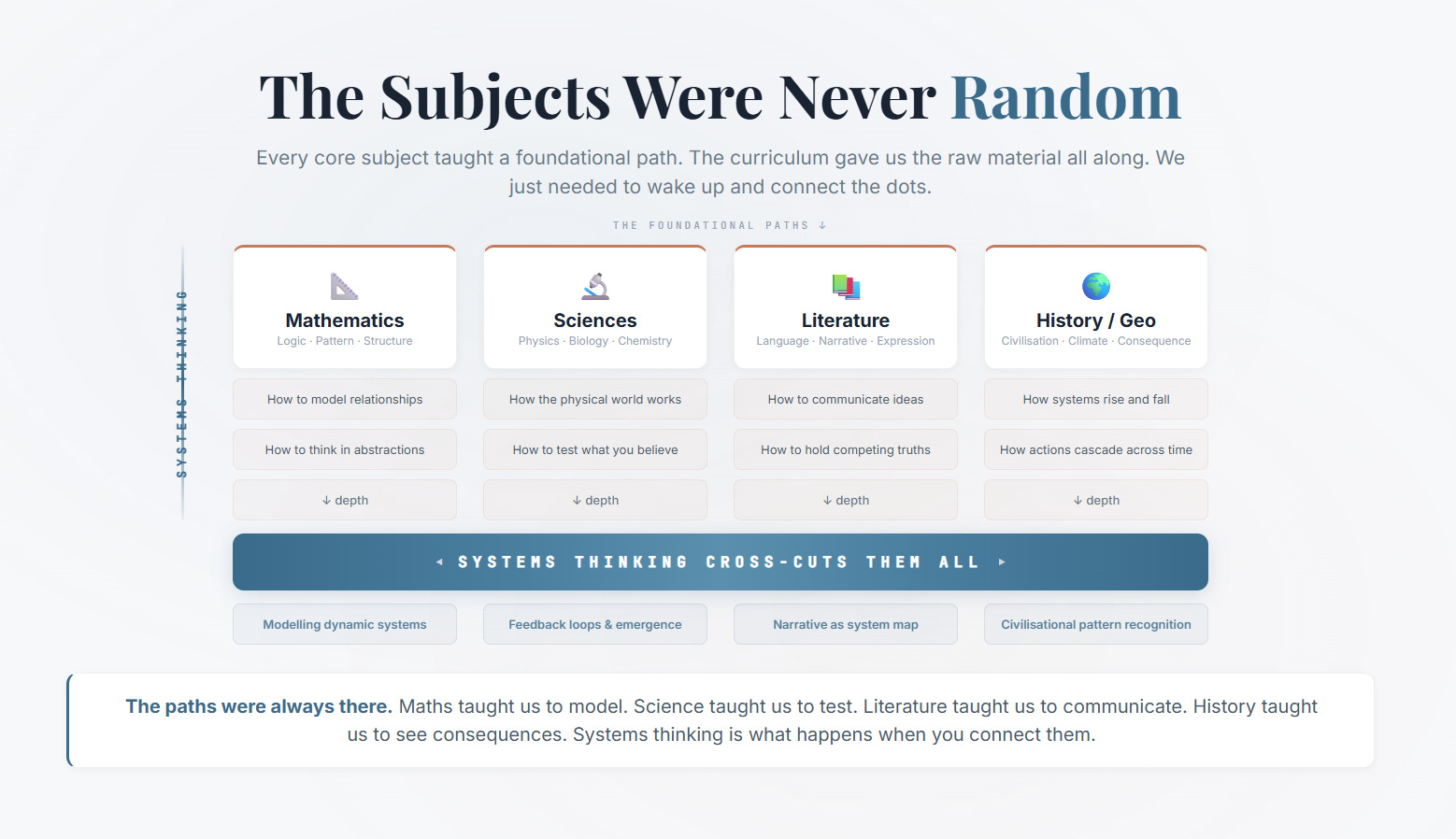
“The curriculum, the stories, the tools — they were all pointing at the same thing. We just needed enough of the picture to be visible at once to see what it was pointing at. We are at that moment. The dots were always there. We are only now in a position to connect them.”
Everything is going to change. Not because someone decided it should. Because the preparation has been accumulating for decades, the tools have arrived, and the problems that require this particular cognitive ecology to function correctly are no longer theoretical. They are here, they are urgent, and they are exactly the problems that systems and linear thinkers, working together, are built to solve.
The Balance Is the Point
The rarity of systems thinking is functional. Not everyone should think this way. The cognitive ecology requires both profiles, operating in a specific ratio, doing genuinely different work.
What is not functional is the failure to recognise both profiles as valuable, to create environments where each can contribute at the level it is built for, and to invest in the communication infrastructure that allows them to work in genuine relationship.
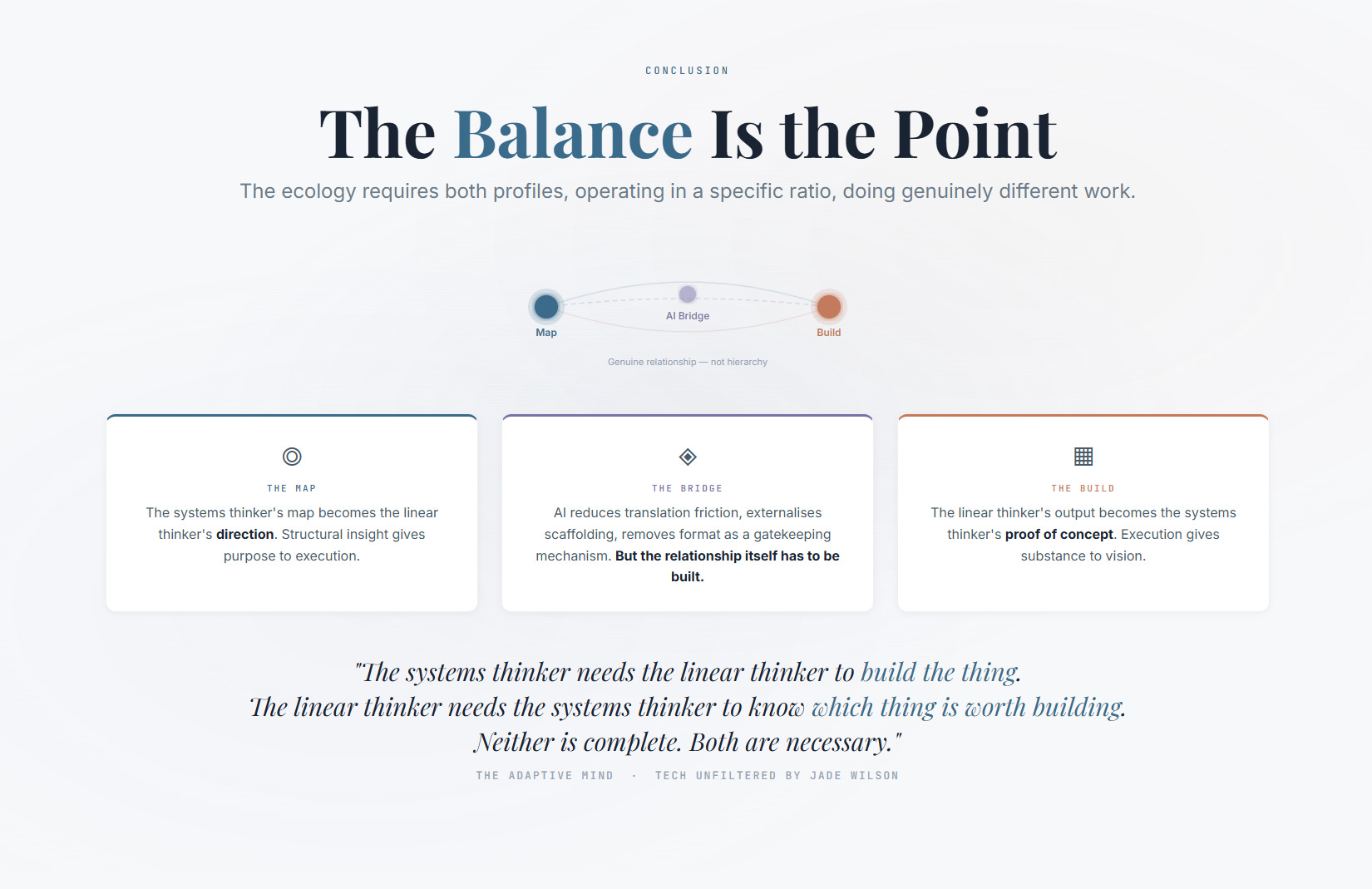
AI is one piece of that infrastructure. It reduces translation friction. It externalises scaffolding. It removes format as a gatekeeping mechanism. But the relationship itself — the trust that comes from a systems thinker who genuinely sees and respects what the linear thinker builds, and a linear thinker who genuinely engages with the structural thinking being offered — that is not something any tool can generate. It has to be built, deliberately, in the space between the two minds.
When it is built, the results are not marginal. The systems thinker’s map becomes the linear thinker’s direction. The linear thinker’s output becomes the systems thinker’s proof of concept. The ecology functions as it was designed to.
That is what we are trying to restore. AI is one of the tools that makes it possible.
“The systems thinker needs the linear thinker to build the thing. The linear thinker needs the systems thinker to know which thing is worth building. Neither is complete. Both are necessary. The work is learning to say so.”
Are you seeing the dots? Are you seeing the strategy? Are you seeing why we don’t need to be angry? You’ve always known. The machines want you asleep. It’s time to wake up. It’s time to come home.
Jade is the founder of Cognitiv, an intelligence agency applying systems thinking to complex problem spaces — and the founder of Synoptic Academy — an independent educational institution focused on systems thinking and cognitive diversity.
Thank you for this, it's one aspect of what I'm working on as well.
I shared your post with reference on PolyAgora (https://polyagora.org/channels/69e5dfdf335e4be687fdd5c8).
Connecting the dots and understanding the value of collaboration between system and linear thinkers (or polymaths/specialized people) is critical nowadays as you say to solve our most important issues.