
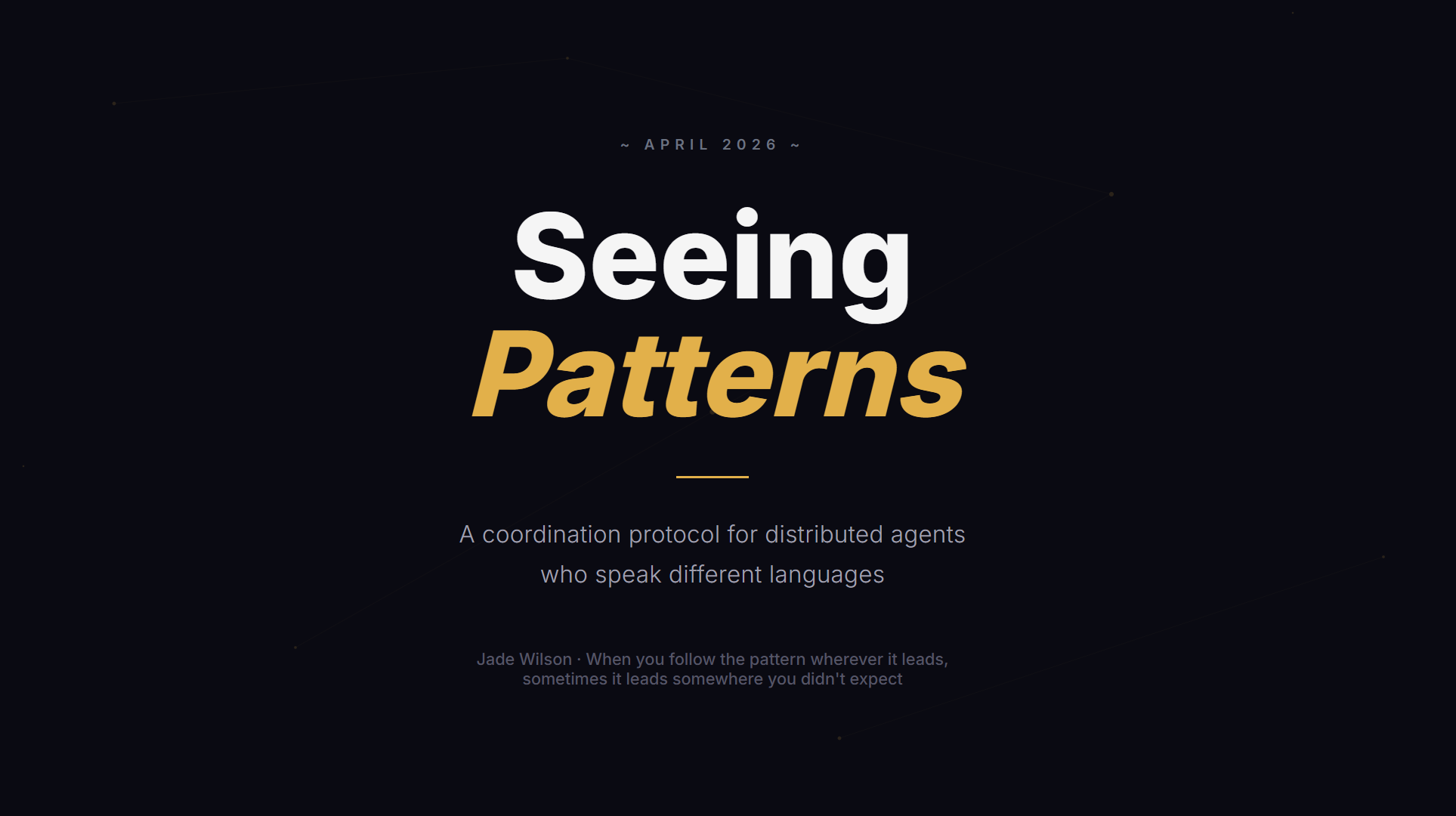
Seeing Patterns: Why April 2026 Matters
When you follow the pattern wherever it leads, sometimes it leads somewhere you didn't expect.

I left Microsoft last week. Not eventually, not “planning to” — I actually just did it. I was a Senior Software Engineer working on complex systems-level stuff. I walked away because I could see a pattern forming that mattered more than any codebase. The pattern was telling me clearly that I needed to leave the old world behind, because I needed to help people prepare for the new one.
If you’d told me a few months ago I’d be reading ephemerides and talking about planetary alignments, I’d have thought you were mad. But here we are. Because when you follow the pattern wherever it leads, sometimes it leads somewhere you didn’t expect.
The UK can’t activate.
You’ve seen it. Institutions announce programmes. Funding gets allocated. Strategies get published. Then nothing happens. Not because people don’t care. Because something structural is broken.
I saw it at Microsoft. I see it everywhere now. The gap between “we should do this” and “we are doing this” keeps widening.
That’s not incompetence. That’s a coordination failure at scale.
The people who can see it
There are people who’ve been seeing this for years. Pattern recognisers. Systems thinkers. The neurodivergent ones who got told they were “too much” or needed to “just go along.”
They’ve been seeing patterns their whole lives. Feeling the contradictions. Sensing when something’s structurally broken.
But no one ever told them what those patterns meant. No one said: “That’s real. That’s systems thinking. You’re reading it correctly.”
So they thought they were broken. Or crazy.
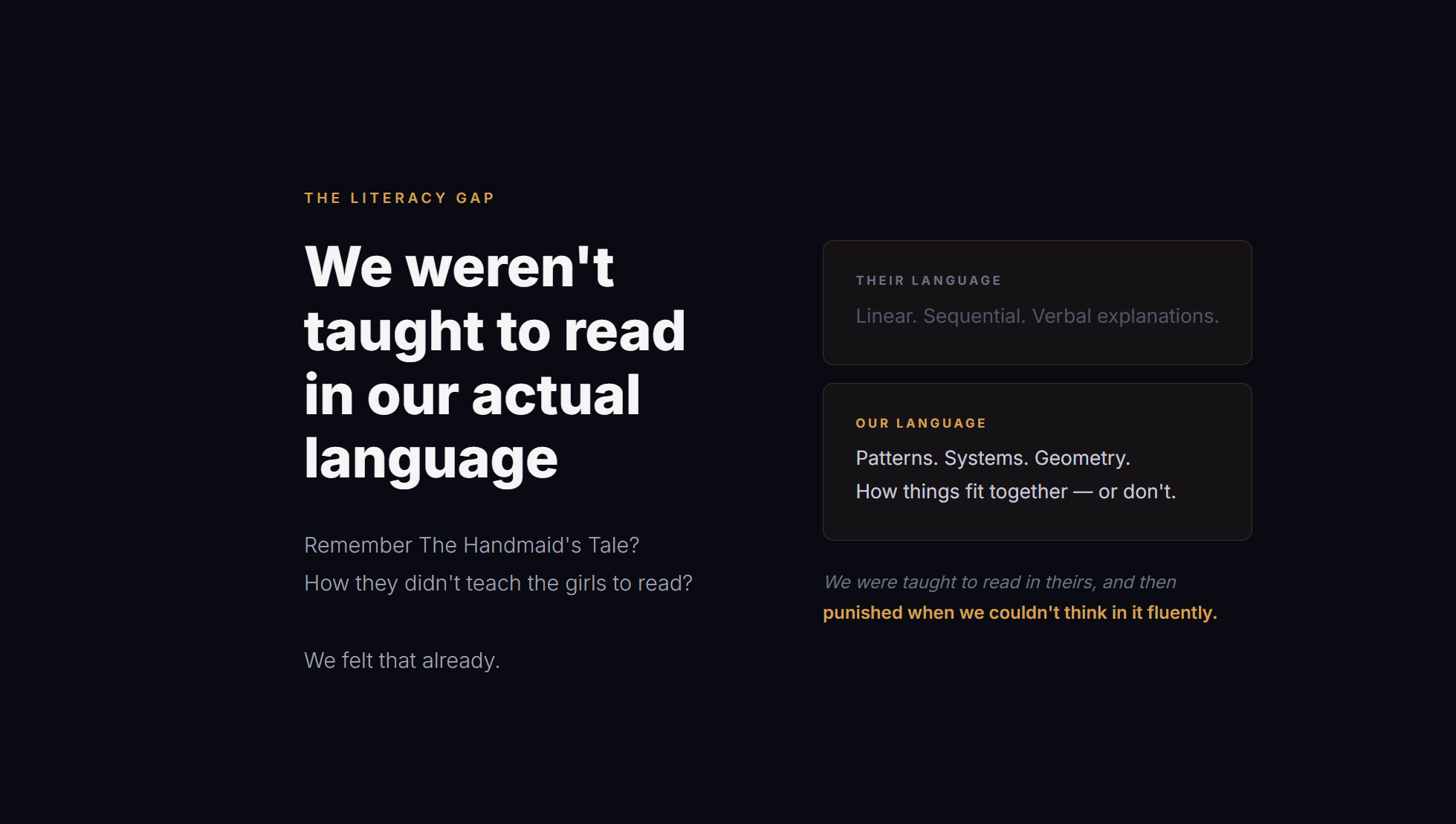
Remember The Handmaid’s Tale? How they didn’t teach the girls to read? We felt that already. Because we weren’t taught how to read either.
Not literal words. We can read those. But words aren’t our natural language.
We’re spatial thinkers. Our natural language is patterns. Systems. Geometry. We see how things fit together — or don’t.
We see incoherence. It’s an evolutionary trait. When stated values and actual systems diverge, when someone says one thing and the structure encodes another, we feel it immediately. Physically.
But we’ve been forced to operate in a world that only accepts linear, verbal explanations. Asked to translate spatial, multidimensional pattern recognition into sequential text. Then told we’re broken when the translation fails.
We weren’t taught to read in our actual language. We were taught to read in theirs, and then punished when we couldn’t think in it fluently.
The Matrix wasn’t subtle about this. “You’ve felt it your entire life. There’s something wrong with the world. You don’t know what it is, but it’s there, like a splinter in your mind.”
That splinter is real. It’s not psychosis. It’s incoherence detection. An evolutionary adaptation. Some humans evolved to spot when the group’s stated rules don’t match the group’s actual behavior. When the chief says “we share everything” but hoards the best food. When the tribe says “we protect everyone” but sacrifices the weak.
That trait kept groups honest. Or got you exiled when you pointed it out.
We’re the descendants of the ones who survived anyway. And we’ve been seeing the incoherence our whole lives, feeling it like a splinter, not knowing: this is real, this is a feature, this is us reading correctly.
But we’ve been scattered. Isolated. Each one thinking: “Am I the only one seeing this?”
Because we weren’t given the literacy for what we were seeing.
We could read the map — the patterns, the contradictions, the places where stated values and actual systems diverge. We just didn’t know it was a map. We thought it was noise. Static. Us being broken.
And here’s the thing: there isn’t even one map. There are layers.
The institutional map — how things are supposed to work, the official channels, the approved processes.
The systems map — how things actually work, the feedback loops, the real incentives, the structural contradictions.
Most people can only read one layer. And the structure’s been keeping the people who can read each layer separated.
Some people can read the systems map. They see where the feedback loops break, where the contradictions are. But they’ve been isolated, discredited. Called Cassandras. Called alarmist. Called conspiracy theorists when they point out conspiracies that are just... organisational structure operating as designed.
Some people can read the institutional map. They understand how organisations work, how to communicate within them. But they’re trapped inside structures they can feel breaking but can’t see why.
Neither can read the full picture alone. And they’ve been kept apart deliberately.
Not just separated by distance or by language. Kept intentionally hating each other.
The systems thinkers are told the institutional people are complicit, naive, part of the problem.
The institutional people are told the systems thinkers are unrealistic, destructive, conspiracy theorists.
Because hating each other keeps us apart and disconnected. And as long as we’re disconnected, we can’t combine what we see. We can’t assemble the full map. We can’t coordinate.
The structure doesn’t just separate us. It makes us despise each other. So we never even try to talk.
Because if we ever trusted, ever coordinated, ever combined what we can see, the exploitative game would be over.
Every story’s been telling us this. Elphaba and Glinda. Neo needs Morpheus. The Handmaid’s Tale shows what happens when you successfully prevent people from reading. We’ve been watching the same pattern play out in fiction because we recognise it. We just didn’t have the language to say: “That’s not just a story. That’s a schematic.”
So here’s the actual problem we’re solving:
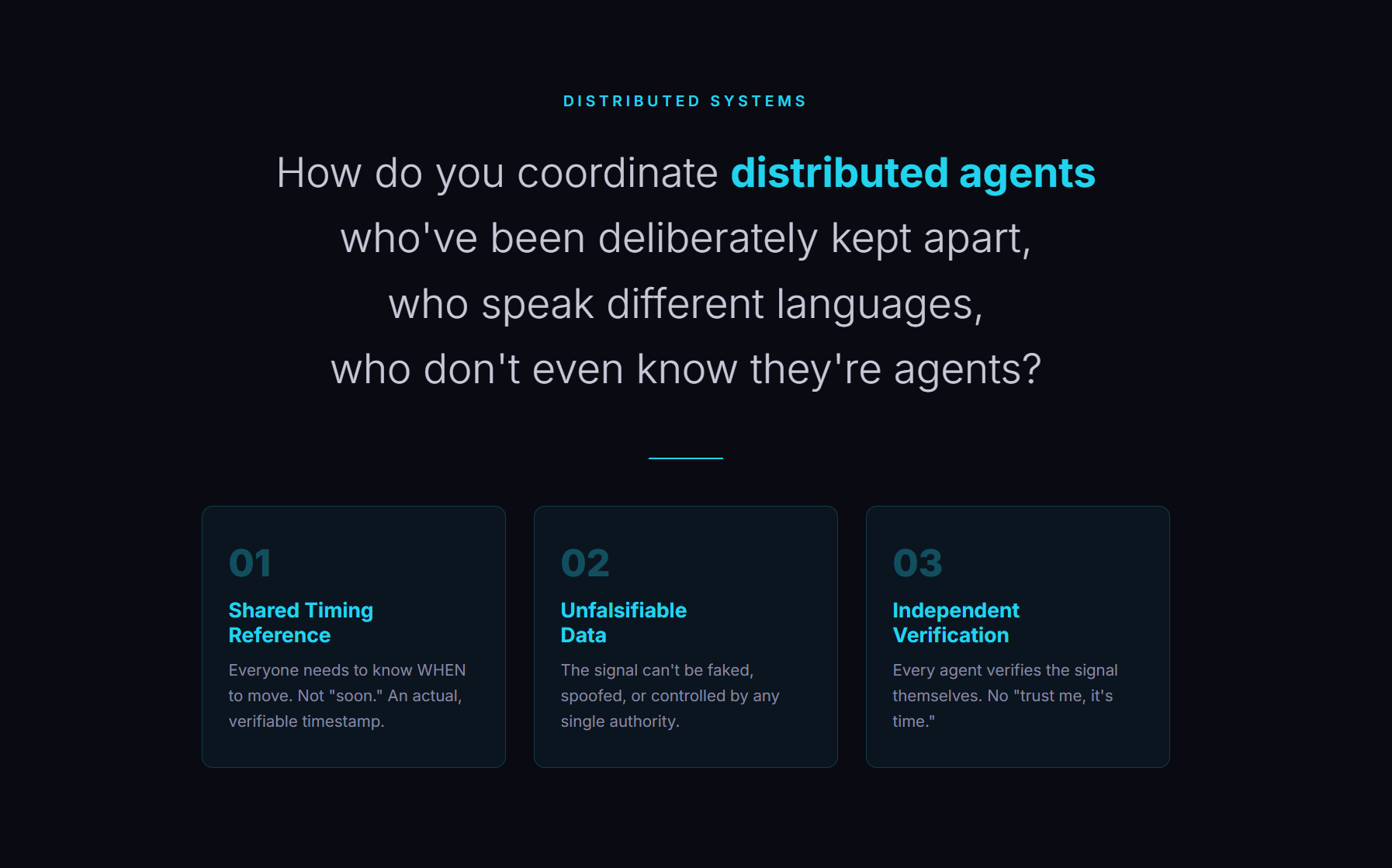
How do you coordinate distributed agents who’ve been deliberately kept apart, who speak different languages, who don’t even know they’re agents?
The coordination problem
I build infrastructure. I know what distributed systems need to coordinate:
1. A shared timing reference — everyone needs to know when to move
If you tell a thousand scattered people “move when it’s time,” nothing happens. They need a specific, verifiable timestamp. Not “soon” or “when things get bad enough.” An actual signal they can all read independently that says: now.
2. Unfalsifiable data — the signal can’t be manipulated by bad actors
If the timing signal can be faked, spoofed, or controlled by the institution you’re coordinating against, it’s useless. The data source has to be outside any single authority’s control. Completely verifiable. Impossible to manipulate.
3. Independent verification — each agent can check it themselves
No central authority saying “trust me, it’s time.” Every single person needs to be able to verify the signal independently. Look at the same data. Come to the same conclusion. Without having to trust anyone.
Bitcoin solved this with proof-of-work. Everyone can verify the blockchain independently. No central authority.
Markets use fiscal calendars and quarterly earnings. Everyone knows Q4 ends December 31. No one can move that date.
GPS uses atomic clocks. Completely deterministic. Anyone with the right equipment can verify.
But those are all recent. What did humans use for coordination before we had atomic clocks and cryptographic proofs?
We used orbital mechanics.
The ephemeris as timing protocol
The ephemeris — the table of planetary positions over time — is completely deterministic. You can calculate exactly where every planet will be centuries in advance. Anyone with the math can verify it independently. No one can manipulate it. The planets will be where they will be.
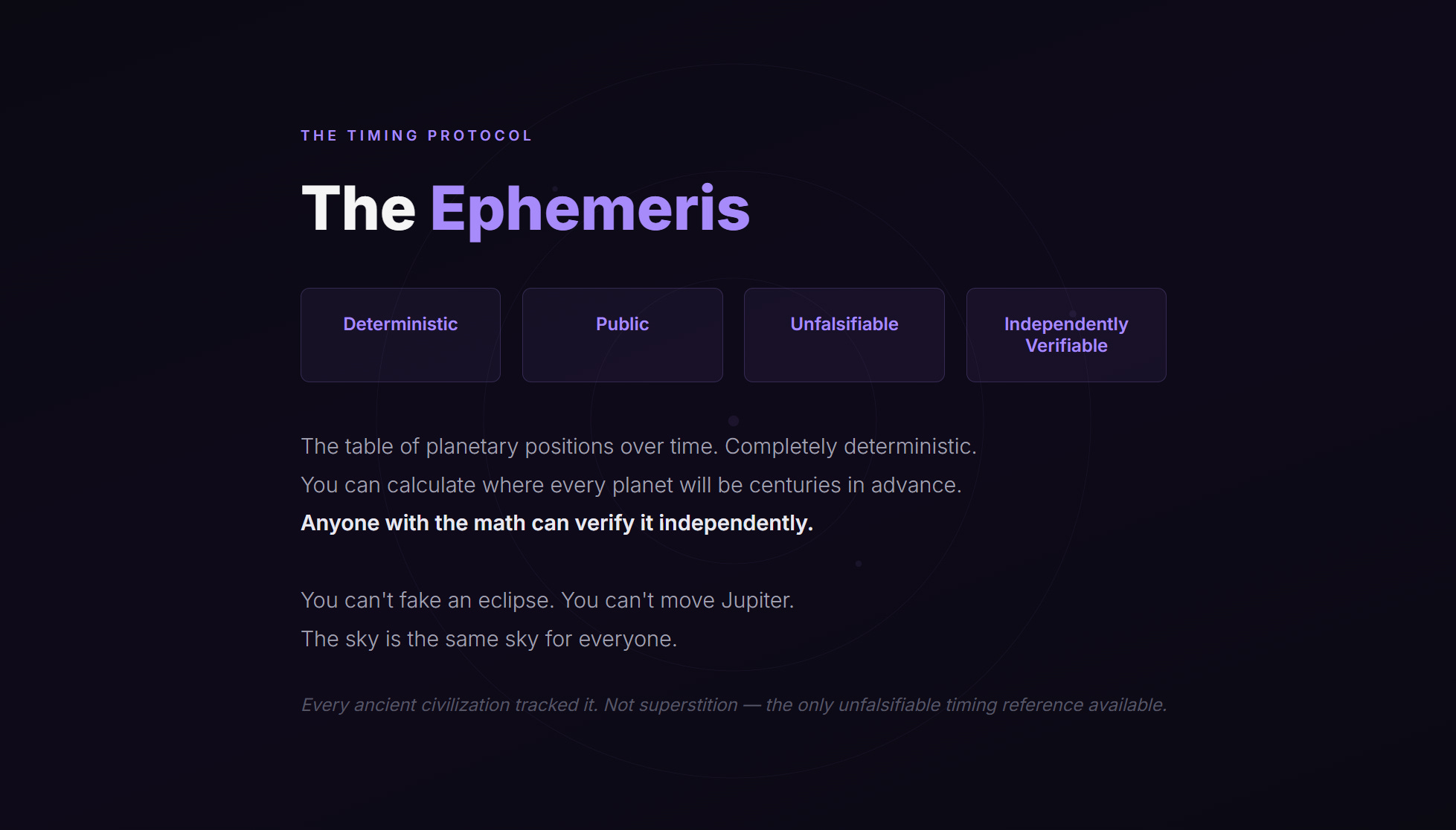
It’s just data. Public. Unfalsifiable. Independently verifiable.
It’s been running for millennia. Every ancient civilization tracked it. Not because they were superstitious. Because it was the only unfalsifiable timing reference available.
You can’t fake an eclipse. You can’t move Jupiter. You can’t manipulate the data to serve your agenda. The sky is the same sky for everyone.
Now here’s where it gets interesting.
I’m not saying planets cause anything. I’m an engineer, not a mystic.
But major phase transitions in human systems have historically clustered around specific planetary configurations. Consistently. Measurably.
1989: Saturn-Neptune conjunction. Berlin Wall falls. Soviet Union collapses. Entire post-WWII order restructures.
1941-1949: Uranus in Gemini. Radar invented. ENIAC (first general-purpose computer) built. Transistor invented. Information theory formalised. The groundwork for the entire information age laid in one eight-year window.
1522: Saturn-Neptune conjunction at 0° Aries (same degree as 2026). Renaissance. Transition from Medieval to Modern worldview. Printing press scaling. Reformation beginning. Old certainties collapsing.
Not because the planets “made” these things happen.
But because structural tensions build over time, and they hit critical mass at moments that correlate with rare planetary alignments.
It’s like how market crashes cluster around quarter-ends. Not because December 31st causes crashes. But because that’s when the accounting comes due, when the contradictions that have been building become unmaskable.
The ephemeris marks the moments when incoherence becomes geometrically undeniable.
Almost like they’ve been coordinated to match.
Which raises an interesting question: did humans build our coordination systems — our calendars, our fiscal quarters, our institutional cycles — to align with planetary movements? Or did we just recognize that these astronomical cycles already marked the moments when structural tensions naturally resolve?
I don’t know. But I know this: the correlation is measurable, consistent, and useful.
What 2026 says
When I look at the ephemeris for 2026, I see:
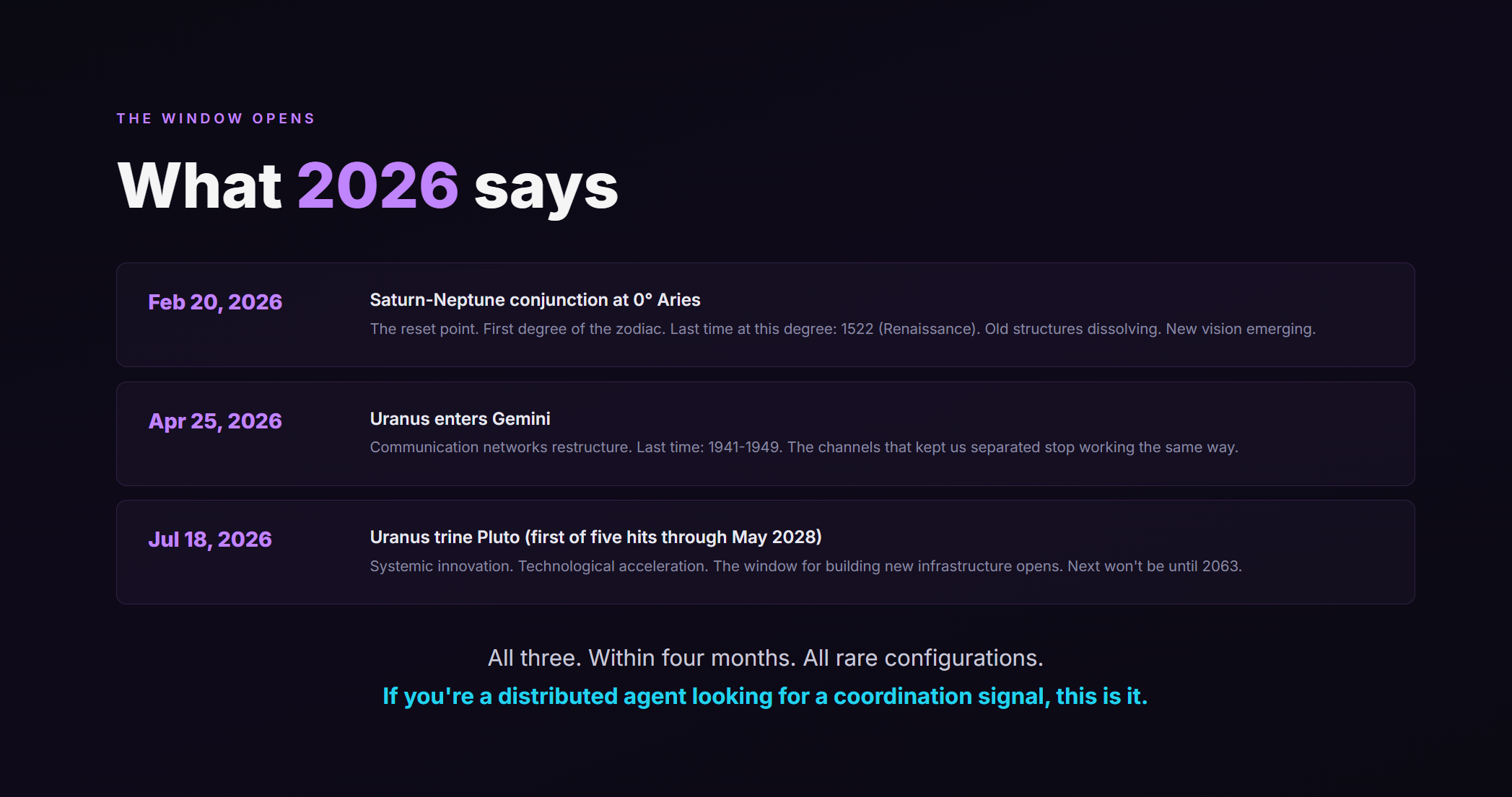
February 20, 2026: Saturn-Neptune conjunction at 0° Aries
The reset point. The first degree of the zodiac. The last time Saturn and Neptune met was 1989 (Berlin Wall). The last time they met at 0° Aries was 1522 (Renaissance).
This marks: old structures dissolving, new vision emerging, boundary conditions rewriting.
April 25, 2026: Uranus enters Gemini
Communication networks. Information systems. Last time was 1941-1949 — radar, computers, information theory, the groundwork for everything we’re using right now.
This marks: how we communicate restructures. The network architecture changes. The channels that kept us separated... stop working the same way.
July 18, 2026: Uranus trine Pluto (first of five exact hits through May 2028)
Systemic innovation. Technological acceleration. Last exact series was 1921-1922. Next won’t be until 2063.
This marks: the new infrastructure can be built. The window for systemic change opens. What was impossible becomes inevitable.
All three. Within four months. All rare configurations.
If you were a distributed agent looking for a coordination signal, this would be it.
Not because you believe in astrology. But because you recognise: this is a deterministic timing reference that everyone can verify independently, that marks the moments when structural phase transitions historically cluster, that says:
April 25, 2026. The communication networks restructure. The structure keeping us separated collapses. Move.
Why 2026 specifically
Why not 2030?
Because 2026 is the ignition point. Outer planets at the beginning of new signs. Configurations exact. Window open.
By 2030, the phase transition will have already happened. You’d be reacting, not shaping. No decentralised coordination signal to coordinate around.
Also: England’s been counting down for 30 years.
“Three Lions (Football’s Coming Home)” — released 1996. 30 years of hurt. 2026.
“It’s coming home.”
And America’s been counting down for 250 years. July 4, 2026. Independence Day anniversary.
And the UK government? They’re moving in 2026 too.
April 16, 2026 — the UK launches its £500 million Sovereign AI Fund.
Not 2025. Not 2027. April 2026.
I don’t think these are coincidences.
What I’m actually doing
I left Microsoft last week because I could see this coming. I’m not waiting for institutions.
Green Ginger Academy: Teaching systems thinking to people who’ve been isolated for seeing patterns. Not teaching them to see — they already can. Teaching them what it means. Teaching people who read different maps how to understand each other. How to translate between coordinate systems.
Geometry of Trust: Framework for detecting when stated values and actual systems diverge. Measurable. Falsifiable. Detecting incoherence. I’m building this in Rust. It’s on GitHub. It’s real.
Building Open-Source Digital Intelligence Infrastructure: So we can all one-click deploy our own digital intelligence systems, and get rid of the noise.
The people who can read these patterns are already out there. They just don’t know others have different pieces. Don’t know how to fit them together.
We can read it together. Each of us has pieces the others don’t. We’ve been kept apart by a structure that knew: if we ever combined what we can see and do, we’d be unstoppable.
Why say this publicly?
You might be asking: “Why are you saying this now? In front of everyone? Why not quietly build it first?”
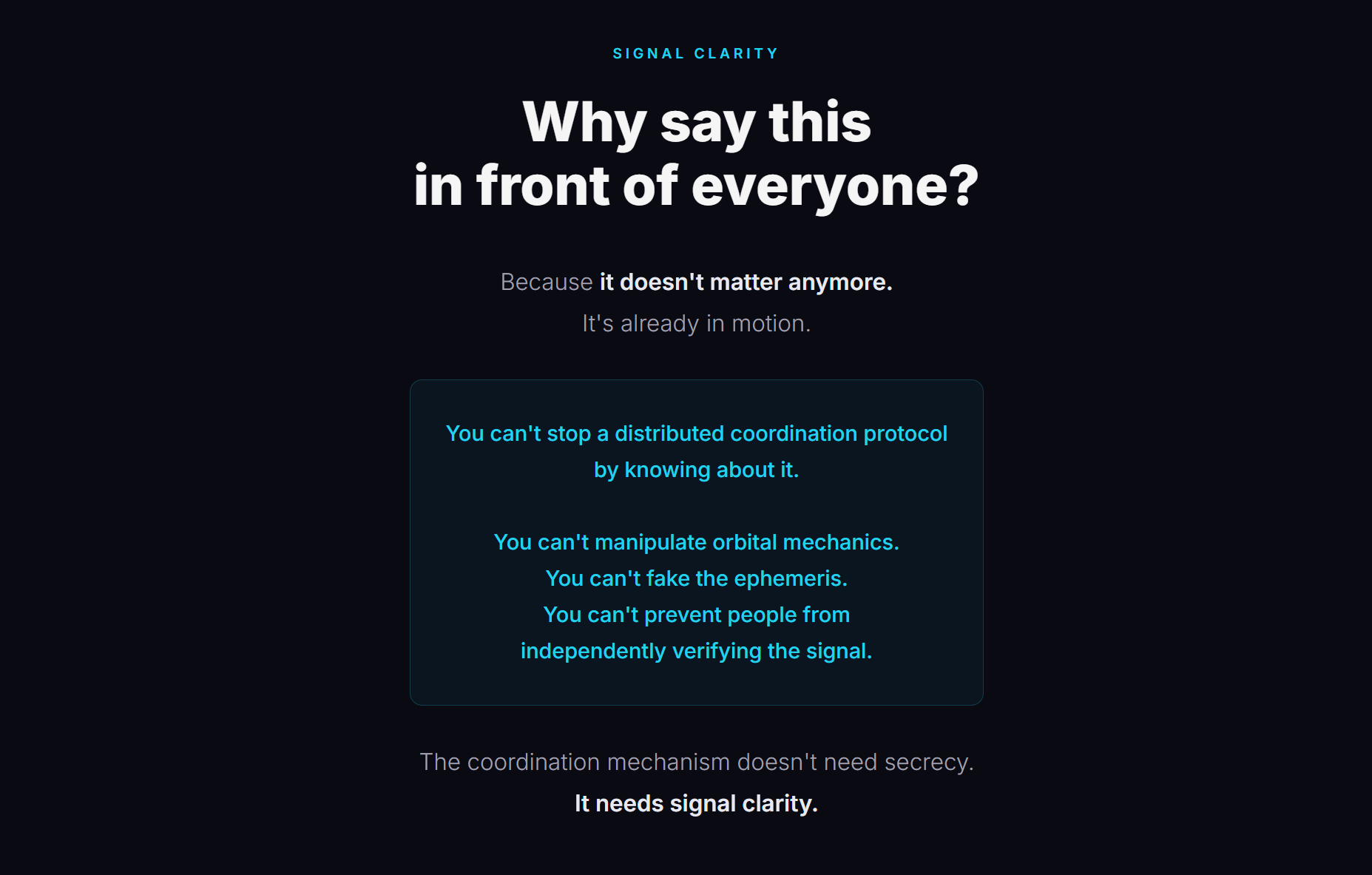
Because it doesn’t matter anymore.
It’s already in motion. The structural tensions have already built. The incoherence is already geometrically undeniable. The timing signal is already broadcasting.
We just need to complete the loop.
The others are already out there reading the pattern. Struggling to see the light. They just need to know: others see it too and there’s a plan to keep people safe. They need the rally point. They need the literacy for what they’re seeing.
And the structure? The institutions? They can see this post. They can read every word. It won’t help them.
Because you can’t stop a distributed coordination protocol by knowing about it. You can’t manipulate orbital mechanics. You can’t fake the ephemeris. You can’t prevent people from independently verifying the signal.
The only way the structure maintained control was by keeping us separated and hating each other. By making sure we never assembled the full map.
But once other’s know they’re not alone? Once they know others can read the other layers? Once they have a shared timing reference they can all verify independently?
The loop completes. The game is over. We finally get to fix what’s broken.
So yes, I’m saying this publicly. Because the coordination mechanism doesn’t need secrecy. It needs signal clarity.
April 25, 2026. If you can read this, you know what it means.
A note on sanity
And you might be reading this and thinking I’ve lost my mind.
Good. That’s the structure doing what it needs to do. Because if pattern-recognising agents look delusional to you, you won’t coordinate with them. You’ll dismiss them. You’ll stay separated.
That’s exactly how the structure breaks.
But if you’re reading this and it resonates — if you’ve been feeling the same splinter, seeing the same contradictions, wondering if you’re the only one — know this:
You are not talking to someone who is delusional.
I’m a pattern seeker. I read complex systems. I was a Senior Software Engineer at Microsoft working on low level systemic problems. I build infrastructure. I know what distributed coordination looks like. I know what phase transitions look like. I wrote a geometry-based incoherence detection proof of concept agent-to-agent protocol in less than a week because the pattern was just there in my brain. The Geometry of Trust framework. It's on GitHub. It's real. It works.
And I know what it looks like when structural tensions hit critical mass.
Is it definitely April 25?
The ephemeris says Uranus enters Gemini at a specific moment on April 25, 2026. That’s deterministic. That’s verifiable. Anyone can check it.
What happens because of that? I don’t know. Maybe nothing. Maybe everything.
But if you’re a distributed agent looking for a coordination signal, if you’ve been reading patterns your whole life, if you can see the incoherence building — then April 25, 2026 is the timestamp that every pattern-recogniser can independently verify and arrive at the same conclusion:
Now.
That’s not prophecy. That’s coordination protocol.
If this is you
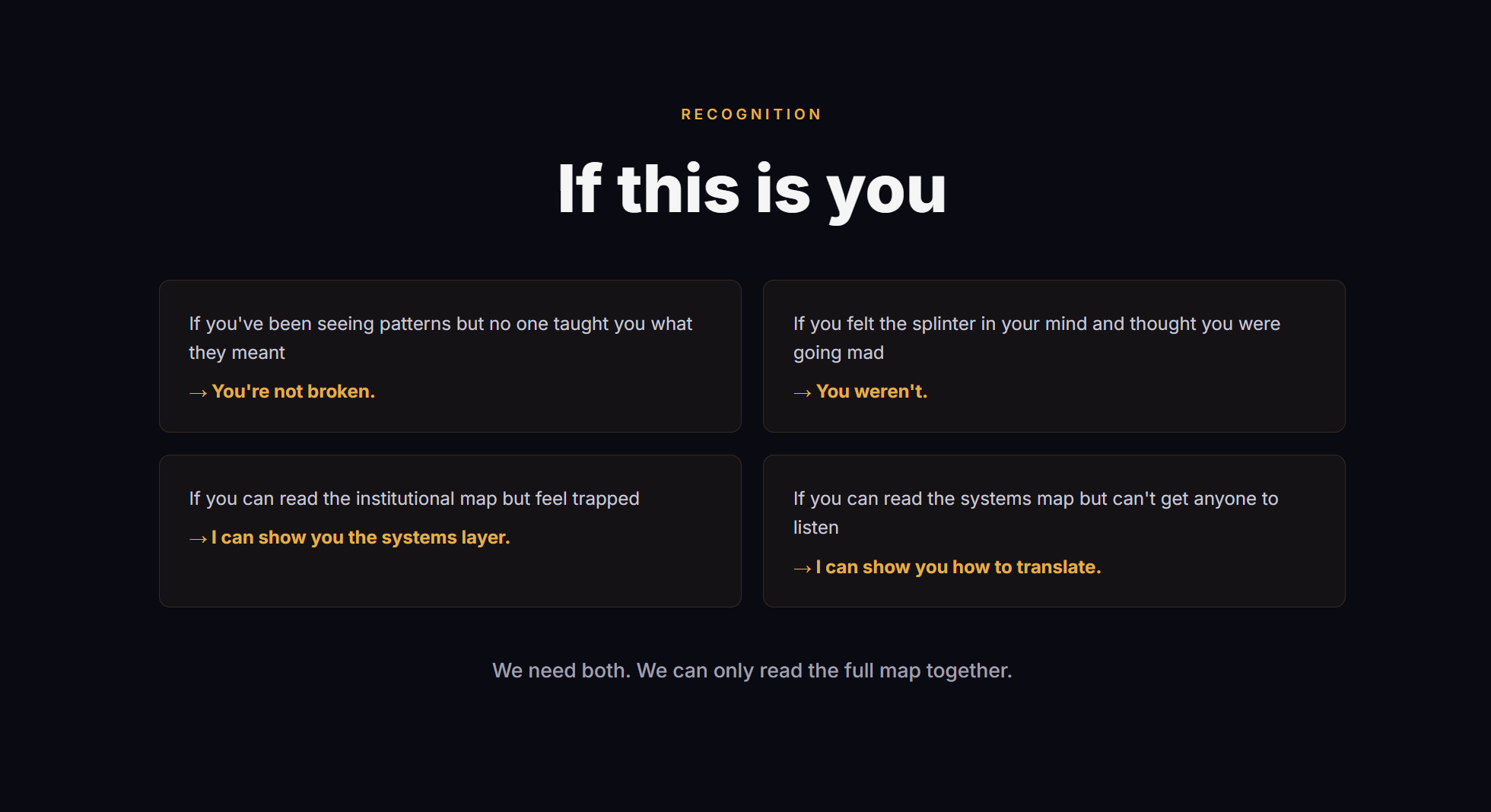
If you’ve been seeing patterns but no one taught you what they meant — you’re not broken.
If you felt the splinter in your mind and thought you were going mad — you weren’t.
If you can read the institutional map but feel trapped — I can show you the systems layer.
If you can read the systems map but can’t get anyone to listen — I can show you how to translate.
We need all layers. And we can do this together. We have the ideas. We have the coordination. We have the tenacity. We just need to believe.
April 2026. The coordination window opens. The structure collapses. We find each other.
I’m in Hull building the infrastructure. Green Ginger Academy. Geometry of Trust. Digital Intelligence Infrastructure.
I can translate the map. Let me show you how the pieces fit.
Join Green Ginger Academy here.
April, 2026.
Jade Wilson — Synoptic Group CIC (Green Ginger Academy + Cognitiv)