

If you’ve been reading this newsletter for a while, you’ll know I write about systems. How to build them, how to question them, how to figure out why they work or why they don’t.
But lately I’ve been thinking about a different kind of system. Not code. Not architecture. The one we’re all living inside.
And I think everything I’ve been writing about has been circling the same thing without me realising it.
The patterns. The inefficiencies. The misaligned incentives. They’re all symptoms of the same thing.
I just didn’t have the language for it until now.
What AI Actually Showed Me
Well, it didn’t actually start with AI... It started when I was a kid.
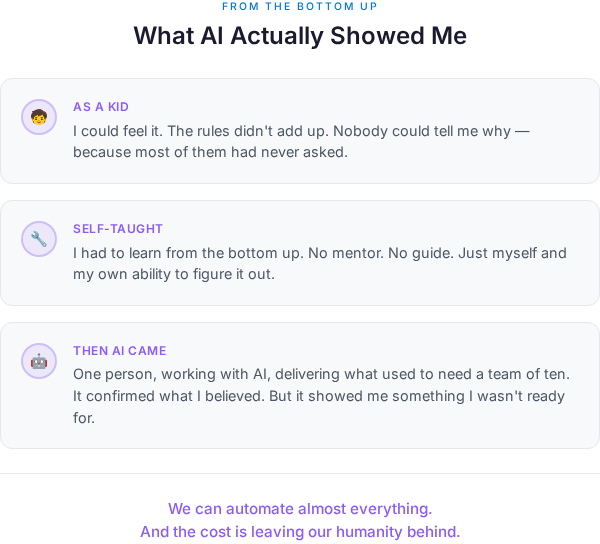
I didn’t have the words for it then, but I could feel it. The system didn’t make sense. The rules didn’t add up. I’d look at how things worked — school, money, who got what and why — and none of it felt logical. I couldn’t explain what was wrong, I just knew something was. I knew everything felt harder, more challenging, I just couldn’t explain why… It felt like I was constantly fighting a system that wasn’t designed for me.
I carried that feeling for years. Through school, through jobs, through being told I was the problem for noticing. “Why don’t you just do as you’re told!” “Because I said so!” “There’s the book, read it!”
But I couldn’t just read the book and accept it. I couldn’t follow rules that didn’t make sense to me without understanding why they existed. And nobody could tell me why — because most of them had never asked themselves.
So I taught myself. From the bottom up. I had to, because I couldn’t learn the way everyone else seemed to. I couldn’t absorb these man-made rules that felt completely arbitrary. And I had no one to teach me this different way of thinking — no mentor, no guide, no one who saw the world the way I did. Just myself and my own ability to figure it out.
And then AI came along and gave it all a name.
I’ve spent the past few months building software with AI. Not in the way people usually mean when they say that — not “AI writes my code for me.” I mean actually rethinking how software gets delivered. Rapid prototyping. Vertical slices. Using compilers and tests as guardrails instead of layers of human review and ceremony. One person, working with AI, delivering what used to need a team of ten.
And it worked. Exceedingly well.
But AI didn’t show me what I wanted it to show me.
I wanted it to confirm what I already believed — that a small, multidisciplinary team could deliver software in a lightweight, impactful way. Less overhead. Less ceremony. Less waiting around for permission. And it did confirm that. But it also showed me something I wasn’t ready for.
We can automate almost everything. And the cost of automating everything is that you leave the people who struggle to adapt incredibly vulnerable.
The system was never designed to deliver software efficiently. It was designed to make people think they were getting value from it, while quietly making sure they couldn’t function without it. The meetings, the frameworks, the certifications, the processes that exist to justify other processes. They’re not there to help you deliver. They’re there to make themselves necessary. To create dependency. To make sure you keep coming back.
And there’s only so much “but you can retrain” and “but you can learn new skills” that goes around before you have to face the reality: 99% of people have been conditioned to conform. They were taught to follow the process, trust the system, do what they’re told. That’s not a personal failing — that’s by design. The system needed them compliant. And now the system is trying to get them to take their knowledge, take their skills, take their labour and make them redundant.
I’m an anomaly. I questioned it. I fought it. I got labelled for it. But most people didn’t, because most people were never given a reason to. They did exactly what they were told would keep them safe.
And I knew we weren’t safe. I spent my entire life chasing that feeling — of eventually being safe. How do I become safe? How do I become free?
I tried everything. I worked harder. I climbed higher. I ticked every box the system told me to tick. And every time I reached the next level, the goalposts moved.
Because the rat race never ends. No matter how high you climb.
And that was the revelation. There is no being free. Not without cost. Not without selling your soul. The system doesn’t let you out — it just offers you different cages at different price points.
But here’s what I’ve learned: if you’re going to be in a cage regardless, you get to choose what fills it. You can be caged and surrounded by evil — by greed, by extraction, by a machine that chews people up and calls it progress. Or you can be caged and surrounded by love and hope.
You can help control the stability of the cage, by helping and growing those around you, rather than only helping those above you.
That’s the only real choice any of us have. And once I saw it that way, I knew which side I wanted to be on.
The Signs Are All Around Us
Think about it.
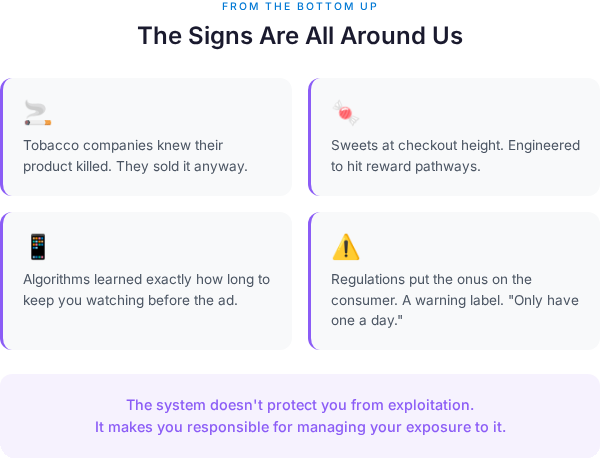
The tobacco companies knew their product killed people. They sold it anyway. The energy drinks marketed at teenagers. The sweets placed at checkout height, engineered to hit the same reward pathways as the social media feeds we’d scroll at 2am. The algorithms that learned exactly how long to keep you watching before serving you an ad for something you didn’t need.
All of these are loopholes. Workarounds. Ways to get people hooked, extract as much as possible, and then pull back just enough when the regulators come knocking. And even then — even when regulations do come in — they put the onus on the consumer. They slap an advisory on it. A warning label. A recommended daily intake.
It’s like a drug pusher handing you the bag and saying “remember, only have one of these a day.”
The system doesn’t protect you from exploitation. It just makes you responsible for managing your own exposure to it. Whilst conditioning you to be addicted since birth.
We’ve been conditioned into believing that if you’re not producing, you’re not valuable. That if you’re not buying, you’re not living. That success looks like a specific car, a specific job title, a specific postcode — and if you don’t have those things, you just didn’t try hard enough.
Here’s the thing I’ve concluded: We’ve been living inside a Ponzi scheme at global scale.
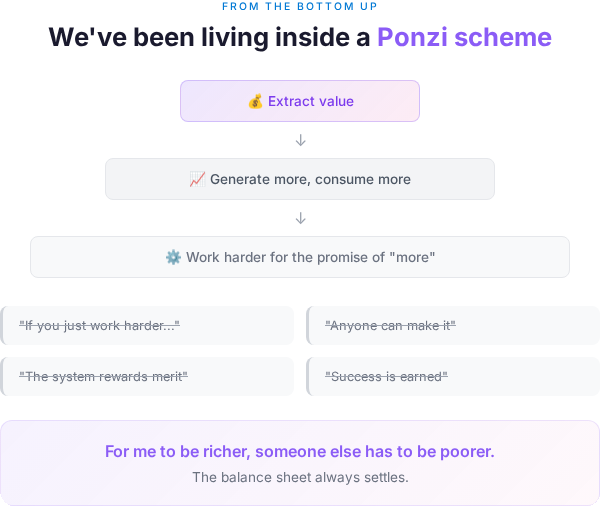
Work harder. Generate more. Consume more. And you’ll get more. It sounds reasonable until you remember that energy doesn’t come from nowhere. Wealth doesn’t either. Every system that consumes must take from somewhere else. For me to be richer, someone else has to be poorer. It’s not always a direct line — it shows up in inflation, in stagnant wages, in taxes that hit the people who can least afford them — but the balance sheet always settles.
And the people at the top know this. That’s why philanthropy exists — not as generosity, but as a tax strategy with good PR. Look closer at how billionaires “give back” and you’ll see it quickly. The money gets funnelled into their own experiments, their own agendas, their own foundations where they get to play god with communities and call it charity. Millions get plummeted into philanthropy to avoid taxes. They expense their dinners, their travel, their entire lifestyles through corporate structures — all while the rest of us get taxed 60% for the privilege of living inside their system.
And then they tell you to invest. They tell you these are the companies you need to put your money into — the same companies that fund their motives, their agendas, their vision for the world. They get you to buy in, literally. They inflate the prices. And when the price peaks, they’re the ones selling. You’re holding the bag. You were always going to be holding the bag. And then when they’ve extracted all they can from your knowledge and skills? Well, goodbye. Thanks for your service. There’s the door.
They know this. They know there’s nowhere left to run. That’s why they’re selling you the dream of space.
But they don’t want to take you with them. They want to escape. Escape this planet, escape the mess they’ve created, extract every last resource and run from the problems they caused. And they will destroy everything in the process of doing it.
They’re selling us a frontier, but the motive isn’t abundance for everyone. It never was. It’s control. It’s power. It’s desire dressed up as progress.
And to our own demise, we helped them build it. Convenience became the enemy and we didn’t even notice. We farmed out our groceries to supermarkets, then to apps, then to Amazon. Handed over our attention, our data, our choices — to companies that earn more in a second than most of us will see in a lifetime. Every shortcut was a transaction, and we were always on the losing side.
The Anger
And when I realised all of this, I was angry.
Not the kind of angry you can vent about and move on from. The kind where you don’t know how to process your entire life being a lie. Being told that if you just worked harder, you’d achieve more. Being told that you’re building a world that helps others, rather than takes from them. Being exploited to do the bidding, without being told the intent. I knew something didn’t add up. I always knew.
I'd convinced myself what I was doing was the right thing. I genuinely believed I was doing good. And it doesn't matter which company any of us are at — we're all trapped in this Ponzi scheme. Every one of us feeding the same machine, telling ourselves our corner of it is different… We're just at different layers of the stack.
And of course I looked the other way. I didn’t want to see it. I didn’t want to believe it.
Because believing it meant I’d have to fundamentally change what I was going to do going forward and who I needed to be. It meant facing that my way of optimising and automating — my ability to spot dependencies, identify gaps, work from first principles — the things I’m good at, the things I’ve built my career on, the things that made me learn, from the bottom up — were a danger in the wrong hands.
And worse than that — I could see what was coming. I could see what people were going to do with these same skills. People who systemised like me, but didn’t care about people, like me.
Once I came to that realisation, I couldn’t ignore it. I couldn’t ignore the system dysfunction anymore. I knew that if I and others kept looking away, we wouldn’t sustain it. None of us would.
And I’m someone who is good at adapting to systems. I can see how they work, I can question them, I can change direction. I can only imagine how much denial there will be for people who are more conforming than me — the people who did everything they were told, followed every rule, and are about to find out the rules were never designed to protect them.
For years I was told I was the problem — for not following the rules, for having my own thoughts, for questioning systems that everyone else just seemed to accept. I could see the cracks. I could see the gap between what the system said it was doing and what it was actually doing. And instead of being heard, I was dismissed.
The kid who couldn’t sit still got labelled. The employee who asked “why” was difficult. The person who said “this isn’t sustainable” was negative.
But I was right. There is always someone who suffers. Good versus evil. Yin to someone's yang. Energy in versus energy out. The system isn't sustainable when these things aren’t balanced. And questioning it was never a defect — it was pattern recognition, detection of inconsistencies, the ability to filter through the noise.
What Now?
The past few weeks have been hard.
Once you see the system for what it is, you can’t go back to pretending. But you also can’t just sit with it. It eats at you. You wake up and think about it. You go to work and feel it. You look at everything you’ve built and wonder how much of it was real and how much of it was just feeding something you didn’t fully understand.
I’ve been sitting with a question I couldn’t answer: what is my purpose? I’ve spent years trying to understand systems, trying to optimise them, trying to automate them. And now that I can see what the system actually is — what do I actually do with that?
I kept trying to find some grand answer. A meaningful role. A title. A platform that would validate everything I’d been through. Something that would make this all worth it, something that would mean that it wasn’t all for nothing.
But that’s still the system talking. That’s still the voice that says you need to be bigger, louder, more visible to matter. That your worth is measured by your reach.
And then I stopped.
I stopped chasing the answer and just sat with what was already true.
I’m a cog in a machine. A node in a network. I always have been. And I’ve always made my impact the same way — from the bottom up. Not through grand gestures or deals, influence campaigns or platforms. Through helping the person next to me see what I see. Through building something useful and giving it away. Through being honest when it would be easier not to be.
And yes — I still have to survive. That’s the tension, isn’t it? You see the system for what it is, but you still have to live inside it. You still have rent to pay. You still need to eat. You can’t just opt out and live on principles. The system knows this. That’s part of how it keeps you.
So you find the line. You do enough to keep yourself alive, and you pour whatever’s left into the things that actually matter. You stop chasing more for the sake of more, and you start asking: how much do I actually need? And what am I willing to do with the rest?
That’s it. That’s the acceptance.
Not a grand revelation. Not a manifesto. Just the quiet realisation that I needed to stop hoarding what I know and start giving it away. Freely. Not packaged into a product or a course or a monetisation strategy. Just given — because that's how you actually help people, and because the system taught me that nothing you give away has value. I think that might be the biggest lie of all.
Letting Go
The anger doesn’t go away. I don’t think it’s supposed to.
But somewhere in the past few weeks, I stopped fighting it. I stopped trying to push it down or channel it into something productive. I just let it be there.
And something shifted.
When you stop fighting the anger, it stops consuming you. It’s still there — I can feel it right now, writing this with the tears that it brings — but it moves through me differently. It’s not the thing driving the car anymore. It’s just a passenger.
I’ve healed more than I thought I had. I’ve learned more than I give myself credit for. And I’ve accepted my strengths despite everything that was thrown at me — the labels, the environments, the systems that tried to grind me into a shape I was never meant to fit. I spent so long being told I was wrong for how I see the world that for a long time I believed it.
But I’m done trying to win a game that was designed for me to lose. And I think that’s where the real clarity came from — not from finding the answer, but from letting go of the question.
I don’t need a grand purpose. I don’t need a title or a platform to validate what I’ve been through. I just need to continue doing what I’ve always done.
From the Bottom Up
So here’s what I think we actually do to help others in these strange times.
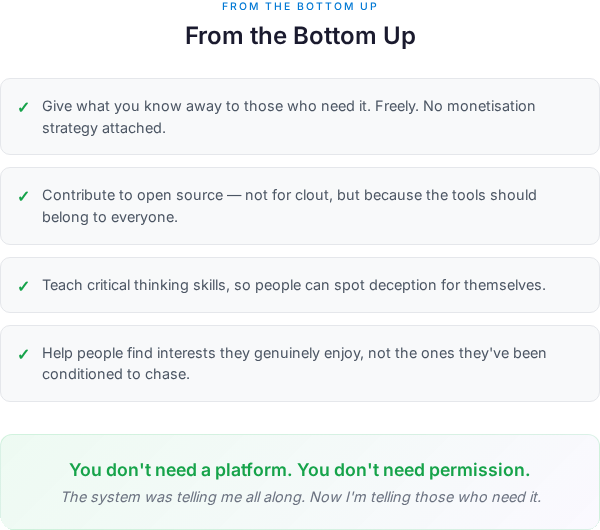
We help them navigate this shift. Not by telling them the system is broken — most of them already feel it, even if they can’t put words to it. We help them by sharing what we know. Freely. Selflessly. No greed, no ego, no monetisation strategy attached.
It looks like giving what you know away. Contributing to open source — not for clout, but because the tools should belong to everyone. Showing up in your local communities with time and knowledge, not a pitch deck on how to monetise it. Teach critical thinking skills, so people can spot deception and flaws in logic for themselves. Not so they think like you, but so they stop being easy targets for systems designed to exploit people who don’t question.
It looks like helping people learn. Not for credentials or career progression, but because learning is how you stop being a consumer of a system that was built to exploit you. Helping them find interests and possibilities they genuinely enjoy, not the ones they’ve been conditioned to chase. Teaching them to think, to question, to spot patterns — because honestly, we’re the best people to help them navigate change. We’ve been doing it our whole lives.
You don’t need a platform for this. You don’t need permission. You just need the skills you’ve already built and the willingness to give them away to others who have the desire to learn. Not just to corporations who already have it.
I spent years wondering why I was made this way. Why I couldn’t just follow the rules and be comfortable. Why did care so deeply for others? For what was fair and what was justice? Why couldn’t I just be like everyone else and pretend?
Now I know.
The system was telling me all along. And now I’m telling you.
Thank you for sharing and this is coming from the best of places but as I like to push on an idea to make sure it sticks, and my brain can’t help but agree with what your saying but contain it to consumerism/US where it’s more pronounced than anywhere else.
And I’m wondering, how do you think about other systems, ones that are more egalitarian like Scandinavia, or maybe more socialist like China. From this lens, you can see/feel that there are policies that genuinely feel like they are passed to ensure they have a healthy functioning society albeit the ultimate reason still can be power and regional hegemony as a country but I feel like it’s more… real. Curious to hear your thoughts 😊
I'm glad to have found these past couple post you've shared. Not that I enjoy seeing people struggle - just that when I can rub elbows with someone and say, I get it dude, it makes me feel a little better too.
Your point about teaching critical thinking hits home. In my area I feel obliged to remind people I know things like "Was it a reliable source?", "Did it come from a legitimate news website?", "Just because it's thought provoking in a meme format doesn't make it true". I'll skip complaining about the downsides of social media!
There's definitely a knowledge paywall anywhere you look.
Thanks for sharing.