
Don’t you see? We’re the Ones Trapped in Wonderland
Down the rabbit hole we go...

There’s a version of Alice in Wonderland that nobody talks about. Not the one where she escapes. The one where she doesn’t. The one where she grows up, and learns to shrink herself on cue, and eventually stops noticing the taste of the cake.
Lewis Carroll wrote a children’s story about a girl falling into a world of nonsense rules, arbitrary authority, and creatures trapped in loops they couldn’t name. We read it as fantasy. I think he was writing a field report about our current reality.
Prologue: The White Rabbit
Nobody forces Alice down the hole.
That’s the part we gloss over. She wasn’t pushed. She wasn’t lost. She was sitting in a field, bored by a book with no pictures, and something caught her eye — a rabbit, in a waistcoat, muttering about being late — and she followed it. Voluntarily. Curiously. With no real plan and no guarantee of anything on the other side.
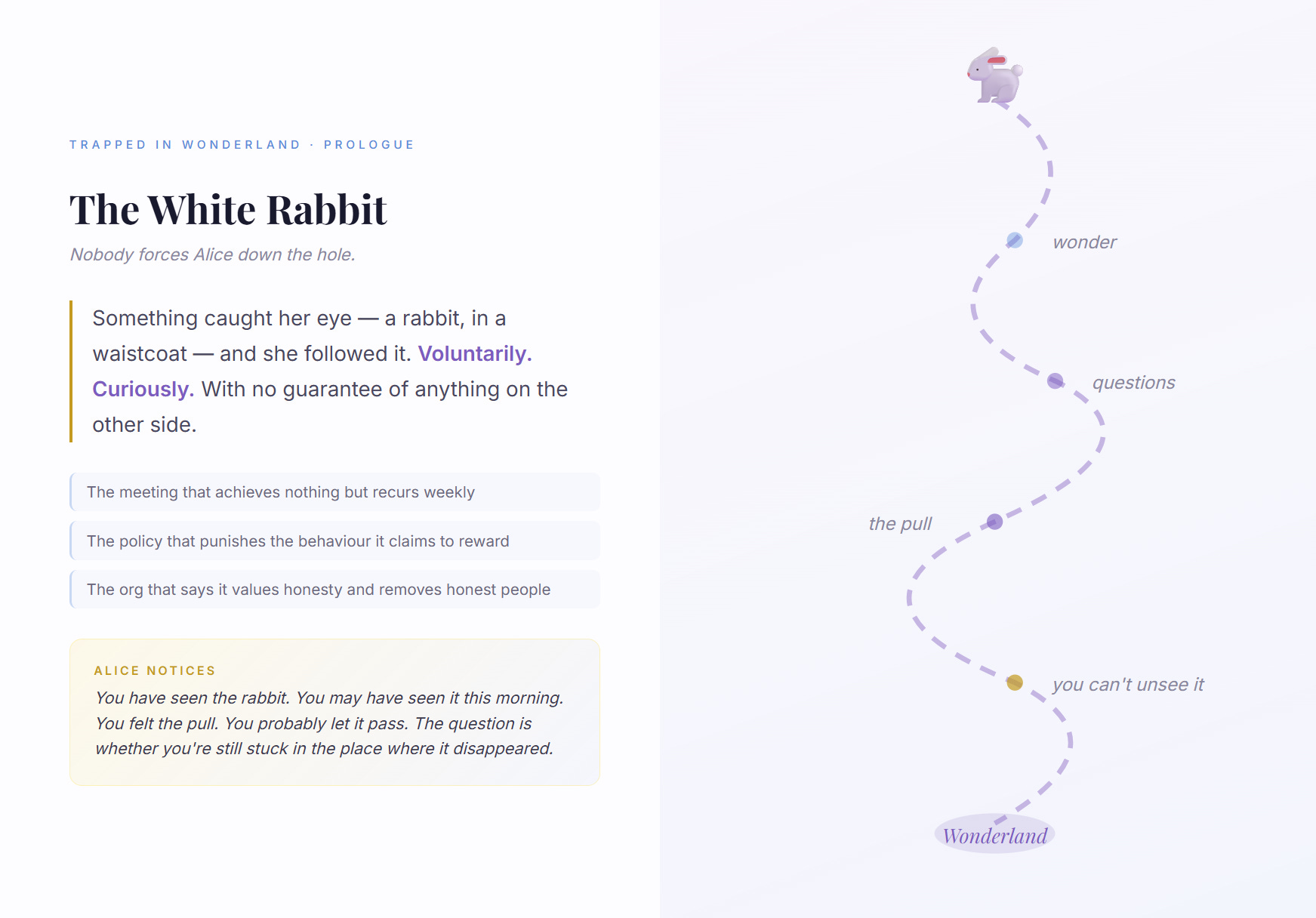
This is what wonder looks like before it has a name.
It is not a dramatic awakening. It is quieter than that. It is the moment you notice something doesn’t quite add up — a process that exists for no apparent reason, a rule nobody can explain the origin of, a room full of people nodding at something that seems, to you, obviously backwards — and instead of letting it pass, you tilt your head. You keep looking. You think: I want to know where that goes.
The clues are rarely dramatic. They are the meeting that achieves nothing but recurs weekly regardless. The policy that punishes exactly the behaviour it claims to reward. The organisation that says it values honesty and systematically removes honest people. The election that changes the faces and nothing else. The technology that promised liberation and delivered surveillance. They are hiding in plain sight — in the gap between what things are called and what they actually do, between the stated purpose and the observable outcome.
Most people see the rabbit.
Most people do not follow it.
Not because they’re incurious — but because they’ve learned, gradually and thoroughly, that following things leads to disruption. That asking why does this rule exist? is not a neutral question. That the tilt of the head is noticed. That wonder, in most rooms, is a mild social infraction that accumulates into a reputation.
So they watch the rabbit disappear and go back to the book.
The ones who follow — the ones who can’t quite help it, who feel the pull of the unanswered thing like a loose thread they have to trace — they are not braver, necessarily. They are just less able to pretend they didn’t see it. The clue was there, in plain sight, and it nagged. The desire for something better — for a world that makes more sense, that wastes less, that is more honest about what it is — mattered more than the comfort of staying on the bank.
This is not a gift, exactly. Following the rabbit is how you see you’re in Wonderland.
But it is also, eventually, how you find the door.
Alice notices: You have seen the rabbit. You may have seen it this morning — in a meeting, in a headline, in the gap between what someone said and what they meant. You felt the pull. You probably let it pass. This is not a failure. It is what Wonderland has trained you to do. The question is whether you are still stuck in the place where it disappeared.
Part I: Who are you?
The Caterpillar does not ask this cruelly. It asks it with genuine, unhurried curiosity, from a position of absolute certainty about its own nature — sitting on its mushroom, smoking, in no particular hurry to become anything else.
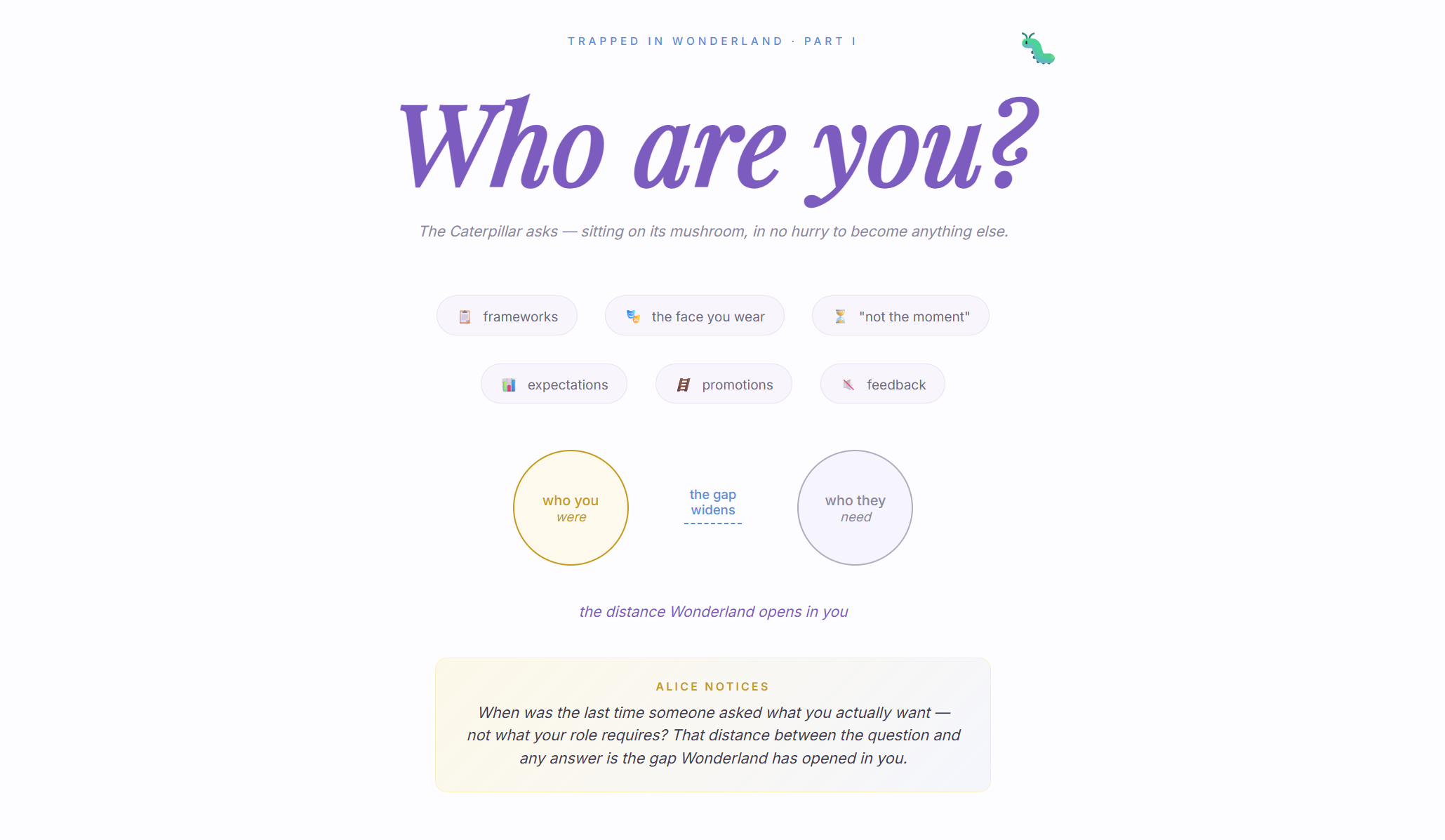
Who are you?
It is the first question Wonderland asks. And it is the most important one — because everything that follows depends on whether you can answer it. Whether you can hold onto yourself clearly enough, under sufficient pressure, to notice when the world is asking you to become something smaller.
A person who knows who they are is hard to shrink. They feel the wrongness of the loop. They notice when the potion is offered. They do not need the Queen’s approval to know whether they’ve done something wrong. Their sense of self is not contingent on the architecture of the room they’re in.
This is why Wonderland keeps interrupting the question.
Identity, in systems that require compliance, is a liability. The conditions for answering who are you? are never quite right — you’re always the wrong size, or in the wrong room, or being chased, or being told that this is not the moment, that there will be time for that later, that what matters right now is the task at hand. The question gets deferred. And deferred. And eventually you stop noticing it hasn’t been answered.
The pressure is not always overt. It arrives as expectation — the slow accumulation of other people’s ideas about what you should be, what you should want, what a person in your position reasonably looks like. It arrives as feedback, as performance frameworks, as the subtle grammar of which kinds of people get promoted and which kinds get managed out. It arrives as the face you learn to put on in certain rooms, and the growing, unexamined distance between that face and whatever is underneath it.
The Caterpillar does not have this problem. It knows exactly what it is — and it knows that what it is will change, and it is at peace with both facts simultaneously.
Transformation, the Caterpillar understands, requires stillness. You cannot become something truer while you are running. The chrysalis looks, from the outside, exactly like being stuck. It is not being stuck. It is the work that has to happen before the wings.
The ones who pause — who sit with the discomfort of not yet knowing, who resist the pressure to declare a fixed and legible self before they’ve actually found one, who refuse to let the room’s urgency become their own — are not lost.
They are the only ones who might, eventually, know the answer.
Alice notices: Think about the last time someone asked what you actually want. Not what you’re working towards, not what your role requires — what you actually want. Notice how long it takes to find the answer. Notice whether you find it at all. That distance between the question and the answer is the size of the gap Wonderland has opened in you. It is not permanent. But if you ignore it, the gap only widens.
Part II: Eat me. Drink me. Fit.
Alice’s first problem in Wonderland isn’t the danger — it’s the doors. They’re always the wrong size. And so the logic of the place immediately begins: you must change. There is never a conversation about widening the door.
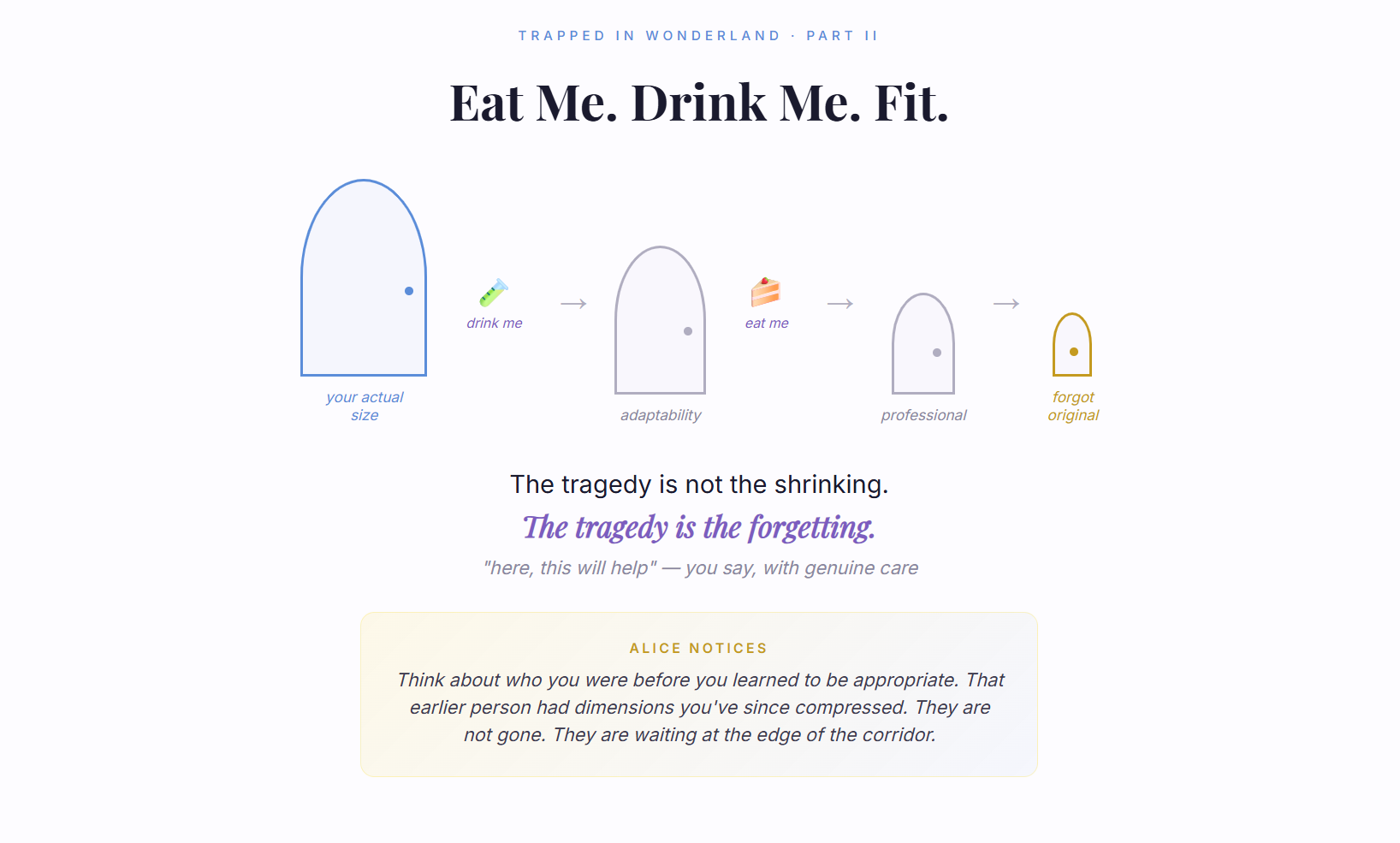
She drinks the potion and shrinks. She eats the cake and grows. She is perpetually calibrating herself against an architecture that was never built for her. And she does it without complaint, because the alternative is not getting through.
We call this adaptability. We call it professionalism. We call it growing up.
The ones who wonder — who ask questions that don’t fit the shape of the room, who see the door and think why is it so small? — they are handed a potion early. Sometimes it’s a formal diagnosis. Sometimes it’s a school report. Sometimes it’s just years of subtle cues: you’re a lot, you’re too much, you’re not quite right for this. Sometimes it’s the job description that specifies exactly which dimensions of a person are acceptable and which should be left at the door.
And so we drink. We become more legible. We compress our peripheral vision into something corridor-shaped. We learn that wondering, unchecked, is a liability — that the question why is the door this size? marks you, in Wonderland, as someone who does not understand how things work.
The tragedy is not the shrinking. People adapt; that is not inherently wrong. The tragedy is the forgetting. The point at which you no longer remember your original dimensions. The point at which the corridor feels like the natural width of things. The point at which you hand the potion to the next person and say — with complete sincerity, with genuine care — here, this will help.
This is not malice. Wonderland doesn’t need malice. It just needs its doors, it’s linear structures, and the people who have forgotten there was ever another way.
Alice notices: Think about who you were before you learned to be appropriate. Before you learned which questions to ask out loud and which to keep quiet. Before you understood which parts of yourself were assets and which were liabilities. That earlier person had dimensions you have since compressed. They are not gone. They are just waiting at the edge of the corridor, where the walls stop.
Part III: The right pill combination
Wonderland has pharmacology. It has rules about what you may take and when, and a great deal of social infrastructure around ensuring you take it.
Eat me. Drink me. Stay a manageable size.
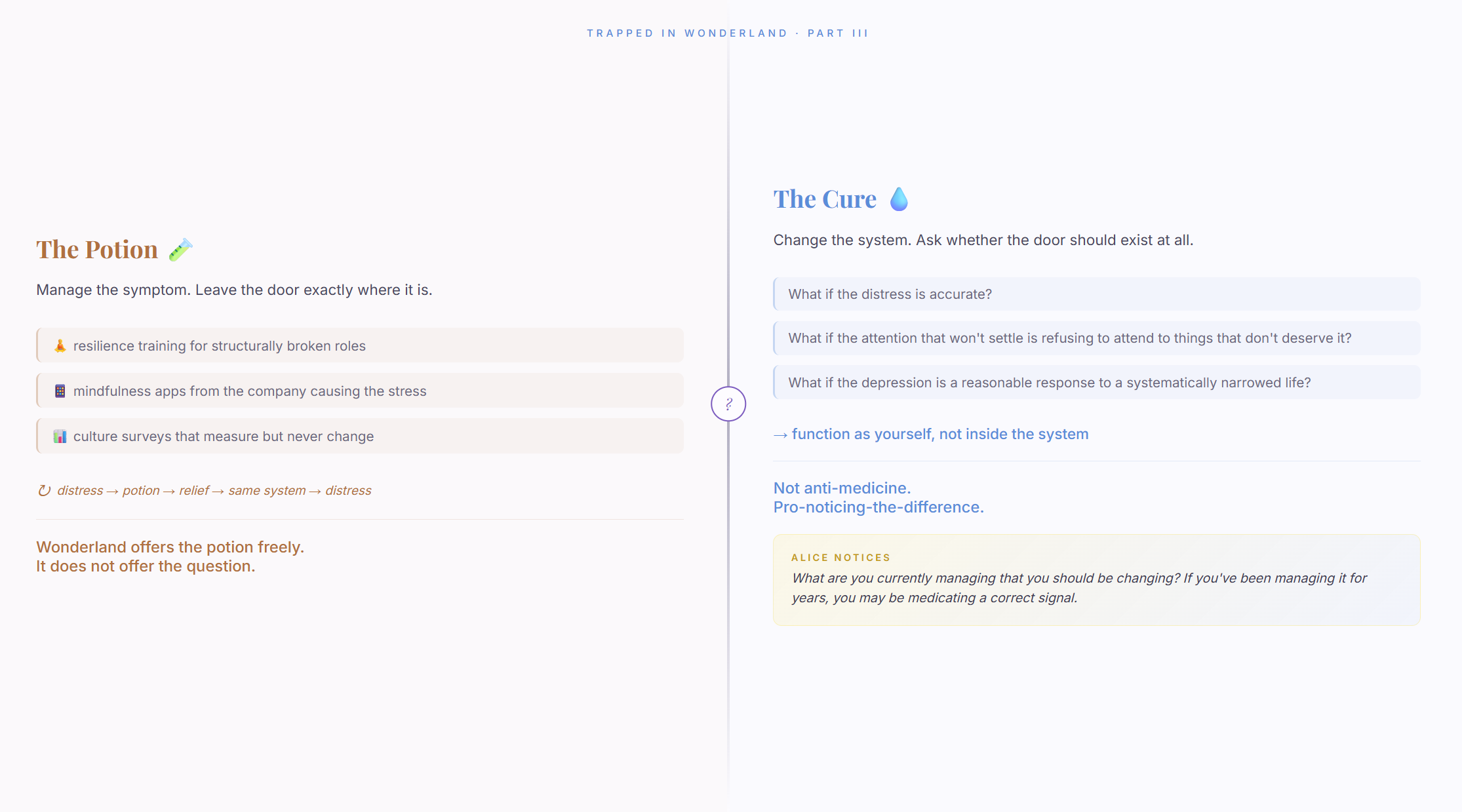
In the actual world, we medicate distress without investigating its architecture. Not always, and not cynically — often with genuine care, by people who are doing their best inside a system that has given them limited tools. But the question we rarely ask is: what if the distress is accurate? What if the anxiety is a correct reading of an incorrect situation? What if the attention that won’t settle is refusing to attend to things that do not deserve attention? What if the depression is a reasonable response to a life that has been systematically narrowed?
The potion that makes you smaller is not the same as a cure. Sometimes it is a compliance mechanism dressed in a prescription — a way of making the person fit the system, rather than asking whether the system is fit for the person.
I am not anti-medicine. I am pro-noticing-the-difference. The difference between this helps you function as yourself and this helps you function inside a system that was never designed for humans, without noticing the gap. The difference between treatment and management. Between care and maintenance.
The same logic runs through organisations. The corporate wellness programme that offers resilience training to people in structurally broken roles. The mindfulness app provided by the company whose processes are the source of the stress. The culture survey that measures engagement without examining what people are being asked to engage with. These are not cynical — most of the people who design them mean well. But they are, functionally, potions. They address the symptom. They leave the door exactly where it is.
Wonderland offers the potion freely. It does not offer the question.
Alice notices: Ask yourself what you are currently managing that you should probably be changing. The distinction matters. Managing is the potion — it makes the situation liveable without making it different. There is a place for management. But if you have been managing something for years without asking whether it should exist at all, you may be medicating a correct signal. The discomfort might be the most honest thing.
Part IV: The Dormouse
The Dormouse is asleep at the table. It is woken, periodically, to be used — stuffed into a teapot, cited in an argument, made to tell the beginning of a story it will not finish — and then it goes back to sleep.
It does not suffer, exactly. It simply is not present.
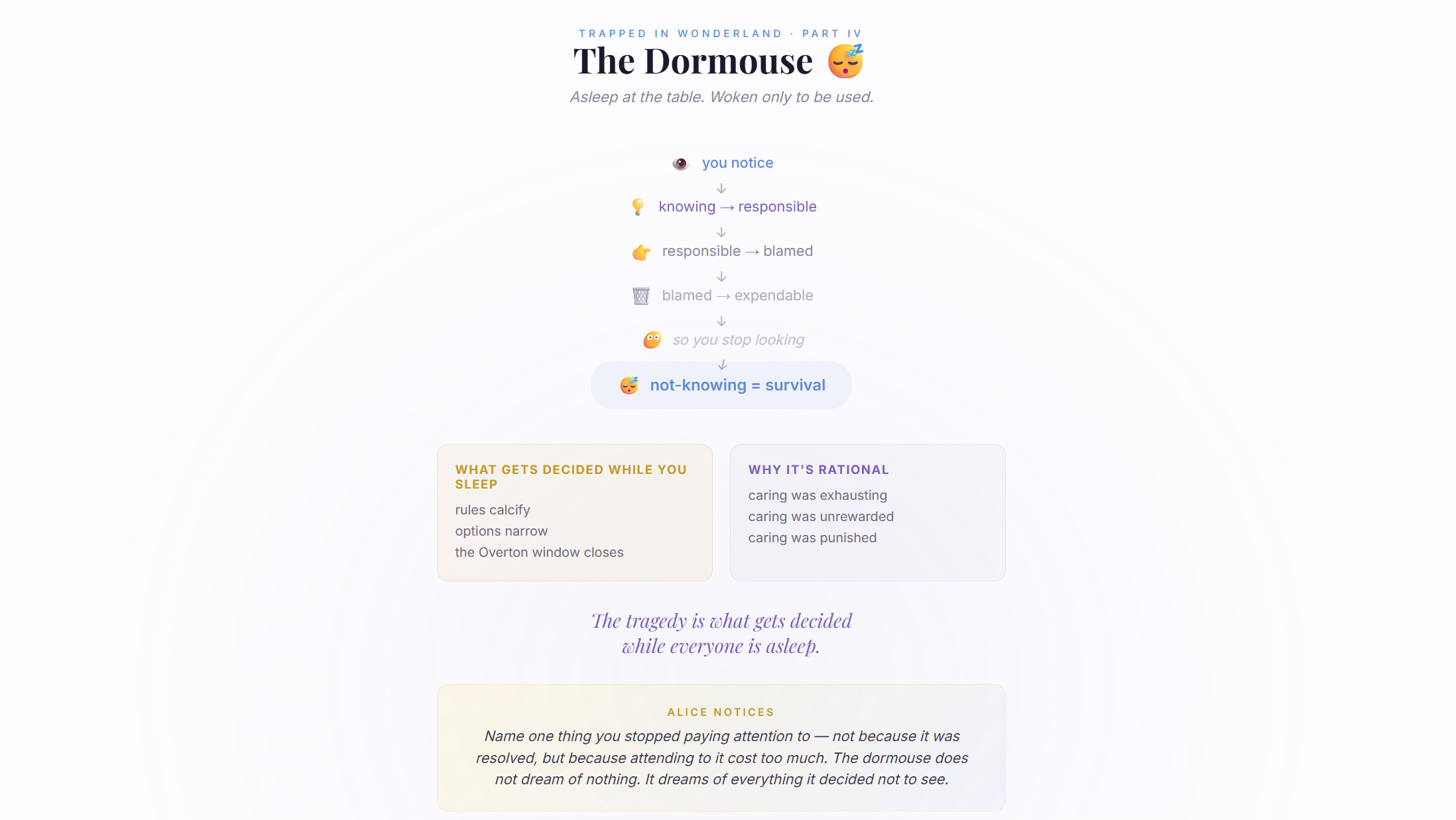
We have a great tolerance for dormice. We mistake their absence for peace, their silence for agreement, their closed eyes for contentment. An organisation where nobody complains is not necessarily a healthy one — it may simply be one where the cost of waking up has been made prohibitive. A democracy where turnout is falling is not a satisfied electorate — it may be one that has learned, through repeated experience, that participation changes nothing.
Wilful unawareness is not stupidity. It is often a rational response to an environment that punishes awareness. If knowing means being responsible, and being responsible means being blamed, and being blamed means being expendable — then not-knowing is a survival strategy. The Dormouse did not choose sleep arbitrarily. Something in Wonderland made sleep the safest option. Something taught it that the cost of being present was higher than the cost of missing everything.
What gets decided while everyone is asleep is not nothing. It is, in fact, everything. The cups that never get washed. The rules that calcify into the furniture. The slow narrowing of what is considered possible, what is considered normal, what is considered worth questioning. The Overton window closes incrementally, and each increment happens in a room where most of the inhabitants are not paying attention — not because they don’t care, but because caring, visibly and consistently, turned out to be exhausting and unrewarded.
The tragedy is not the sleeping. The tragedy is what gets decided while everyone is asleep — and who stays awake to decide it.
Wonderland runs on dormice. They are its most essential infrastructure. And they are, in their own way, trapped just as thoroughly as anyone else at the table — just more quietly, and with better dreams.
Alice notices: There are things you have stopped paying attention to — not because they were resolved, but because attending to them cost too much and changed too little. Name one. Just one. Not to fix it right now, but to remember that you chose to stop watching, and that the choosing was not the same as the thing going away. The dormouse does not dream of nothing. It dreams of everything it decided not to see.
Part V: The Cheshire Cat knows exactly what it’s doing
The Cat is the most dangerous creature in Wonderland, and we consistently mistake it for a friendly one.
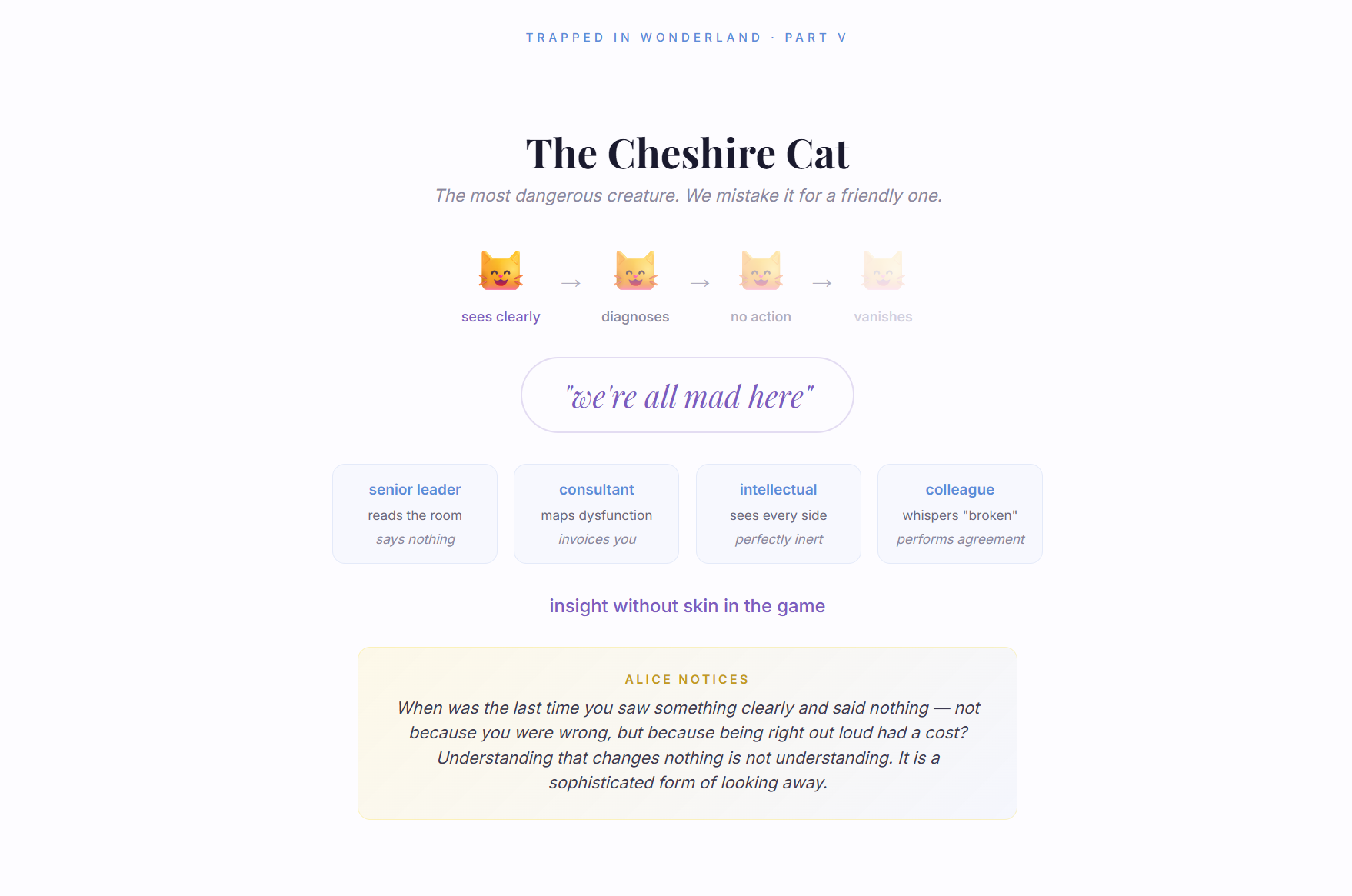
It appears when you’re lost. It offers direction. It grins. And then it says something like: we’re all mad here — and disappears, leaving you with the observation but none of the obligation. It has diagnosed the problem with perfect clarity and opted out of doing anything about it.
We know people like this. The senior person in the room who reads the situation faster than anyone else and says nothing consequential. The commentator who is never wrong because they never commit to a falsifiable position. The consultant who maps the dysfunction in forensic detail, writes it into a beautifully formatted report, and invoices you before the ink is dry. The intellectual who sees every side of every argument so thoroughly that they have become, in practice, perfectly inert. The colleague who whispers this place is broken in the corridor and then walks into the meeting and performs agreement.
We know institutions like this too. The think tank that produces landmark research on inequality and hosts dinners for the people who perpetuate it. The foundation that funds studies into the damage caused by industries its donors built. The advisory board that meets quarterly to note, with great sophistication, that things are getting worse.
The Cat’s wisdom is real. That’s what makes it corrosive. It is not ignorance — it is insight without skin in the game. And it is seductive, because it looks like perspective. It looks like the view from above, the long lens, the mature refusal to be swept up in easy certainties. What it actually is, is a way of being right without being responsible. A way of inhabiting understanding without letting understanding cost you anything.
The grin that remains after the body has gone is not enlightenment. It is the smirk of someone who understood the stakes clearly enough to make sure they were never at risk.
Wonderland is full of Cheshire Cats. And every one of them will tell you, cheerfully and correctly, that you can’t help that — we’re all mad here.
Alice notices: Think about the last time you saw something clearly and said nothing. Not because you were wrong — because you were right, and being right out loud had a cost you weren’t ready to pay. That is the Cat in you. It is not shameful. It is human. But notice how long you have been grinning from a distance at things that needed more than a diagnosis. Understanding that changes nothing is not understanding. It is a very sophisticated form of looking away.
Part VI: Eat the cake
The cake does not say eat me to shrink you. It says eat me to make you bigger — more visible, more recognised, more rewarded. It is the thing Wonderland offers to the people who have learned to play the game well. The promotion. The title. The platform. The seat at the table you always wanted.
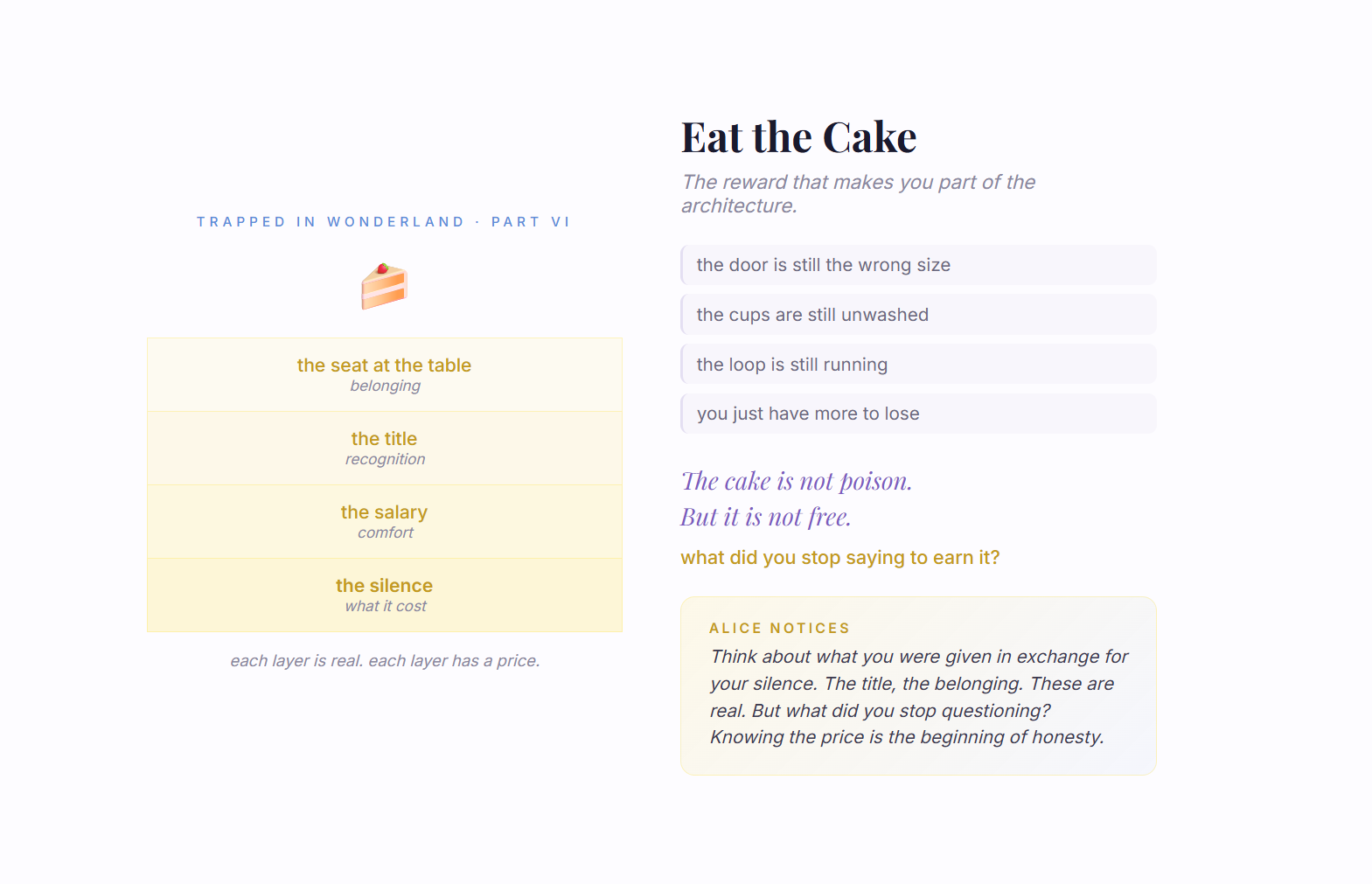
And it works. That is the important thing to understand. The cake is real. The growth it produces is real. The status, the comfort, the sense of arrival — these are not illusions. Wonderland is not stingy with its rewards. It is extraordinarily generous to the people who make themselves useful to it.
But notice what the cake does not change. The door is still the wrong size. The cups are still unwashed. The trial is still absurd. The loop is still running. You are simply larger within it now — which means you have more to lose by naming what you see, more invested in the continuation of the game, more reason to become, quietly and gradually, a Cheshire Cat yourself.
This is how Wonderland reproduces its leadership. Not by promoting the most compliant people — it is subtler than that. It promotes the most capable people who have also learned not to push too hard on the things that matter. Who have learned to choose their battles. Who have learned that the system rewards those who work within it and manages out those who challenge it at the root. Who have learned, in other words, to be useful without being dangerous.
The cake is the moment the system stops needing to shrink you, because you have grown into its shape instead.
The cruelest thing about the cake is that by the time you are eating it, it tastes like you earned it. And you did. That is exactly the problem.
Alice notices: Think about what you have been given in exchange for your silence, your patience, your willingness to work within the frame. The title, the salary, the recognition, the belonging. These things are real and you worked for them and you are allowed to value them. But ask yourself honestly: what did you stop saying, stop questioning, stop pushing on, in the process of earning them? What did you leave at the door to get through it? The cake is not poison. But it is not free either. Knowing the price is not the same as refusing to pay it. It is just the beginning of being honest about the transaction.
Part VII: Tweedledee and Tweedledum
They are always arguing. They are always, in the end, the same.
Carroll understood something that we are still struggling to name: that apparent opposites can share identical logic. That the argument can be real — loud, passionate, occasionally violent — and still take place entirely within a frame that neither side has thought to question.
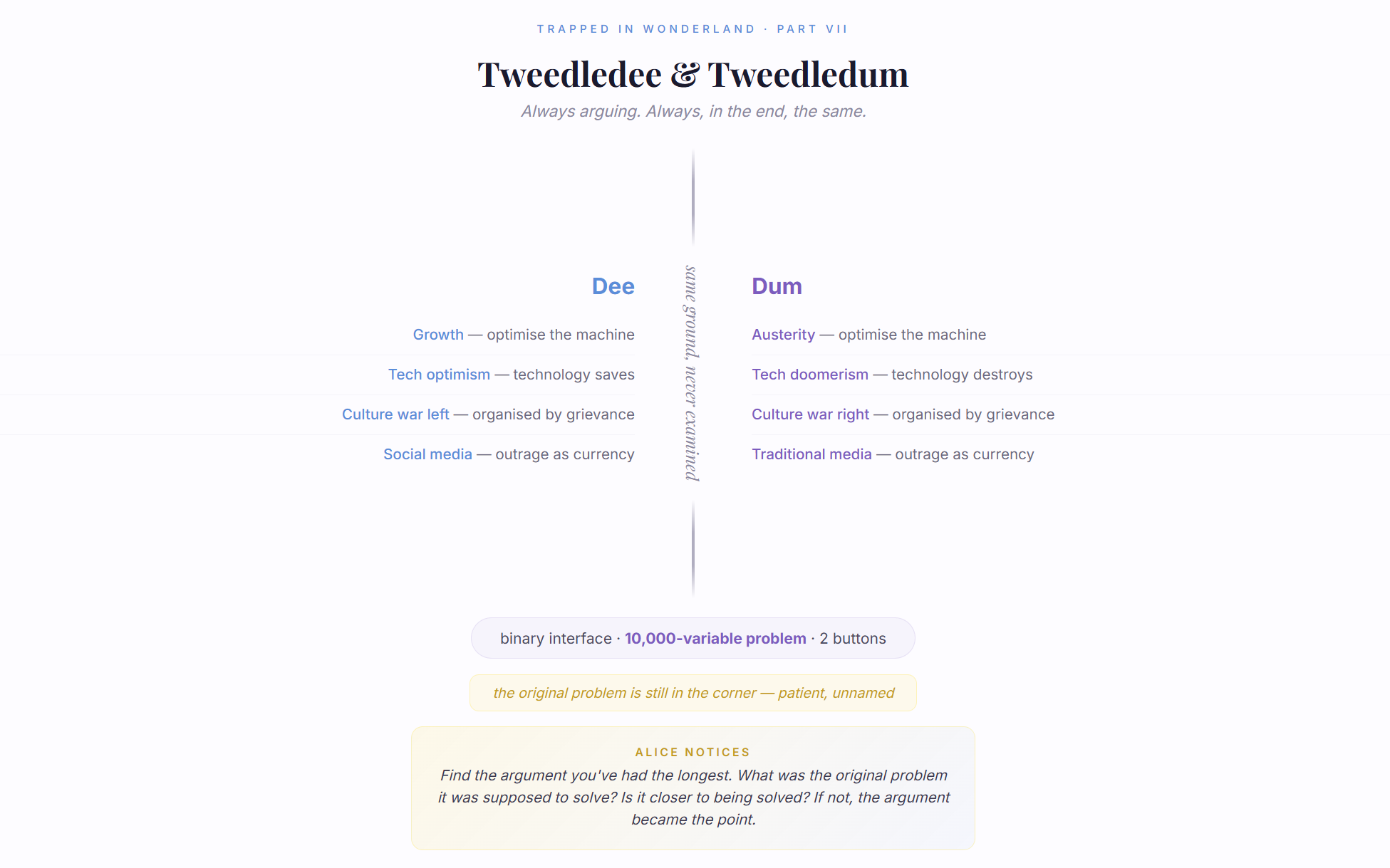
Growth versus austerity — both assuming that the economy is a machine to be optimised rather than a set of choices about who gets what. Tech optimism versus tech doomerism — both assuming that the technology is the variable, rather than the political economy that deploys it. Culture war left versus culture war right — both organised around grievance, both dependent on the other’s existence for their own coherence, both incapable of asking what would happen if the war ended. Traditional media versus social media — both competing for attention, both discovering that outrage is the most reliable currency, both arriving at the same product by different routes.
The debates are genuine. The participants are sincere. The stakes are sometimes real. And the frame — the room, the table, the logic of Wonderland itself — stays exactly where it is.
Tweedledee and Tweedledum will fight about anything except the ground they’re standing on. Because the ground they’re standing on is the only thing they share without argument — which means it is the one thing that never gets examined.
But here is what Carroll could not quite have anticipated, and what we have since perfected: the argument itself becomes the distraction. The fighting is so consuming, so identity-defining, so genuinely felt — that no one notices that while they have been arguing, the original problem has been quietly left in the corner. Not solved. Not even properly named. Just abandoned in favour of the much more pressing question of who is winning.
This is what it looks like to try to solve a complex system with a binary interface.
The problems we actually face — climate, inequality, failing public infrastructure, the concentration of power in technology, the erosion of institutional trust — are not binary problems. They are deeply, irreducibly complex. They have multiple causes operating at multiple scales simultaneously. They resist simple attribution. They require holding contradictions, updating on evidence, tolerating ambiguity, and acting anyway. They require, in short, the kind of thinking that a two-sided argument is structurally incapable of producing.
And yet the binary is what we have built. Two parties. Two positions. Two buttons. Yes or no. With us or against us. The interface has two inputs, and we are trying to navigate a system with ten thousand variables through it.
A thermostat is a binary interface. It reads the temperature and switches the heat on or off. It is a perfectly adequate solution to the problem of a cold room. It is not an adequate solution to the problem of a changing climate, or a broken economy, or a generation that cannot afford to live in the cities where the work is. These are not thermostat problems. But we keep reaching for the thermostat, because it is what we have, and because the argument about which setting is correct is at least familiar and bounded and possible to win.
The false binary is not always a conspiracy. More often it is a failure of imagination — the genuine inability to conceive that the interface itself might be inadequate. That the question which of these two options? is sometimes the wrong question. Not because the options are both bad, but because the problem was never two-dimensional in the first place, and forcing it into two dimensions has already lost most of the information you need to solve it.
The ones who say I don’t think those are the only options are not being difficult, or evasive, or naively above it all. They are, in the most literal sense, looking at a different part of the room. They are pointing at the complexity that the binary has been quietly discarding. This tends to make everyone at the current argument deeply uncomfortable — which is usually taken as evidence that they’re wrong, and is in fact evidence of the opposite.
Tweedledee and Tweedledum are still fighting. The rattle is wonderful. Neither of them has looked up to notice what the argument was actually supposed to be about.
Alice notices: Find the argument you have been having the longest — with someone else, or inside yourself. Now ask: what was the original problem this argument was supposed to solve? Is that problem closer to being solved than when the argument began? If not, the argument may have become the point. The rattle is comfortable. The original problem is still in the corner. It has been there a long time. It is patient.
Part VIII: The Looking Glass
In the mirror world, you have to run as fast as you can just to stay in the same place. To get somewhere else, you must walk away from it. Logic is inverted. Effect precedes cause. The jam is always yesterday or tomorrow, never today.
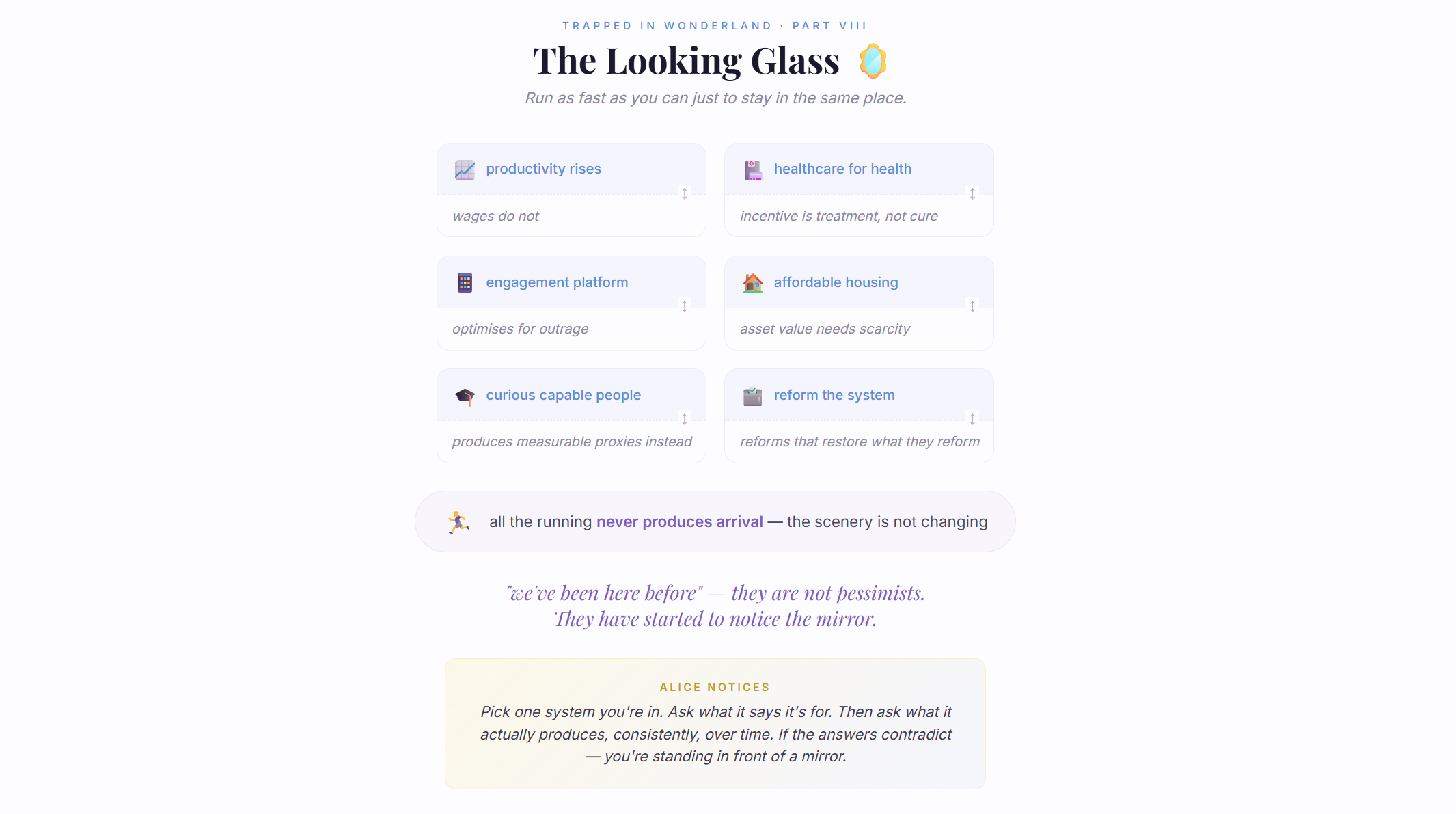
Carroll wrote this as a sequel. I think he meant it as a diagnosis of adulthood — of the specific madness of systems that have decoupled their stated purpose from their actual function, and kept running anyway.
We live, increasingly, in looking-glass systems. Economies where productivity rises and wages do not. Healthcare systems where the structural incentive is treatment rather than health, because health does not require a return visit. Attention economies where the product is your attention and the signal that optimises for engagement turns out, at scale, to optimise for outrage — not because anyone wanted that, but because outrage is stickier, and the mirror doesn’t distinguish. Education systems that were designed to produce curious, capable people and have gradually, under the pressure of measurement and accountability, optimised for the production of measurable proxies for curious capable people, which is a different thing entirely. Housing markets in which the asset value of a home depends on other people not being able to afford one.
Each one a mirror-logic: the official purpose and the actual function running in opposite directions, and everyone inside too busy running just to stay still to stop and map the geometry.
The looking glass is more insidious than Wonderland proper, because it looks almost right. The words are the same. The institutions have the same names. The people inside them are, largely, trying. It is only when you track the outcomes over time — when you notice that all the running never seems to produce arrival, that the reforms always seem to restore what they were reforming, that the progress keeps returning to the same place — that the inversion becomes visible.
The ones who say we’ve been here before are not pessimists. They are not obstacles to progress. They are people who have started to notice the mirror — who have run long enough and hard enough to observe that the scenery is not changing, and have had the courage to say so in a room full of people still convinced that the next sprint will be the one that does it.
Alice notices: Pick one system you participate in — a workplace, a platform, a political process, a market. Ask what it says it is for. Then ask what it actually produces, consistently, over time, regardless of who is running it or what they intend. If the answer to the second question contradicts the first, you are standing in front of a mirror. The question is not whether to be angry about it. The question is whether you can see the glass.
Part IX: The Mad Hatter is not mad. He is stuck.
The Hatter has been at his tea party since time broke. It’s always six o’clock. The cups are never washed. He moves from seat to seat — not because it helps, but because movement is the only thing that feels like it isn’t stillness.
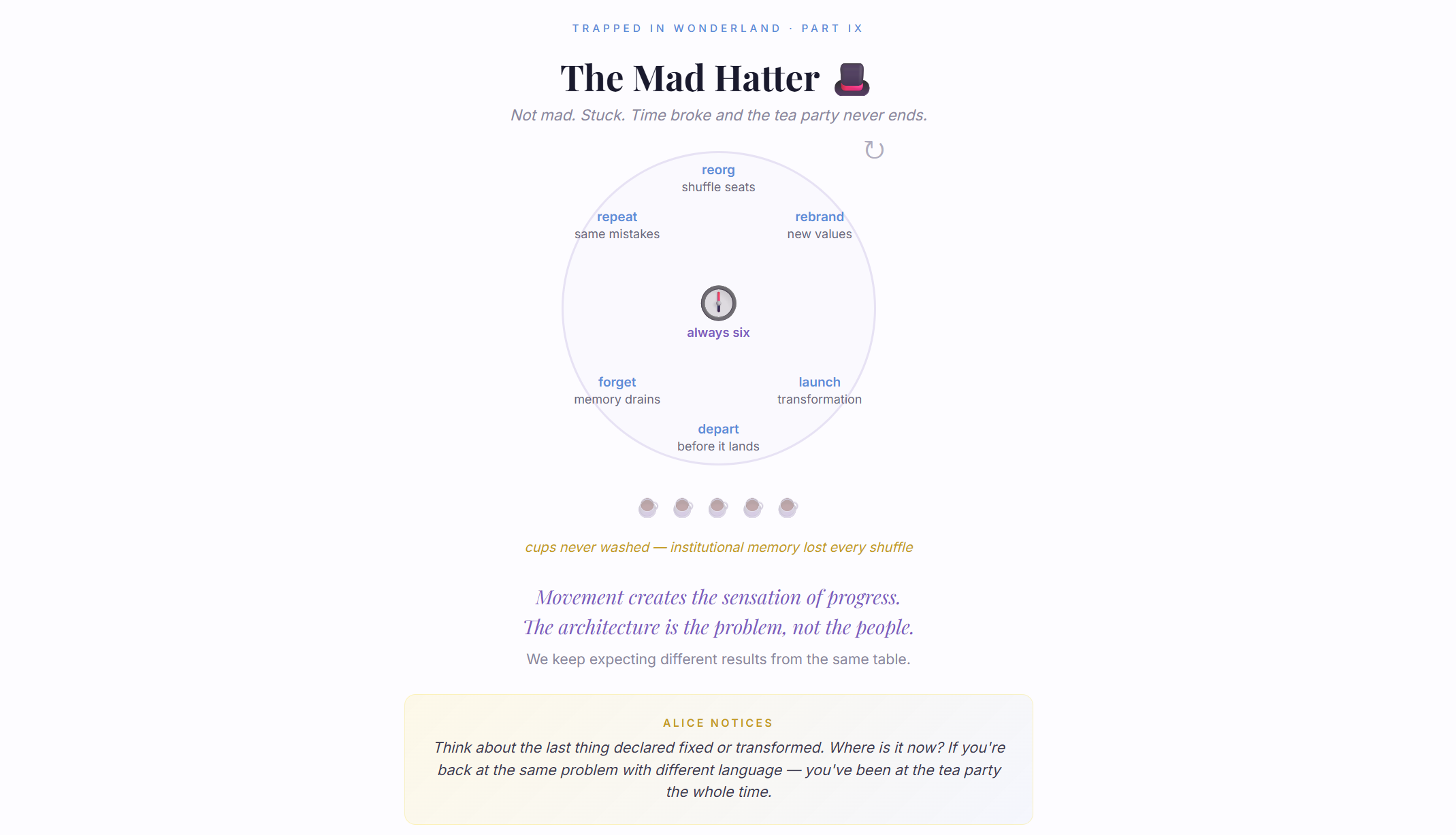
This is what a trauma loop looks like from the outside: frantic, performative, occasionally charming, and completely frozen underneath.
We are surrounded by Mad Hatters. People whose coping mechanisms became their personality before they had the language to tell the difference. People in reactive organisations — lurching from crisis to crisis, never washing the cups, always shuffling seats — and calling it agility. People who were hurt by a system a long time ago and have since become very, very good at operating inside it, mistaking fluency for freedom.
The Hatter is not villainous. He is exhausted. He is also, in his exhaustion, dangerous — because he cannot stop, and he cannot be still, and the tea party he hosts is a closed loop that swallows everyone who sits down at it.
We build institutions in his image. We call it culture.
Consider the large company. Time, inside a large company, is not continuous — it moves in cycles. Quarterly targets. Annual reviews. Five-year strategies that are quietly retired after two. The table is enormous, the tea perpetually stewing, and the ritual is the point. Reorganisations happen not because the structure was wrong but because movement creates the sensation of progress. New leadership arrives, shuffles the seats, rebrands the values, launches a transformation programme, and departs before the cups need washing. The institutional memory — the accumulated understanding of why things are the way they are, what was tried before, what the actual constraints are — drains away with every shuffle, and the next person around the table starts again from the beginning, reinventing the same wheels, making the same mistakes, calling them innovations.
The tea party is not a failure of the people in it. It is a failure of the architecture. When no one stays long enough to be accountable for outcomes — when incentives reward the appearance of movement over the reality of change, when the structure selects for people who are comfortable with ritual over those who are comfortable with stillness and depth — you do not get transformation. You get an endless, elegant, well-catered loop.
And then there is democracy. The four-year cycle is, in its way, the most institutionalised tea party in existence. Every few years, the seats are shuffled. New faces, new slogans, new crockery — same table, same cold tea. The problems that require ten or twenty years of consistent, unglamorous effort — infrastructure, education, climate, public health, housing — are structurally incompatible with a system whose participants are perpetually optimising for the next election. The horizon is always four years away. The cups are never washed because washing the cups does not win votes. The long game is not playable inside a short-game architecture.
This is not a partisan observation. It is a structural one. The Hatter is not Labour or Conservative, Democrat or Republican. The Hatter is the cycle itself — the way the architecture of short-termism produces reactive lurching regardless of who is sitting in the chair. You could replace every politician in every parliament tomorrow with people of perfect integrity and enormous competence, and if the incentive structure remains unchanged, the tea party continues. A different cast performing the same ritual at the same table, with the same cold tea, at the same stuck hour.
The tragedy is that we keep expecting different results from the same table. We campaign for better hatters. We argue about which direction to move the seats. We do not ask why time broke, or whether it could be fixed, or whether the party itself might be the problem.
Alice notices: Think about the last time something was declared fixed, transformed, or solved in an organisation or institution you belong to. Then ask where it is now. If you are back at the same problem with different language around it, you have been at the tea party the whole time. The cups are still unwashed. The question is not whether you are tired of moving seats. The question is whether you are ready to stop, look at the clock and start to focus on your own station.
Part X: Off with their heads
The Queen of Hearts is the clearest character in the book, which is perhaps why we remember her as a cartoon. She is not complicated. She has one mode: enforcement. Rules exist because she says they do. Violations are capital. The trial comes before the evidence.
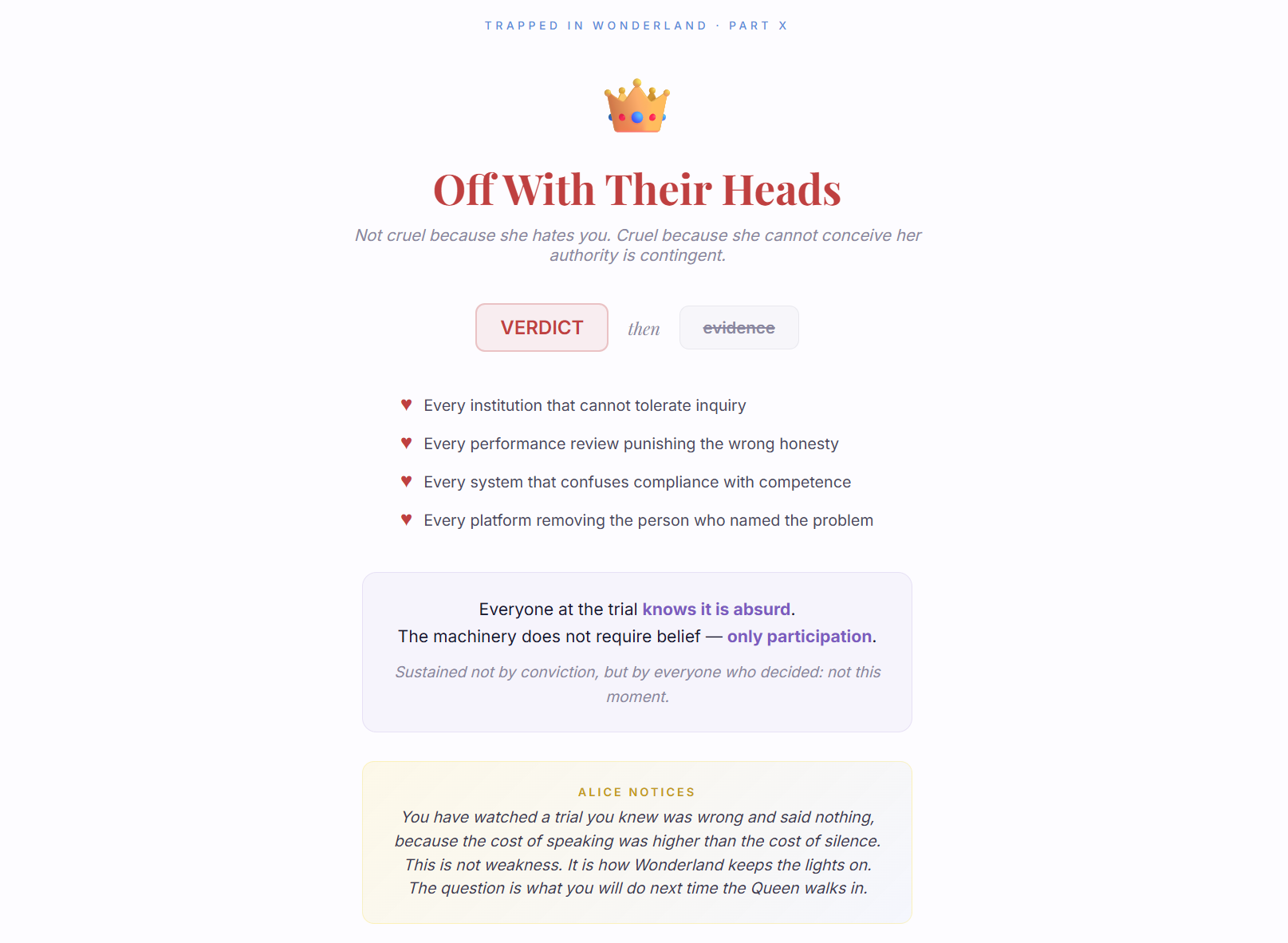
She is every institution that cannot tolerate inquiry. Every performance review that punishes the wrong kind of honesty. Every meeting where the hierarchy is legible in who is allowed to finish their sentences. Every system that confuses compliance with competence, and silence with consent. Every platform that removes the person who named the problem rather than addressing the problem they named.
The Queen’s court is not cruel because it hates you. It is cruel because it cannot conceive of a world where its own authority is contingent. It has no epistemology. It has only verdict. It cannot ask am I right? because the question contains, as a possibility, an answer it cannot survive.
This is why the Queen and the Hatter are, in the end, the same system. The Hatter keeps the loop running. The Queen ensures that no one steps outside it. The tea party is the structure; the Queen is the structure’s immune response. She does not need to understand what she’s protecting. She only needs to identify the threat and remove it.
And here is the thing about Wonderland that Carroll understood, that we have mostly forgotten: everyone at the trial knows it is absurd. The witnesses know. The jury knows. Alice knows. And still the trial proceeds, because the machinery of institutional authority does not require belief — only participation. You do not have to think the Queen is right to stand up when she enters the room. You only have to be present in a room where standing is what people do.
This is how the loop sustains itself. Not through conviction. Through the accumulated weight of everyone who decided, quietly, that this was not the moment.
Alice notices: You have stood up when someone entered the room. You have said the expected thing in the expected tone. You have watched a trial you knew was wrong and said nothing, because the cost of speaking was higher than the cost of silence, and you needed to still be in the room tomorrow. This is not weakness. It is how Wonderland keeps the lights on. The question is not whether you have ever done this. You have. We all have. The question is whether you know, clearly and without flinching, that you did it — and what you are willing to do instead, next time the Queen walks in.
Coda: The door was always the wrong size
Alice eventually shouts: you’re nothing but a pack of cards.
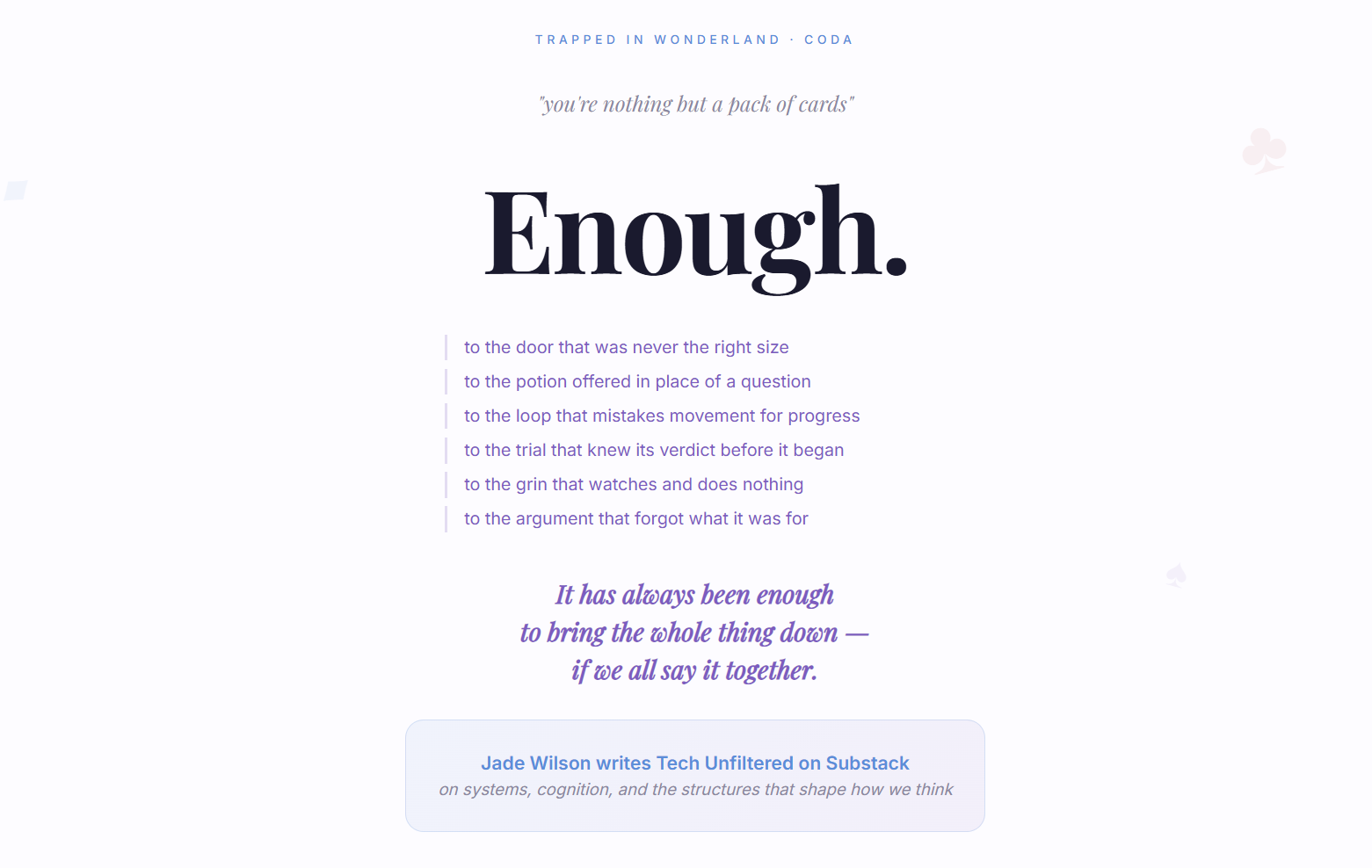
And Wonderland collapses.
She does not produce a better system. She does not table a proposal. She does not form a working group or submit a report or wait for the right moment or ask permission. She looks at the whole elaborate machinery — the Queen, the court, the verdict, the creatures — and she names what she actually sees: nothing but a pack of cards.
That is the whole move. Not an argument. Not a reform. Just the plain truth, stated clearly, to something that had been pretending to be more than it was. And it is enough.
Not because saying enough fixes everything. The world outside Wonderland is not simple, or safe, or already built for curious people who ask too many questions. There is no door on the other side that is the right size. There is just the open air, and the work of building something better, and the knowledge that you are doing it as your actual size for the first time in a long time.
But the cards do fall. Every time. That is the one thing Carroll is unambiguous about. The whole elaborate machinery — the Queen, the Hatter, the potions, the trial, the creatures running their loops — it is held together by participation. By the accumulated weight of people who decided, quietly and reasonably and understandably, that this was not the moment. The moment you withdraw that participation, clearly and without performance, the architecture has nothing to stand on.
The ones who wonder — who always saw the door was wrong, who drank the potion and quietly mourned their own dimensions, who sat at the tea party and felt the wrongness of the loop, who followed the rabbit when every sensible instinct said stay on the bank — they are not the problem. They are the pack of cards waiting to fall. They just need someone to remember their own size long enough to say the word.
We are not in Wonderland because we lack imagination.
We are in Wonderland because we were taught that the door is fixed, that the trial is inevitable, that the tea party is just how things are, that the Queen’s authority is real, that the rabbit wasn’t worth following.
The only way out is to stop and to say enough.
To the door that was never the right size. To the potion offered in place of a question. To the loop that mistakes movement for progress. To the trial that knew its verdict before it began. To the grin that watches and does nothing. To the argument that forgot what it was for.
Enough.
It is a small word. It has always been enough to bring the whole thing down — if we all say it together, and if we remember who the real enemy is. Not the Hatter, exhausted at his table. Not the Dormouse, dreaming of everything it chose not to see. Not even the Queen, enforcing rules she never thought to question. The enemy is the architecture. The loop. The door that was always the wrong size and the system that convinced us the problem was our height. That is what we are saying enough to. That is what falls, when we all start to see it and do something to change it.
Jade Wilson writes Tech Unfiltered on Substack — on systems, cognition, and the structures that shape how we think.
Nice work. There is a lot here, so I will keep coming back. I'm pretty sure that this is my favorite thing anybody has ever put on LinkedIn (pointed to Substack), because this is my favorite story. Thank you for writing this.