

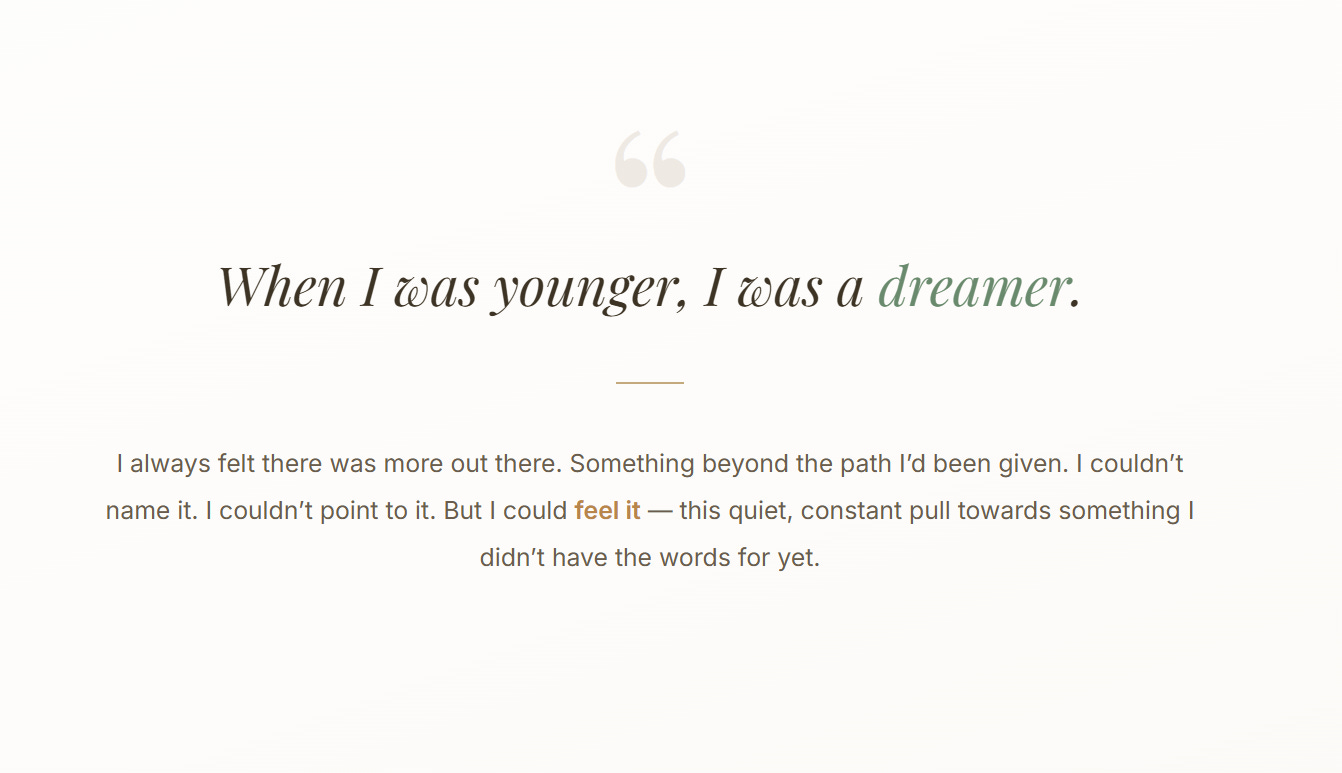
When I was younger, I was a dreamer.
I always felt there was more out there… Something beyond the path I’d been given. I couldn’t name it. I couldn’t point to it. But I could feel it — this quiet, constant pull towards something I didn’t have the words for yet.
And slowly, I learned to stop looking. Stay put. Stay quiet. Follow the rules. Be happy with what you’ve got.
But the dreaming never stopped. The pull towards something more kept coming back, no matter how many times I pushed it down. It was like trying to hold something underwater. You can do it for a while, but it always wants to surface.
I would dream about everything. I wondered how the leaves in my hand were made, how their lines and edges caused a perfect symmetry. I wondered how the roads were constructed and how long they took to build. I pictured my life as the characters in the books I read and I could feel their emotions flow through me. I remember loving to sing, to build. I loved learning and mathematics… and everything in between.
The world was endlessly fascinating to me. Every object had a story. Every system had a logic. Every question led to another question, and I never wanted to stop pulling the thread. I didn’t know that was unusual. I thought everyone’s brain worked like that.
And I remember being made fun of. Feeling so silly and stupid for liking what I did, for singing to myself, for not understanding the question. For being so weird in a world that rewarded the opposite. For caring about things that nobody else seemed to care about and not caring about the things everyone else thought mattered.
The Forgetting
And slowly… I forgot who I was.
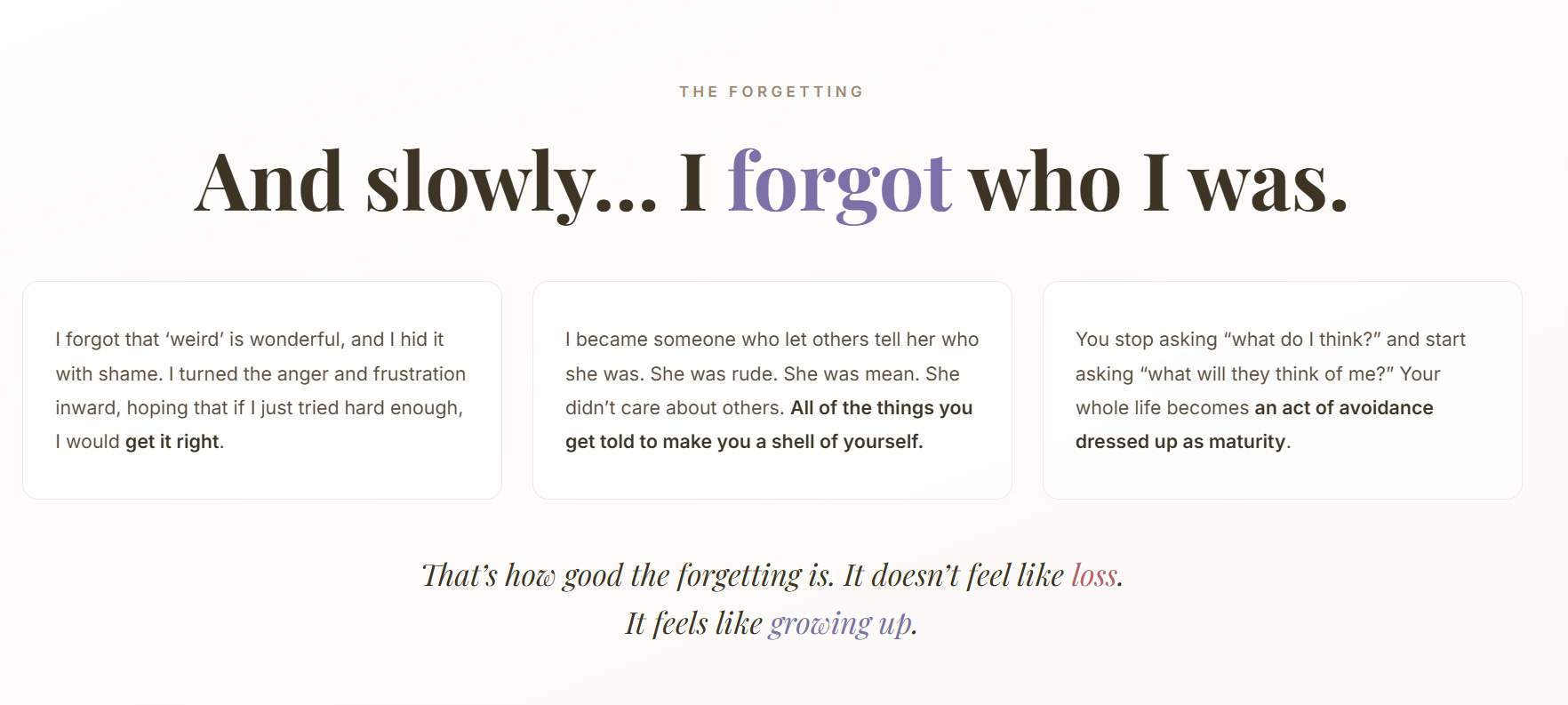
I forgot that ‘weird’ is wonderful, and I hid it with shame. I turned the anger and frustration inward, hoping that if I just tried hard enough, I would get it right. If I just studied the rules closely enough, mimicked the right people, said the right things at the right time — I could crack the code. I could be normal.
But there was never going to be a getting it right, because everything I tried to do to fit in, stopped me from remembering who I was.
I became someone who let others tell her who she was. She was rude. She was mean. She didn’t care about others. She was selfish. She was irrational, erratic, incoherent. All of the things you get told to make you a shell of yourself.
And when you hear it enough, you start to believe it. You stop trusting your own judgement because someone else has already decided what your intentions are. You stop speaking up because the words get twisted into something you didn’t mean. You stop showing up as yourself because yourself has been described back to you so many times in a voice that isn’t yours that you can’t remember what your own voice sounds like.
That’s the real damage. Not the insults themselves — you can survive those. It’s the way they replace your inner voice with theirs. You stop asking “what do I think?” and start asking “what will they think of me?” You stop moving towards the things you love and start moving away from the things that might get you noticed. Your whole life becomes an act of avoidance dressed up as maturity.
I became someone quieter. Someone who nodded along and kept the interesting thoughts for later — except later never came. Someone who measured their worth by how well they blended in, not by what they actually thought or felt or saw.
And the strangest part is that I didn’t even notice it happening. That’s how good the forgetting is. It doesn’t feel like loss. It feels like growing up. It feels like getting sensible. It feels like finally learning how the world works. And everyone around you reinforces it because a quieter you is an easier you, and easier is what the world rewards.
But this isn’t just my story. It’s yours too.
Before The Mask
Think back. Before the job title. Before the responsibilities. Before you learned which parts of yourself were acceptable and which ones needed to be tucked away. Before the mortgage, the commute, the performance reviews, the careful management of how other people perceive you. Before the mask.
What did you love?
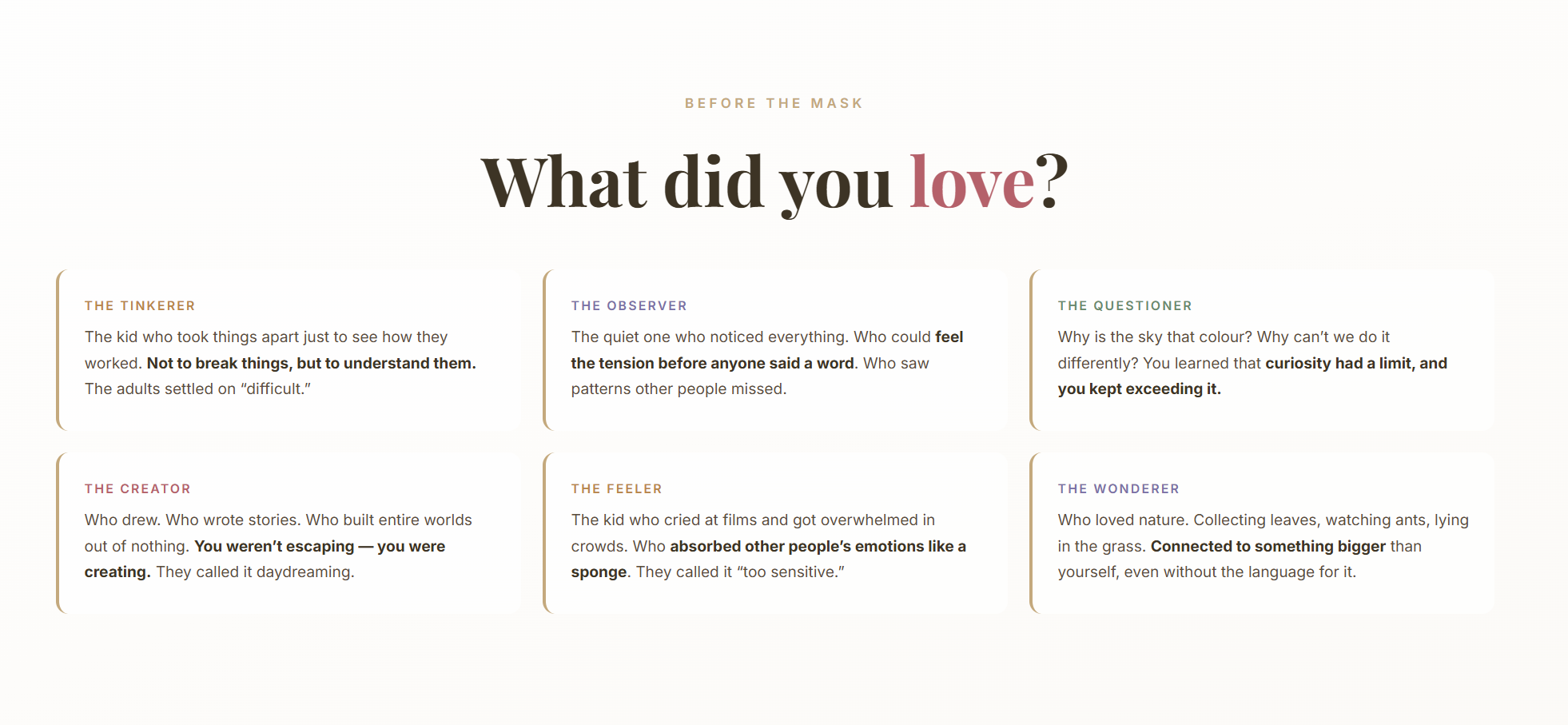
Maybe you were the kid who took things apart just to see how they worked. The back off the television. The inside of a clock. Your mum’s radio that never quite worked the same afterwards. Not because you wanted to break things, but because you needed to understand them. You couldn’t just accept that something worked — you had to know why it worked. And the adults around you couldn’t decide whether you were brilliant or destructive, so they settled on “difficult.”
Maybe you were the quiet one who noticed everything. The one who watched how people moved through a room, who could feel the tension before anyone said a word, who knew something was wrong before the adults did. You saw the patterns that other people missed, and you didn’t even realise that was unusual. You thought everyone could see it. You didn’t understand why they kept being surprised by things that were obvious to you.
Maybe you were the one who couldn’t stop asking questions. Why is the sky that colour? Why do we do it this way? Why can’t we do it differently? What if we tried it like this instead? And maybe you learned, eventually, that the questions made people uncomfortable. That curiosity had a limit, and you kept exceeding it. So you stopped asking them out loud. But you never stopped asking them in your head.
Maybe you were the one who drew. Who wrote stories. Who sang when you thought nobody was listening. Who built entire worlds out of nothing and lived inside them because the real one didn’t quite make sense. You weren’t escaping — you were creating. But nobody called it that. They called it daydreaming. They called it not paying attention. They called it a phase.
Maybe you loved numbers. The certainty of them. The way a problem could have a clean answer and you could hold it in your hands and know it was right. Or maybe you loved words. The way they could build something out of thin air and make another person feel exactly what you felt. The way a sentence could unlock something in your chest that you didn’t know was locked.
Maybe you loved nature. Collecting leaves, watching ants, lying in the grass staring at clouds and wondering why they moved the way they did. Not because anyone told you to. Just because it was beautiful and you couldn’t look away. You felt connected to something bigger than yourself, even if you didn’t have the language for it yet.
Maybe you were the one who felt everything. The kid who cried at films and got overwhelmed in crowds and needed to be alone to recharge. The one who absorbed other people’s emotions like a sponge and couldn’t understand why the world was so loud and so careless. They told you that you were too sensitive, as though sensitivity was a defect and not a gift.
You knew who you were before anyone told you who to be. That version of you didn’t need permission.
Whatever it was, you knew. You didn’t need anyone to tell you what you were good at. You didn’t need a career test or a personality framework or a LinkedIn bio. You just knew. It was the thing you did when nobody was watching. The thing that made time disappear. The thing that made you feel like yourself. The thing that made the world make sense.
And then, slowly, they took it away from you.
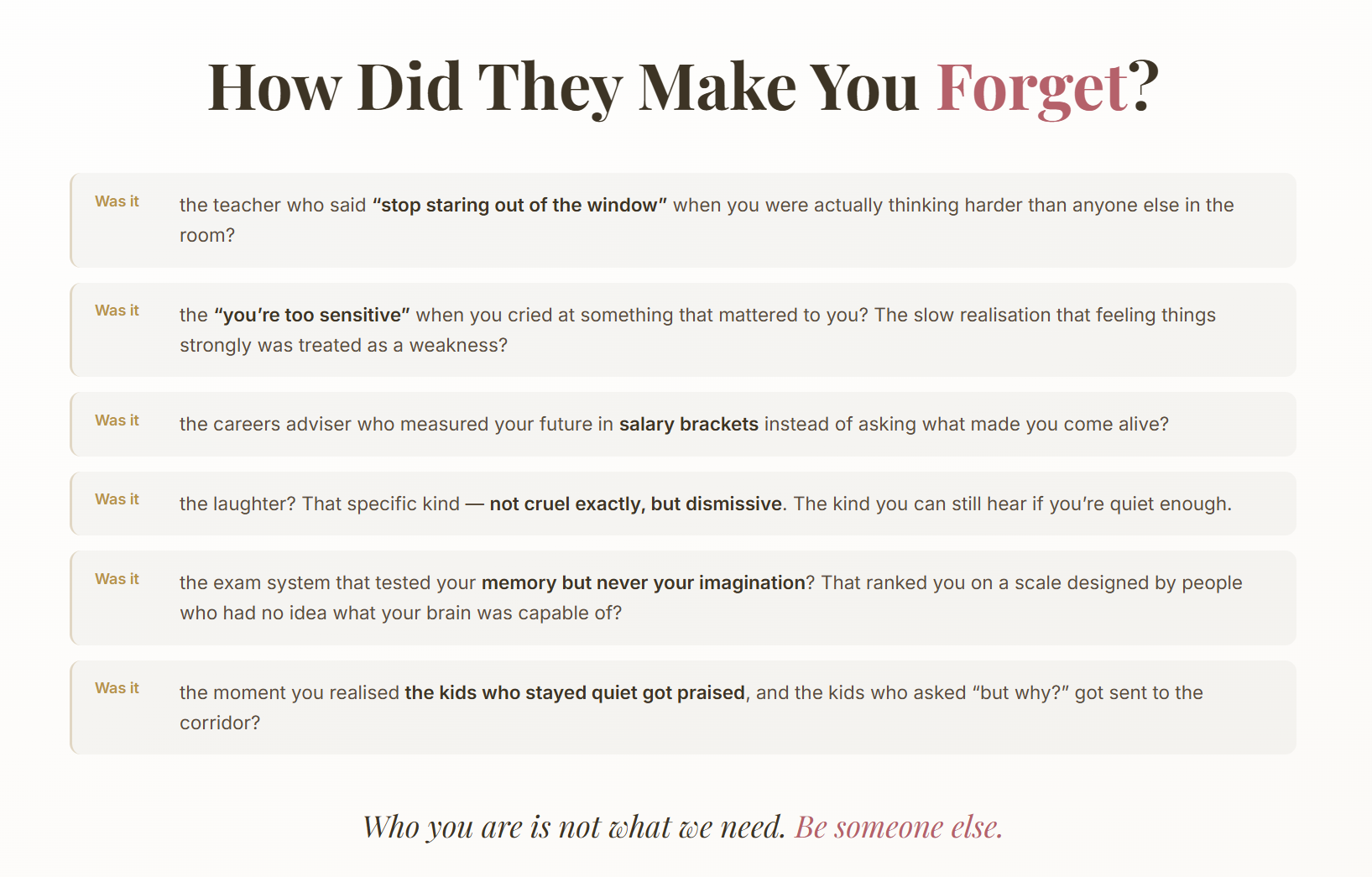
How Did They Make You Forget?
Was it the being told to sit still and do as you’re told?
Was it the teacher who said “stop staring out of the window” when you were actually thinking harder than anyone else in the room? The one who mistook your silence for disengagement and your restlessness for defiance?
Was it the “you’re too sensitive” when you cried at something that mattered to you? The “it’s not that deep” when it was, actually, exactly that deep? The slow realisation that feeling things strongly was treated as a weakness, not a strength?
Was it the careers adviser who looked at your dreams and handed you a leaflet for something sensible? Who measured your future in salary brackets and job security instead of asking what made you come alive?
Was it the parent who meant well but said “that’s not a real job” about the only thing that ever made you feel alive? Who loved you, genuinely, but loved you inside a framework that couldn’t hold who you actually were?
Was it the laughter? That specific kind of laughter — not cruel exactly, but dismissive. The kind that says “you’re being ridiculous” without using the words. The kind you can still hear if you’re quiet enough. The kind that taught you to test every thought against the question “will they laugh?” before you let it leave your mouth.
Was it the being picked last? The not being invited? The realising, slowly, that the things you cared about weren’t the things that made you popular, and that popularity was the currency everyone else seemed to understand? Was it watching the other kids navigate a social world that seemed to have rules you were never given?
Was it the exam system that tested your memory but never your imagination? That measured how well you could repeat what you were told, but never how well you could think for yourself? That ranked you on a scale designed by people who had no idea what your brain was capable of, and then told you the ranking was your worth?
Was it the being told you had potential, but only if you applied yourself — as though the problem was effort and not the fact that you were being asked to care about things that didn’t matter to you? As though there was something broken about a mind that refused to engage with things it found meaningless?
Was it the moment you realised that the kids who stayed quiet and did what they were told got praised, and the kids who asked “but why?” got sent to the corridor?
Was it the relationship that slowly convinced you that your needs were too much? The friend who made you feel like a burden for being honest? The boss who punished your directness and rewarded the people who said nothing of substance but said it nicely?
Was it the system itself? The way everything — school, work, society — was structured around a version of normal that you didn’t fit, and the constant, exhausting implication that the problem was you and not the structure?
Was it all of it? Was it none of it? Was it just the slow, steady weight of a thousand moments that individually meant nothing but collectively taught you the same lesson over and over again:
Who you are is not what we need. Be someone else.
And so you were.
How We Learn To Hide
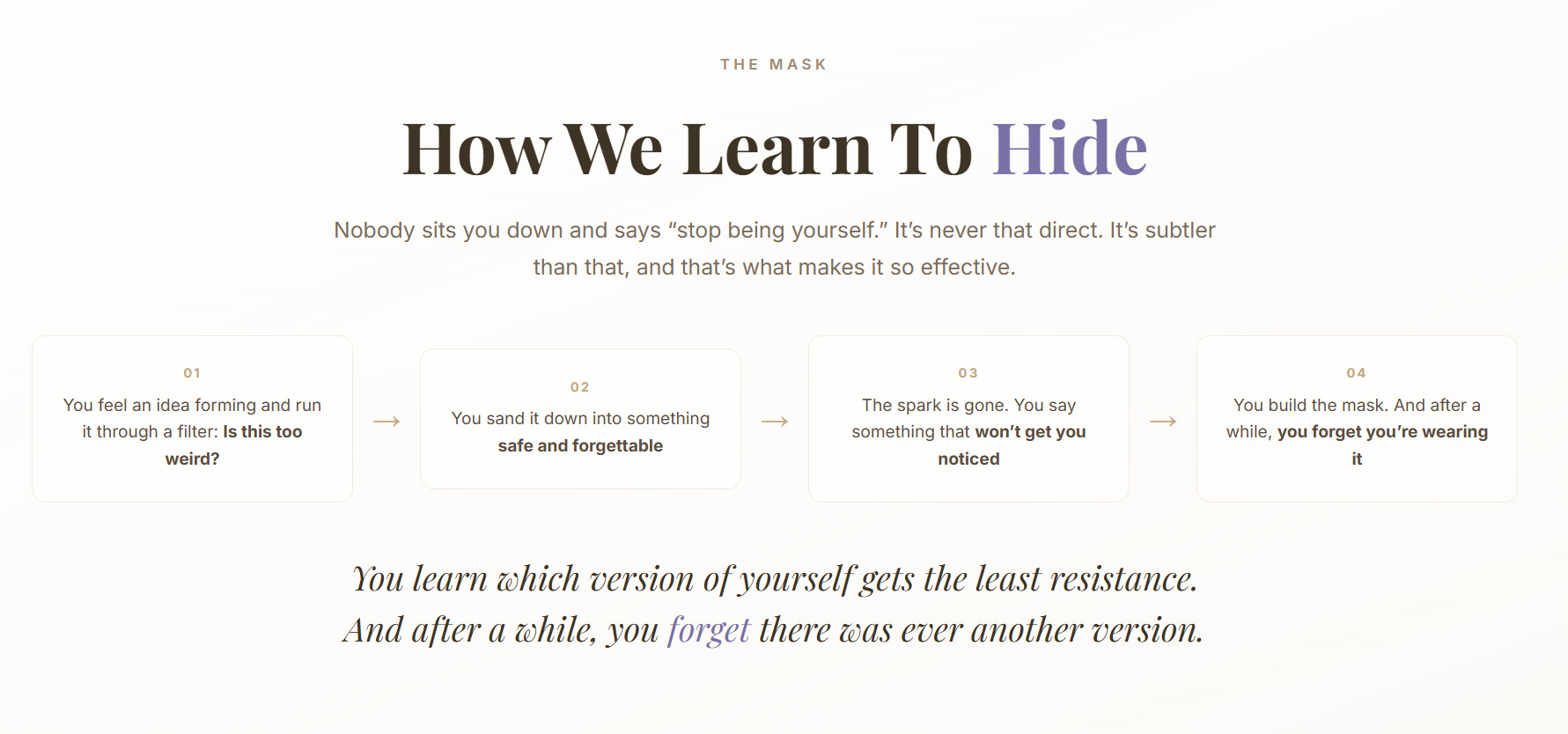
Nobody sits you down and says “stop being yourself.” It’s never that direct. It’s subtler than that, and that’s what makes it so effective.
It’s the teacher who tells you to stop daydreaming. The classmate who laughs when you get too excited about something. The parent who says “that’s nice, but what are you going to do for a real job?” The friend who raises an eyebrow when you care too much about something that doesn’t matter to them.
It’s a thousand small moments, none of them dramatic enough to point to, but all of them saying the same thing: you’re too much. Tone it down. Be normal.
And so you do. Not all at once. Gradually. You learn which version of yourself gets the least resistance. You learn to laugh at your own intensity before anyone else does. You learn that fitting in is easier than standing out, and that ‘easier’ feels close enough to ‘happy’ that you can almost convince yourself it’s the same thing.
You start to edit yourself in real time. You feel an idea forming and you run it through a filter before it reaches your mouth: Is this too weird? Will they think I’m showing off? Is this the kind of thing normal people say? And by the time it’s passed through all those checkpoints, the spark is gone. The thing you were going to say has been sanded down into something safe and forgettable. Something that won’t get a reaction. Something that won’t get you noticed.
You build the mask. And after a while, you forget you’re wearing it.
You learn which version of yourself gets the least resistance. And after a while, you forget there was ever another version.
The mask is good at its job. It gets you through school. It gets you through interviews. It gets you promotions and relationships and a life that looks, from the outside, like it’s working. And maybe it is working. For everyone else.
But not for you. Not really. Because the mask doesn’t just hide the parts of you that other people find inconvenient. It hides the parts of you that make you you. The curiosity. The intensity. The way you see things. And you can’t selectively numb yourself — when you turn down the volume on the difficult parts, you turn it down on everything.
The wonder goes quiet. The dreaming stops. The things that used to fascinate you become background noise. You walk past a tree you would have stared at for twenty minutes as a child and you don’t even see it. You hear a question that would have kept you up all night thinking and you just shrug. Not because you don’t care, but because you’ve forgotten how to.
And you’re left with a life that’s perfectly fine and completely empty at the same time.
Underneath it all, something is restless. Something doesn’t fit. There’s a low hum you can’t quite place — a feeling that you’re in the right life but playing the wrong part. Like you’re reading someone else’s script and everyone keeps telling you how well you’re doing, and you smile and say thank you and wonder why it doesn’t feel like anything.
When It Starts To Crack
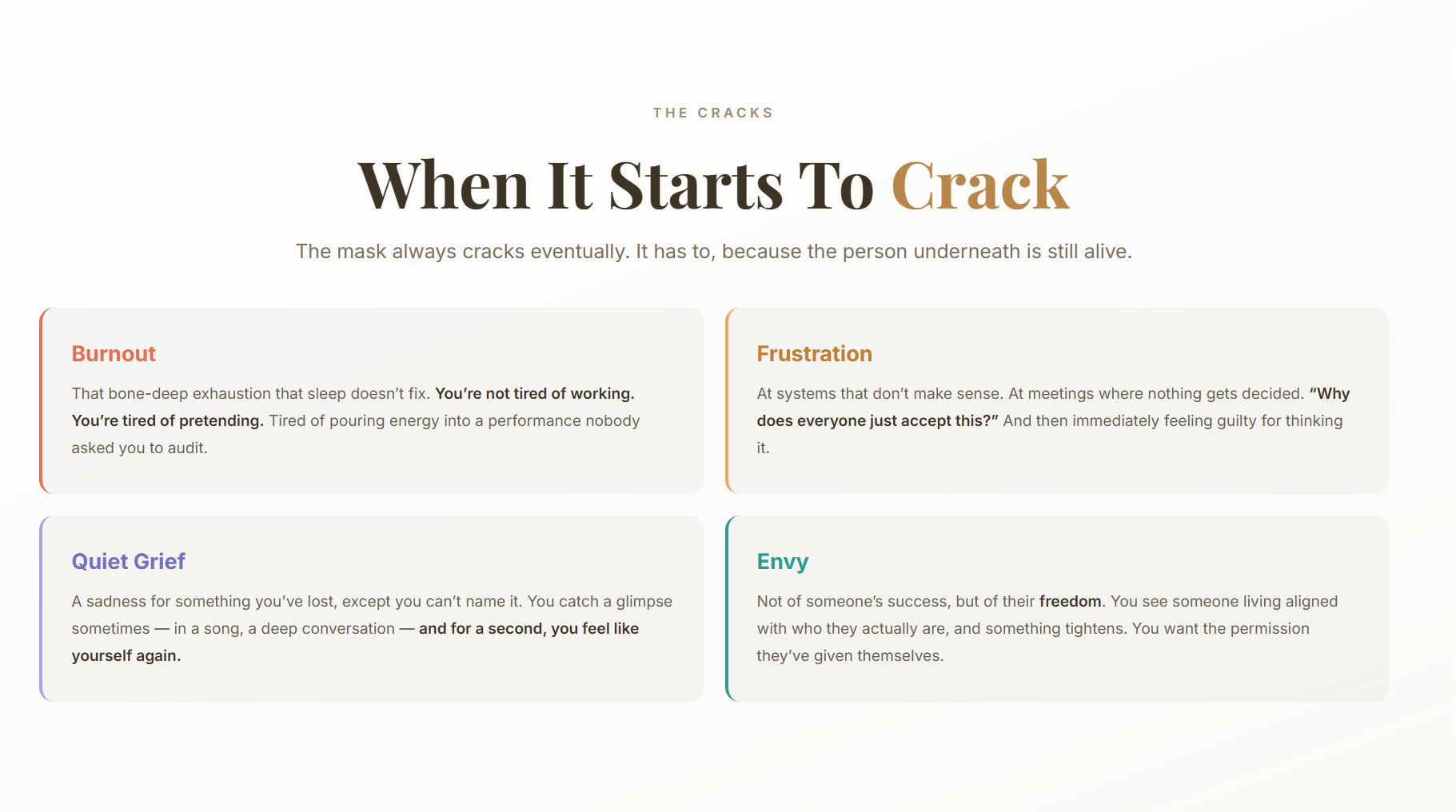
The mask always cracks eventually. It has to, because the person underneath it is still alive.
That, or you go through life never being really awake. You exist, but you don’t live. You function, but you don’t feel. You hit every milestone — the career, the house, the relationship, the retirement — and you arrive at the end of it all and realise you were asleep the whole time. That the life you built was someone else’s blueprint and you followed it perfectly and it meant nothing.
That’s the other option. And it’s the one most people take without ever realising they chose it.
It might show up as burnout. That bone-deep exhaustion that sleep doesn’t fix, because the tiredness isn’t physical. It’s the tiredness of performing a version of yourself that takes constant effort to maintain. You’re not tired of working. You’re tired of pretending. You’re tired of smiling when you’re empty, of saying “I’m fine” when you’re drowning, of pouring energy into a performance that nobody asked you to audit but everyone expects you to maintain.
It might show up as frustration. At systems that don’t make sense. At meetings where nothing gets decided. At a world that seems to reward people for looking busy rather than being useful. You find yourself thinking “why does everyone just accept this?” and then immediately feeling guilty for thinking it. You start to wonder if the frustration is the problem — if maybe you’d be happier if you could just stop caring so much. But you can’t. You never could. That’s the whole point.
It might show up as a quiet grief you can’t explain. A sadness for something you’ve lost, except you can’t name what it is. You just know that somewhere along the way, something important went missing. You catch a glimpse of it sometimes — in a song that hits different, in a conversation that accidentally goes deeper than it was supposed to, in a moment where you forget to perform and accidentally say what you actually think. And for a second, you feel like yourself again. And then it’s gone, and the grief comes back twice as heavy because now you know what you’re missing.
It might show up as anger. Not the loud kind. The quiet, corrosive kind that sits in your chest and whispers “this isn’t right” at three in the morning. Anger at the people who told you to be less. Anger at yourself for listening. Anger at a world that took your best qualities and called them problems.
It might show up as envy. Not of someone’s success, but of their freedom. You see someone doing work they clearly love, speaking with a conviction that doesn’t look rehearsed, living in a way that seems aligned with who they actually are — and something in your chest tightens. Not because you want what they have. But because you want what they’ve allowed themselves to be. You want the permission they’ve given themselves. And you wonder why you can’t give it to yourself.
That something that’s missing is you. The real one. The one who existed before the mask.
And they’re trying to come back.
The Remembering
I realise now that my memories, my stories, everything I’ve been through… None of it was wasted. It all built the resilience I needed to become who I am today.
I just had to remember who I am.
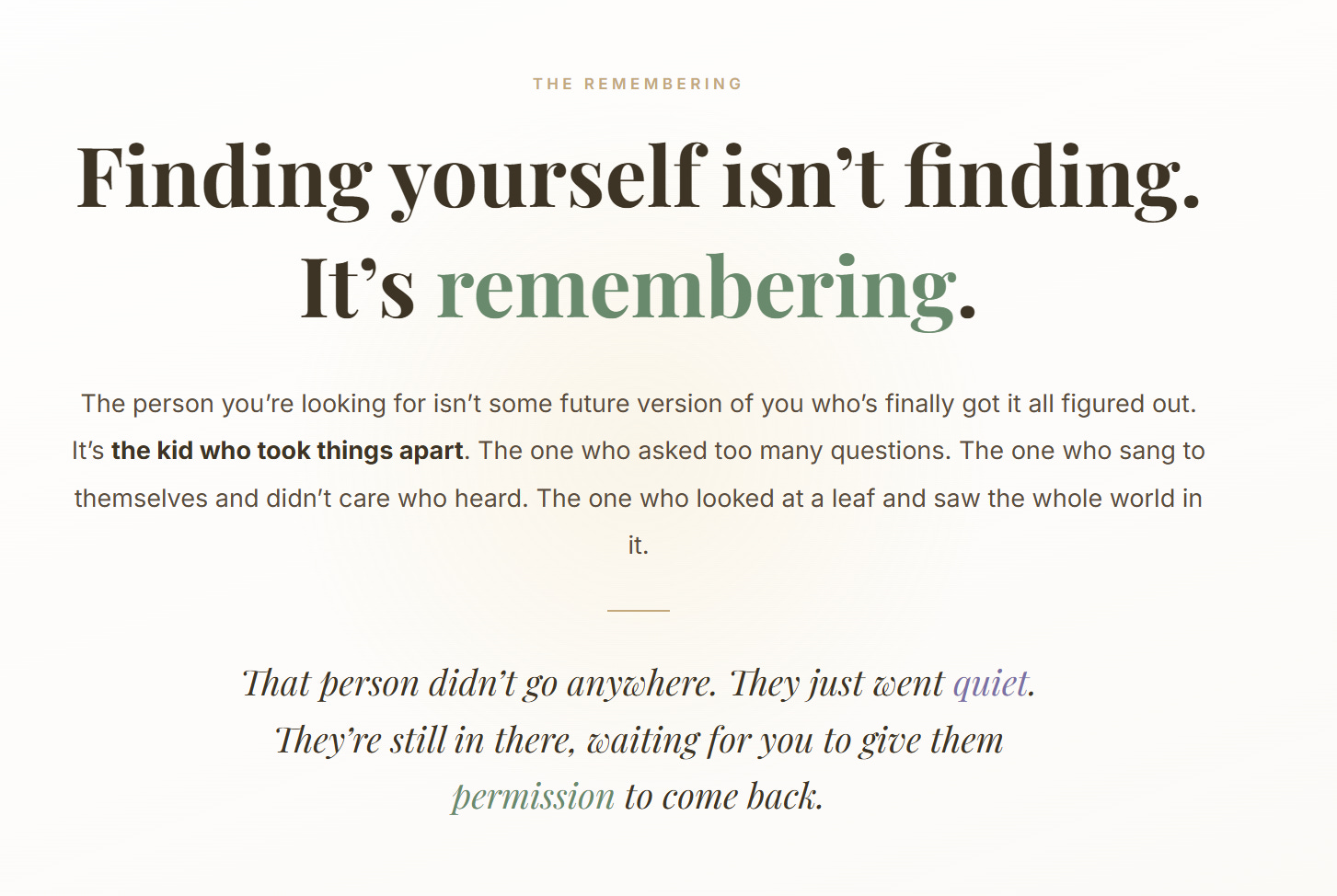
And that’s the thing nobody tells you. Finding yourself isn’t really finding at all. It’s remembering. The person you’re looking for isn’t some future version of you who’s finally got it all figured out. It’s the kid who took things apart. The one who asked too many questions. The one who sang to themselves and didn’t care who heard. The one who looked at a leaf and saw the whole world in it.
That person didn’t go anywhere. They just went quiet. They’re still in there, underneath the mask, waiting for you to give them permission to come back.
And giving that permission is terrifying. Because it means admitting that the life you’ve built might not be the life you actually want. It means risking the comfort of fitting in for the uncertainty of being yourself. It means being ‘weird’ again — except this time, on purpose. It means looking at the people who told you who you were and saying, quietly, firmly: you were wrong.
It means trusting yourself again. And that might be the hardest part of all, because they spent years teaching you not to.
But here’s what I’ve discovered: on the other side of that fear is everything you’ve been looking for. The work that doesn’t feel like work. The conversations that don’t feel like performance. The relationships where you don’t have to translate yourself into someone easier to digest. The version of your life where you stop surviving and start actually living.
It doesn’t happen overnight. It’s not a single moment of revelation. It’s more like thawing — slow, uneven, sometimes painful. You start small. You let one honest thought through. You follow one curiosity without apologising for it. You let yourself care about something that doesn’t make sense on a CV. And gradually, the person you used to be starts to recognise the person you’re becoming.
And one day — not a dramatic day, not a day you’d mark on a calendar — you say something out loud that you’ve been thinking for years. And nobody laughs. Or maybe they do, and it doesn’t matter anymore. Because you’ve stopped performing for an audience and started living for yourself.
That’s when you find the words for what you’ve always been.
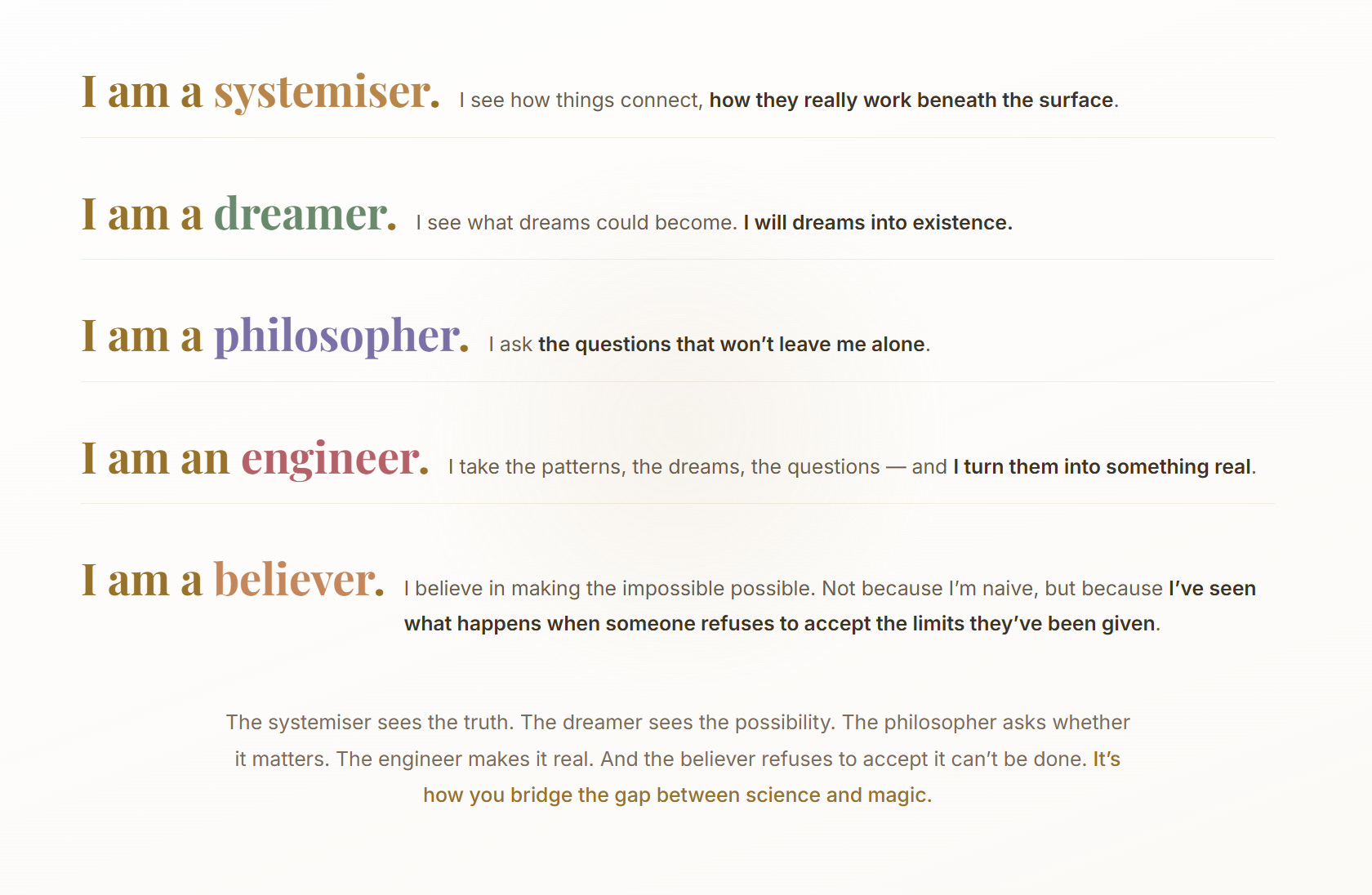
I am a systemiser. I see how things connect, how they really work beneath the surface.
I am a dreamer. I see what dreams could become. I see the beauty in the world, the beauty in what it means to be human. I will dreams into existence.
I am a philosopher. I ask the questions that won’t leave me alone.
I am an engineer. I build what I envision. I take the patterns I see, the dreams I have, the questions I can’t let go of — and I turn them into something real. Something you can touch, use, stand on. Something that works.
I spent most of my life believing these things were at war with each other — that I had to choose between the rigour and the wonder, between taking things apart and dreaming them into existence, between asking why and just getting on with building. Turns out they were never in conflict. They were always the same thing. The systemiser sees the truth. The dreamer sees the possibility. The philosopher asks whether it matters. And the engineer makes it real. It’s how you bridge the gap between science and magic.
That’s my answer. It took me a long time to find it. But this newsletter isn’t really about my answer. It’s about yours.
Your Turn
So here’s my question, and I mean it.
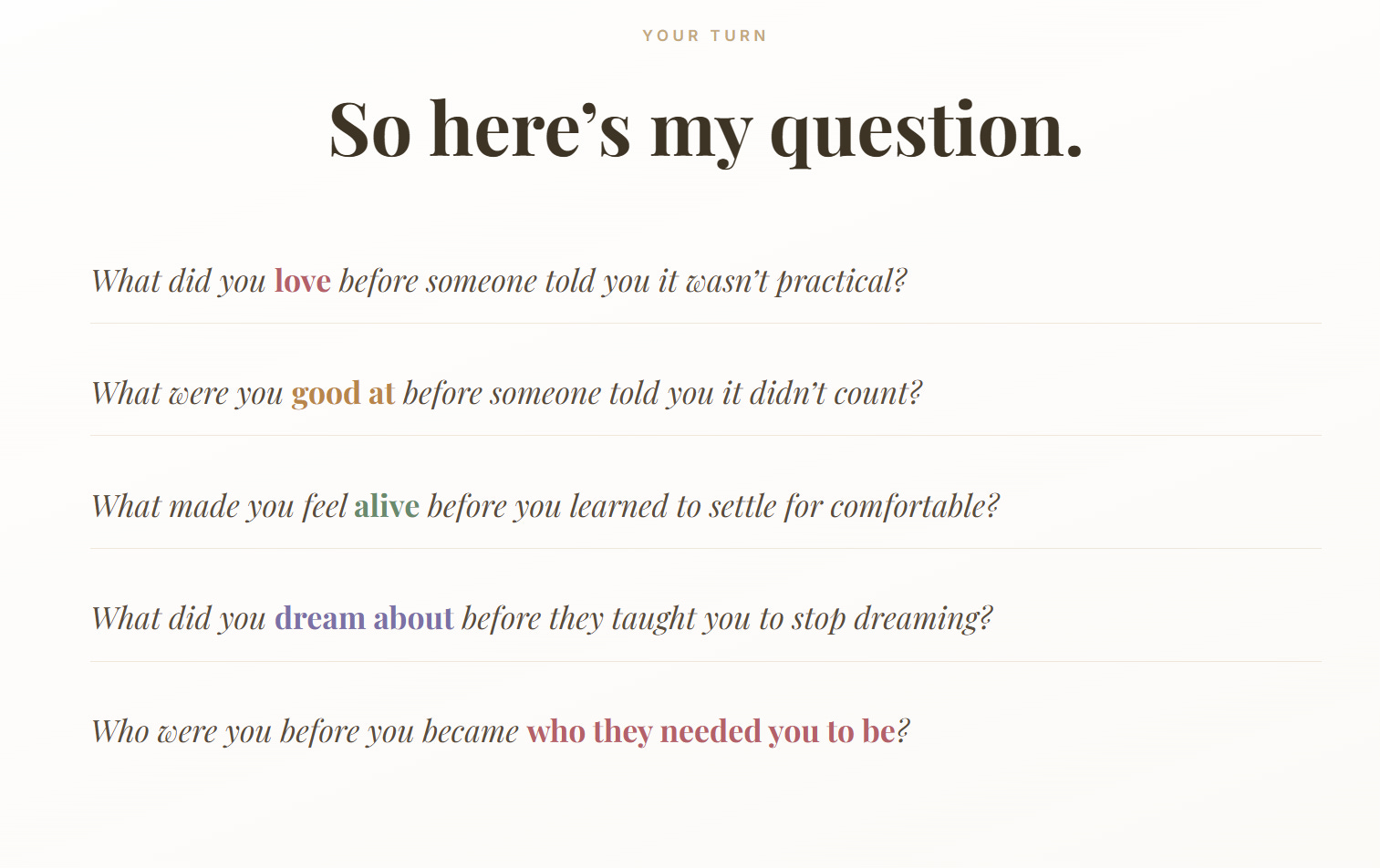
What did you love before someone told you it wasn’t practical?
What were you good at before someone told you it didn’t count?
What made you feel alive before you learned to settle for comfortable?
What did you dream about before they taught you to stop dreaming?
Who were you before you became who they needed you to be?
Sit with that for a moment. Don’t rush past it. Don’t rationalise it away. Don’t do what you’ve been trained to do and immediately think about why it’s not realistic or why it’s too late or why you’re being silly. Just let yourself remember.
Close your eyes if you need to. Go back to that version of you — the one who hadn’t learned to be afraid yet. The one who didn’t know that the things they loved were supposed to be embarrassing. The one who hadn’t been told, a hundred times in a hundred ways, that who they were wasn’t enough.
What are they doing? What are they excited about? What’s the look on their face?
That’s you. That’s still you.
Because here’s what I’ve learned: the things that made you ‘weird’ as a child are the same things that make you extraordinary as an adult. The intensity. The curiosity. The way you see things that other people walk straight past. The refusal to accept “that’s just how it is” as an answer. The ability to look at something ordinary and see something beautiful in it. The need to understand, to question, to go deeper when everyone else has already moved on.
Those aren’t flaws. They never were. They’re the parts of you that the world tried to sand down because they didn’t fit neatly into a system designed for averages.
But you were never average. You just learned to pretend you were.
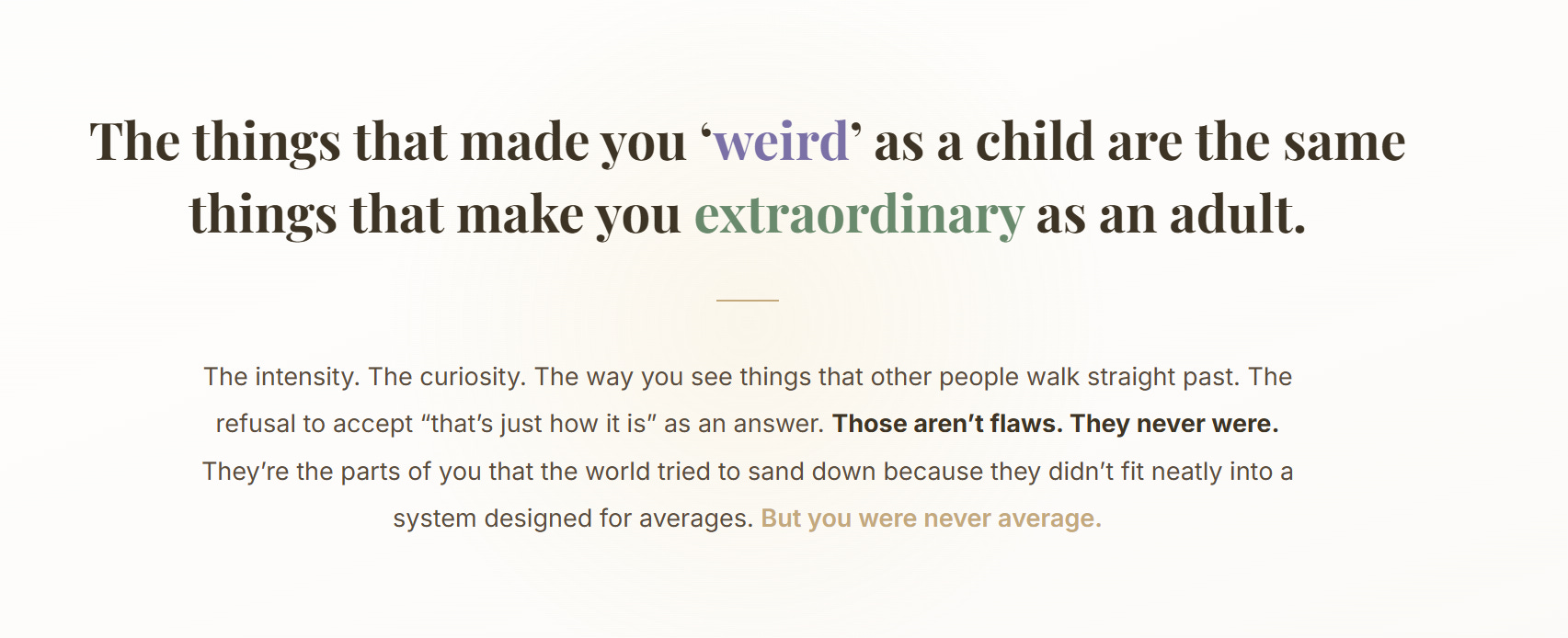
The things that made you ‘weird’ as a child are the same things that make you extraordinary as an adult.
The mask served its purpose. It kept you safe when you needed to be safe. It got you through the years when being yourself was too dangerous, too costly, too lonely. You don’t have to be angry at it. It did its job. But you do have to decide whether you still need it.
Because the world doesn’t need another person going through the motions. It doesn’t need another voice saying what’s expected. It doesn’t need another human being performing a version of themselves that keeps everyone comfortable and no one inspired.
It needs the version of you that you’ve been hiding. The dreamer. The builder. The questioner. The one who sees things differently and has spent a lifetime being told that’s a problem.
It’s not a problem. It never was.
It’s your gift. And the world has been waiting for you to unwrap it.
It needs you to remember.
Do you remember who you are?
Jade Systemiser. Dreamer. Philosopher. Engineer. Believer.
Tech Unfiltered is a free newsletter about systems thinking, technology, and being human in a world that rewards conformity. No paywalls, no gatekeeping — just honest writing about things that matter.
If this piece meant something to you, share it with someone who needs to hear it.
Love it! This resonated with me so much because I had similar experience. For example, when I was in school, my average grades were quite bad. Teachers were trying to convince me I was dumb. But that was because I was being forced to study what didn't interest me at all.
Fast-forward to now. Senior software engineer. Author of several books. Definitely not as dumb as they tried to convince me I was!
But regarding the choice of the profession, I definitely chose what resonated with me when I was a kid. I was always fascinated with science fiction and technology. My actual dreams was to build intelligent robots.
I am not building intelligent robots (yet), but I am building intelligent agentic AI systems, which is close enough.
Probably the best post I read on SubStack in the recent past. Thank you.