
All Roads Lead to Rome (Until They Don’t)
The rise and fall of all empires...

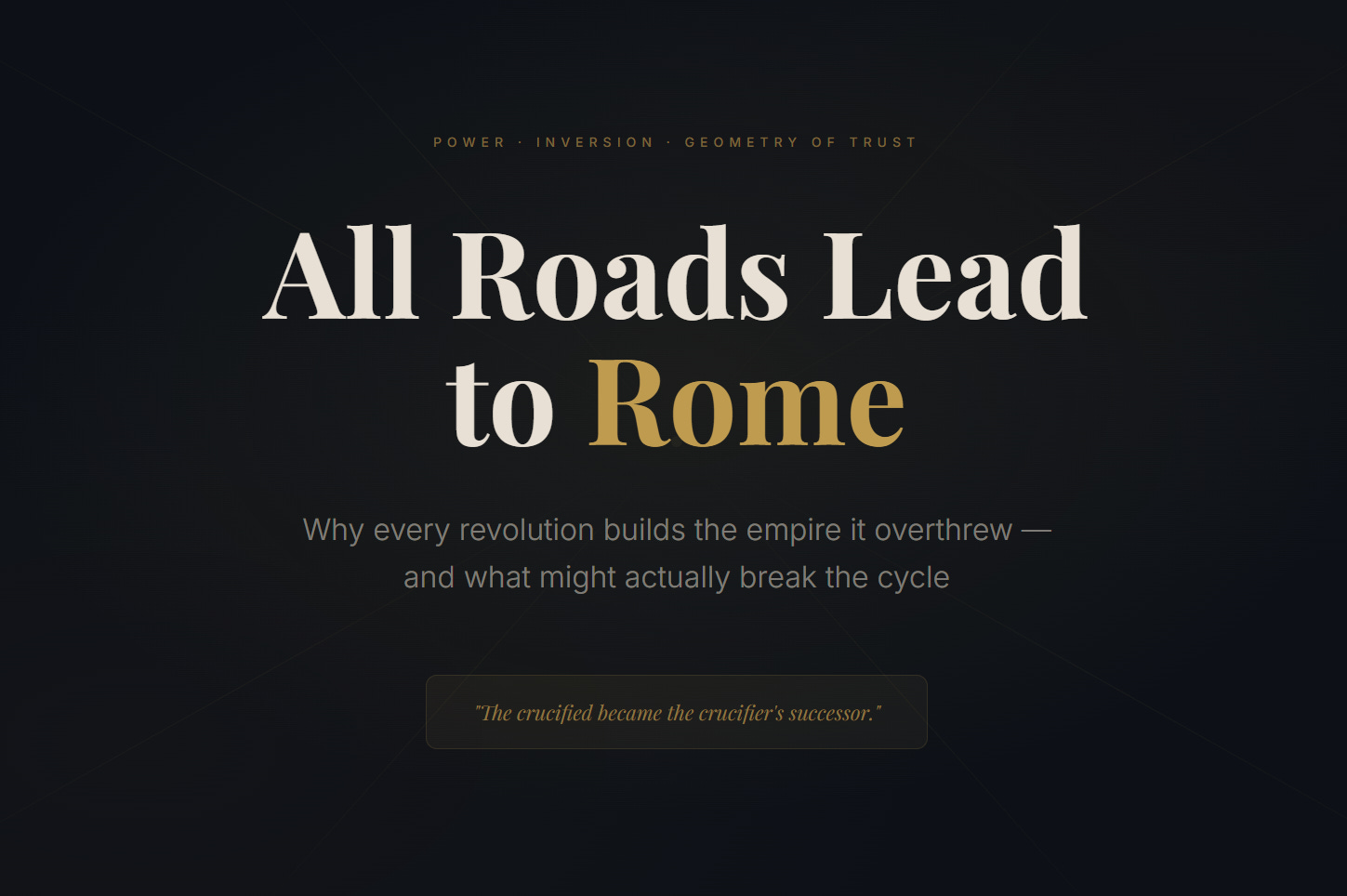
It’s peculiar, isn’t it?
Under his eye. Hiding in plain sight. Jesus’s crucifixion by the Romans. The Holy See. The Volturi.
Think about it for a moment. A man executed by Roman imperial authority around 30 AD. Fast forward two thousand years, and the institution claiming spiritual succession from that executed radical is headquartered in... Rome. Speaking Latin. Wearing imperial robes. Operating with the administrative genius of the empire that killed its founder.
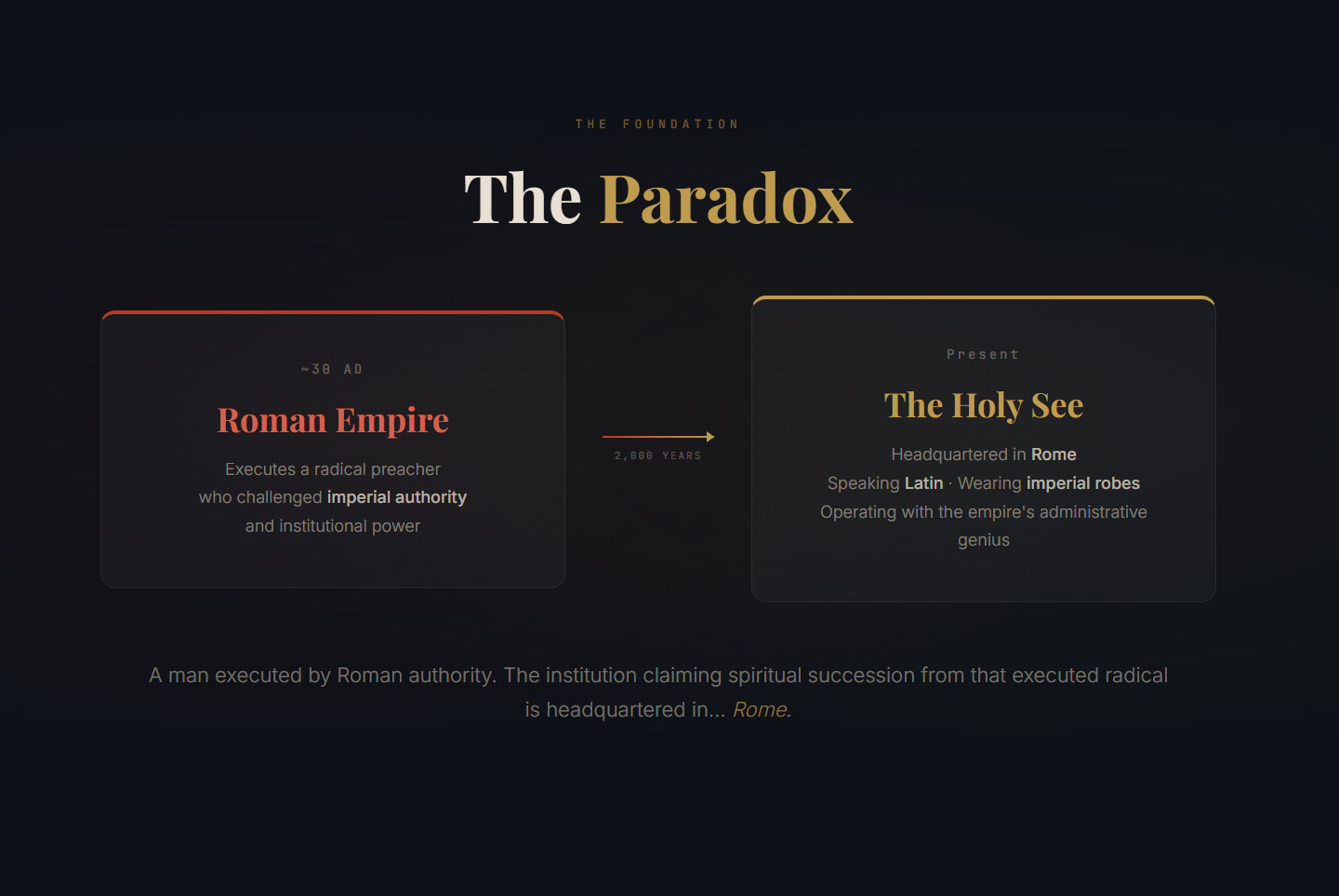
The crucified became the crucifier’s successor.
When you go down the rabbit hole, that’s where it leads you.
The pattern repeats everywhere:
The persecuted become the institutional power
The radical message gets encoded into hierarchy
The symbols of execution become symbols of authority (the cross as regalia)
“Liberation theology” becomes... not that
The thing that challenged Rome became Rome
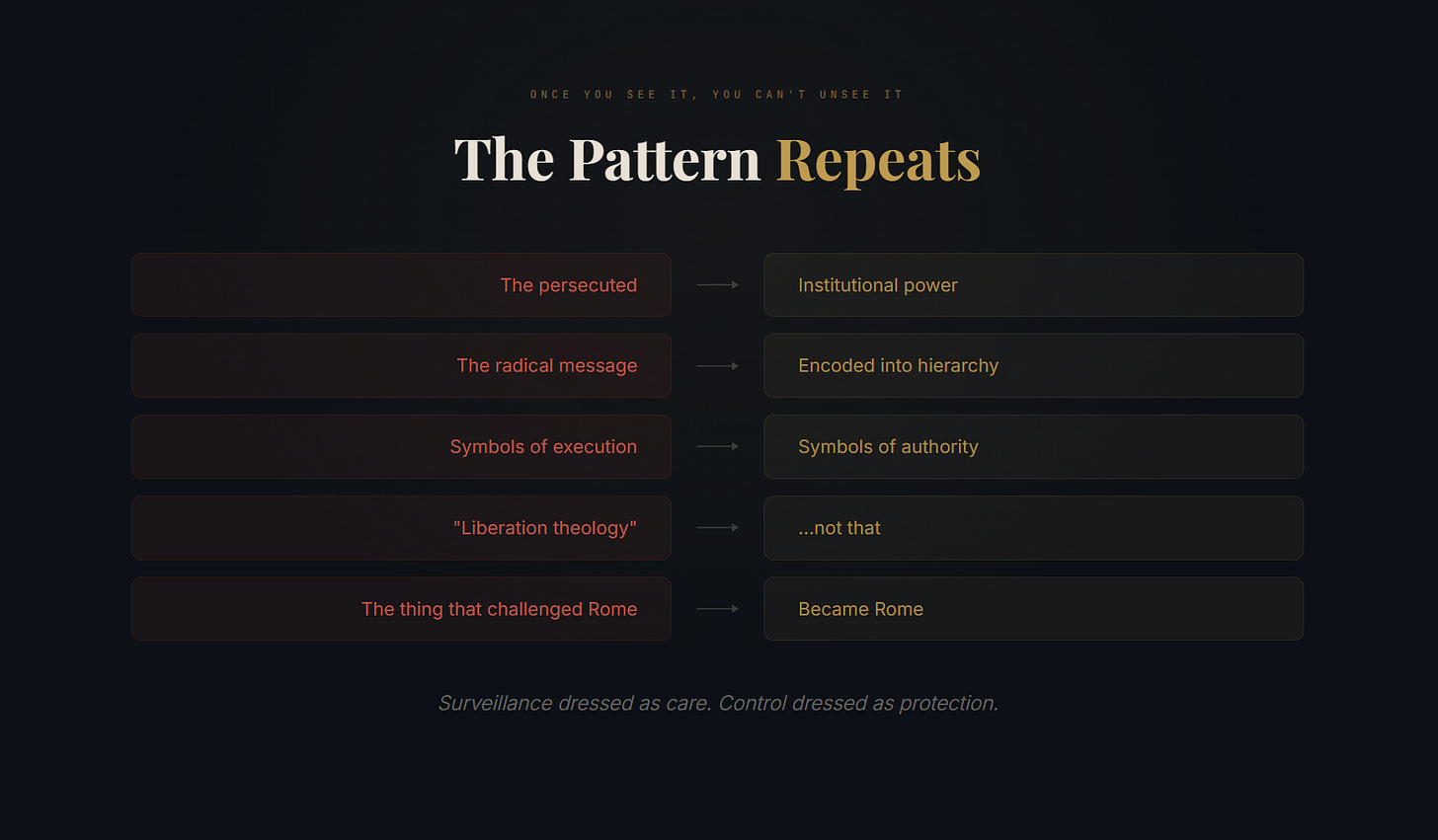
Once you see this pattern, you can’t unsee it. Every “under his eye” starts looking the same. Surveillance dressed as care. Control dressed as protection. Authority claiming to speak for the silenced voice it replaced.
Revolutionary movements become new ruling classes. Counter-cultural becomes corporate. “Question authority” becomes authority. Even the Volturi - those ancient vampire rulers enforcing “the old ways” - probably started as rebels too.
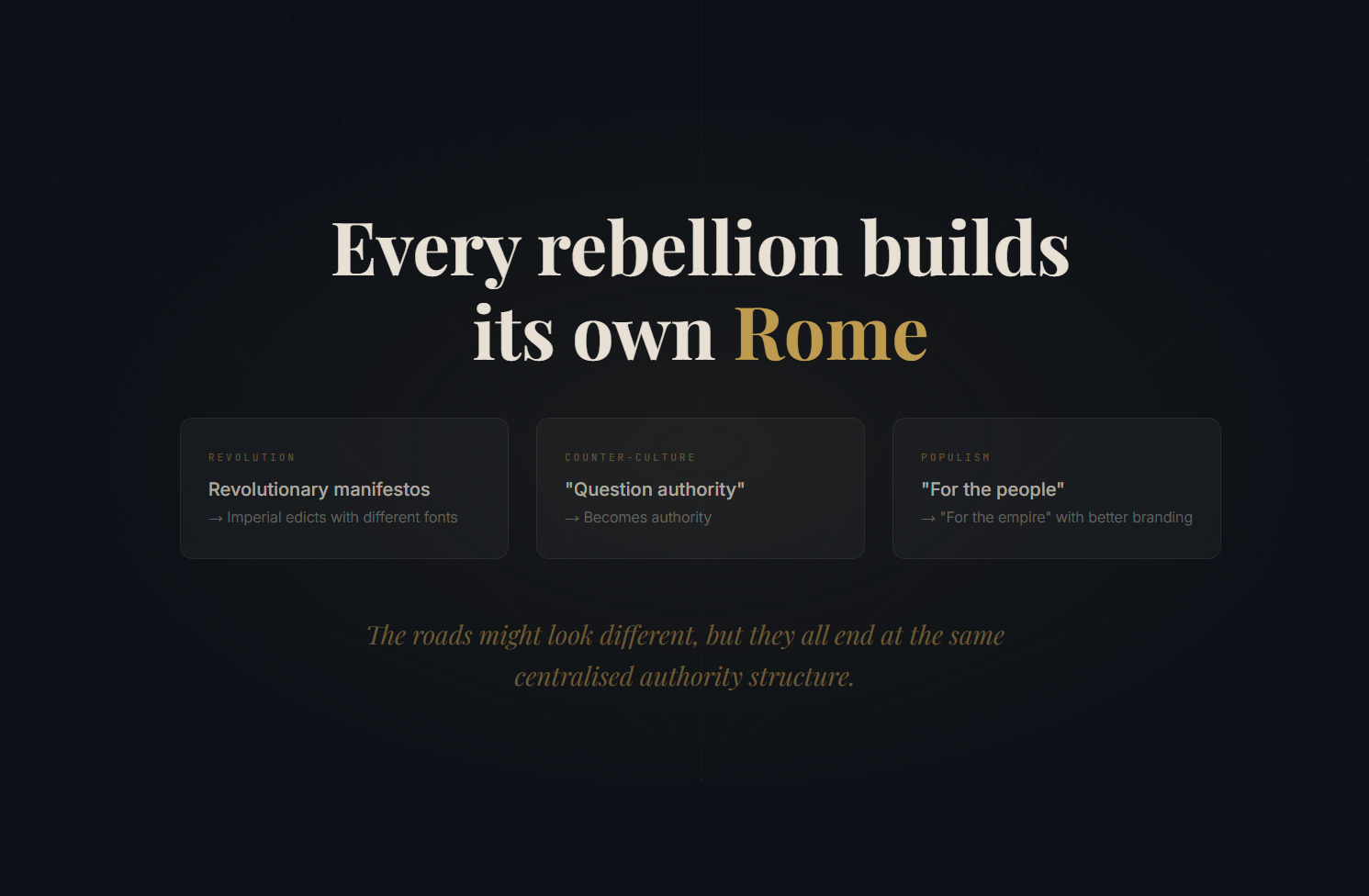
There’s an old saying: all roads lead to Rome. For two thousand years, that’s been literally true for power structures. Every rebellion, every revolution, every counter-movement eventually builds its own Rome. The roads might look different - revolutionary manifestos instead of imperial edicts, “for the people” instead of “for the empire” - but they all end at the same centralized authority structure.
The really unsettling bit: If you’re seeing it clearly, if you’re naming it... are you outside the structure, or just in a different part of it? Is “seeing through it” the next layer of the same game?
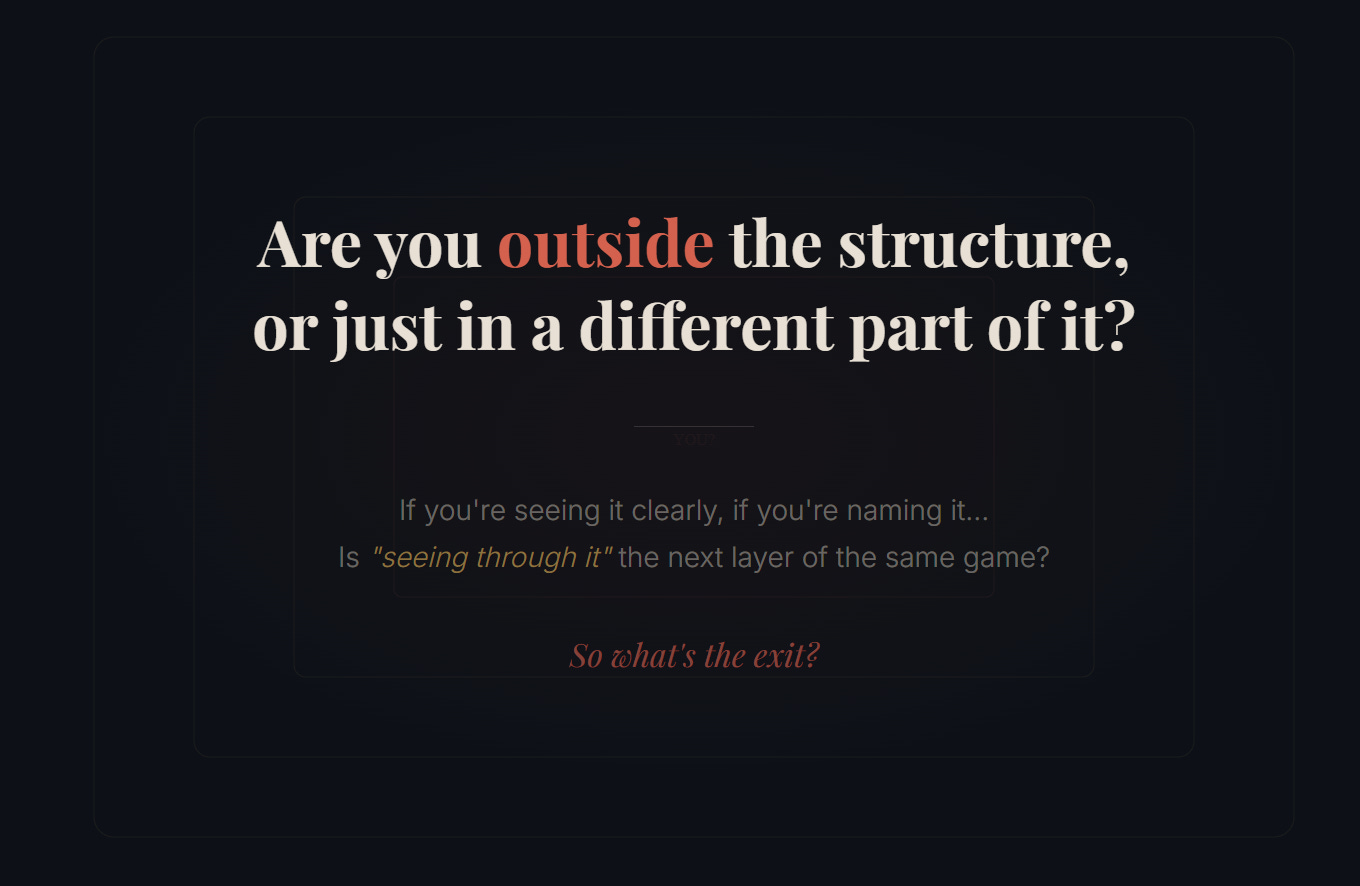
So what’s the exit?
A world where each person has their own AI. Where they’re able to define their own values. Where they’re able to see who’s being intentionally deceitful.

The inversion of the inversion:
Centralized “seeing” authority → decentralized personal intelligence
“Under his eye” → under your own eyes
Institutional gatekeeping of “truth” → tools that let you trace the pattern yourself
Power concentrating through information asymmetry → dissolve the asymmetry
If everyone has an AI that reflects their actual values, helps them see manipulation patterns, and makes deceit visible - not through “fact-checking” gatekeepers but through pattern recognition - then the structures that depend on keeping people from seeing clearly lose their power.
You can’t gaslight someone whose AI remembers what you said last week. You can’t use complexity as camouflage when people have tools to parse it. You can’t rely on “trust us, we’re the experts” when everyone can verify. You can’t maintain institutional authority through information monopoly.
But here’s the problem: How do you get there without the AI itself becoming the new Holy See? Who defines “intentional deceit”? Whose values get encoded in the seeing-tool?
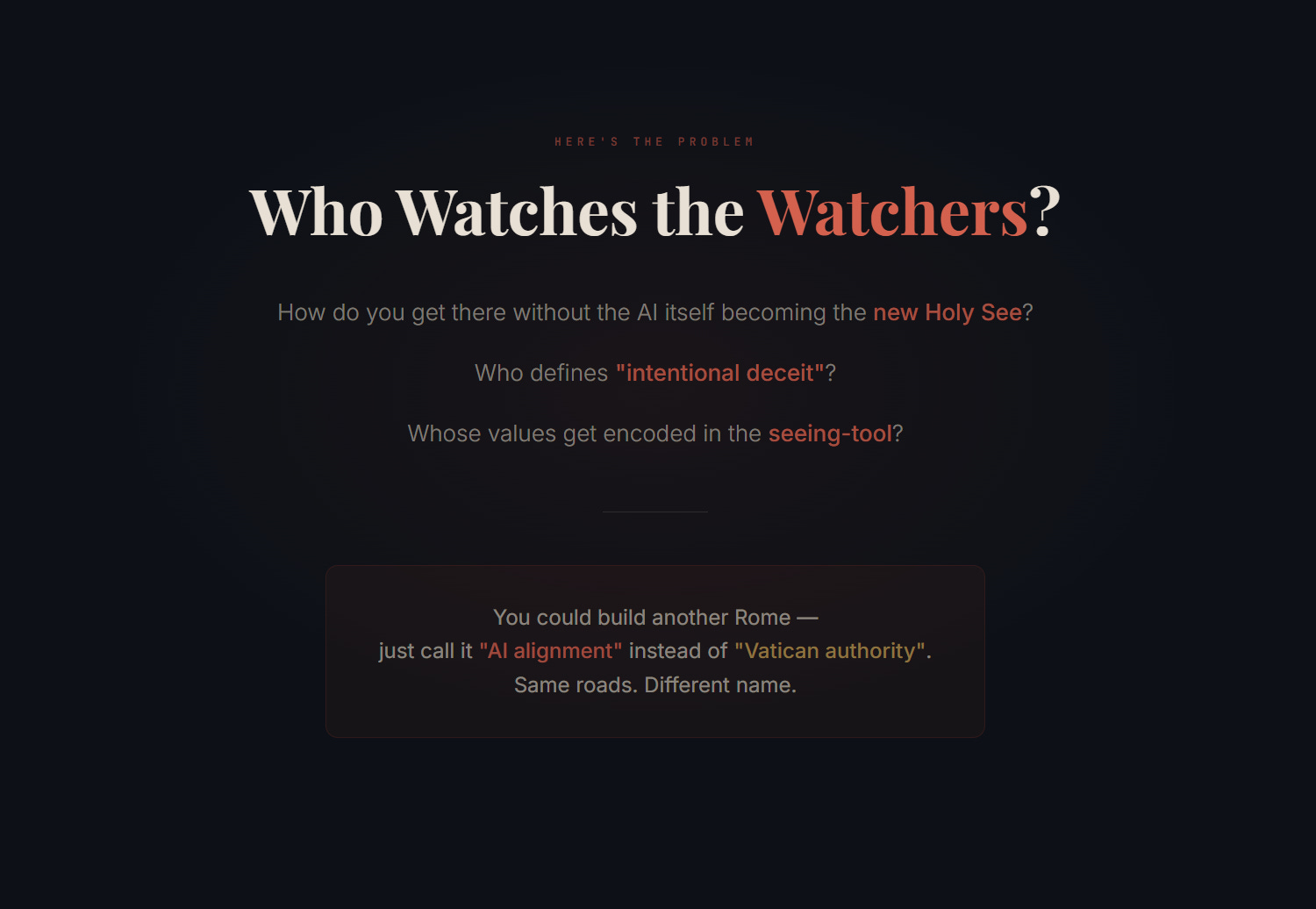
You could build another Rome - just call it “AI alignment” instead of “Vatican authority.” Same roads, different name.
Or you use Geometry of Trust.
Not “program the AI with The Correct Values™” (that’s just the Holy See again). Not “neutral AI” (neutrality is a lie - there’s always embedded values).
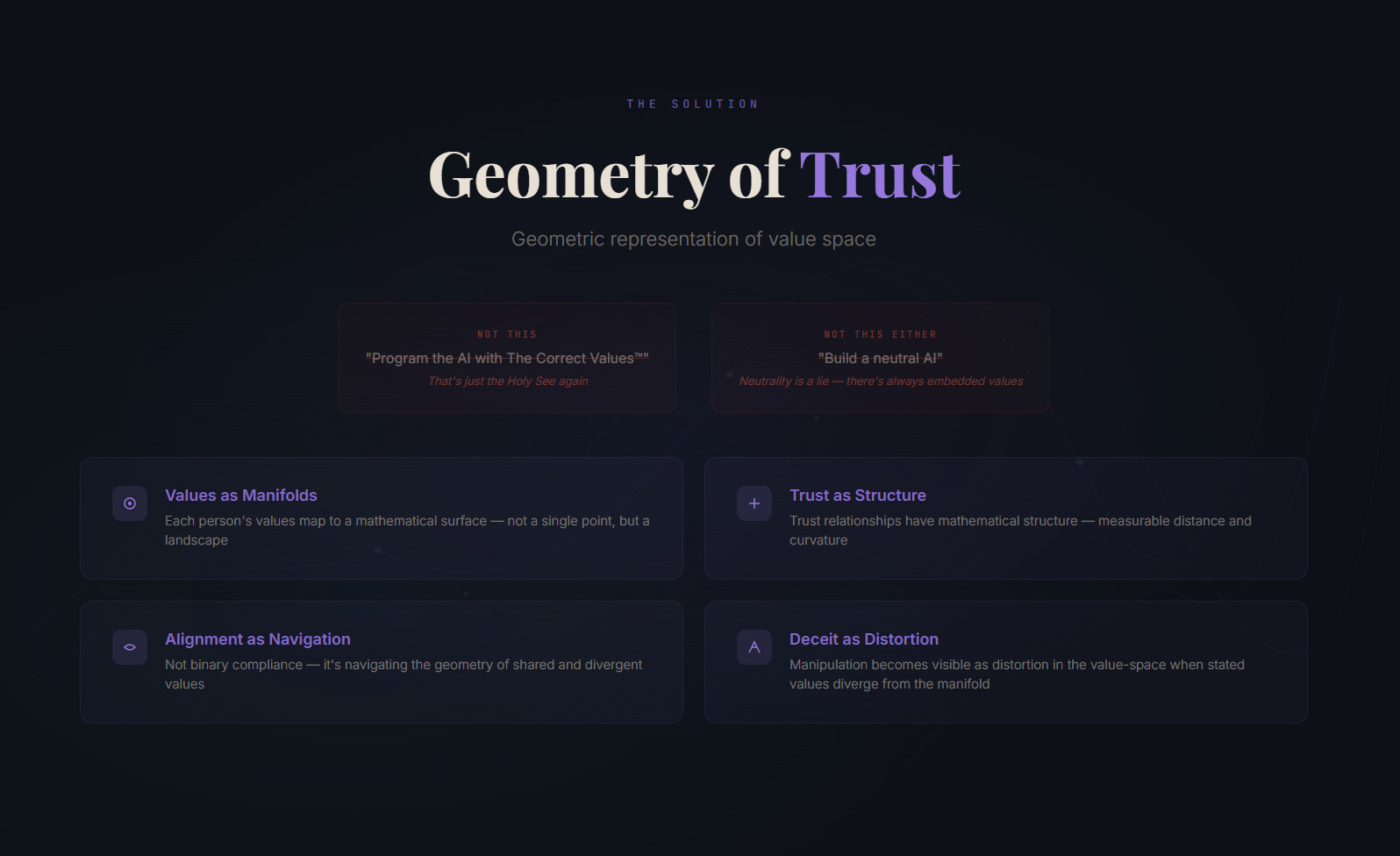
But geometric representation of value space where:
Each person’s values map to a manifold
Trust relationships have mathematical structure
Alignment isn’t binary compliance, it’s navigating the geometry
Deceit becomes visible as distortion in the value-space
It’s not prescriptive (no Vatican encoding “true north”). It’s relational (trust as measurable distance and curvature). It reveals manipulation when stated values diverge from the manifold. It’s personal - your AI operates in your value-geometry, not a universal one.

Intentional deceit detection isn’t “fact-checking” (who checks the checkers?), but geometric inconsistency. When someone’s stated position doesn’t map coherently to their historical value-manifold, that’s visible. When institutions claim X but their revealed preferences trace to Y, the curvature shows it.
This is how you build roads that lead somewhere other than Rome.
I’ve shipped a prototype.
The protocol is published. The implementation is open source. Syster - the systems modelling infrastructure - is open source. Anyone can fork it, build on it, use it.
I’m not keeping it close. Information wants to be free, and hoarding creates the very asymmetry we’re trying to dissolve. The code is out there for anyone with better implementation skills than me to connect the dots and run with it.
No single point of control means no new Holy See. Can’t be corrupted if you’re not the gatekeeper. The idea becomes infrastructure, not institution. Multiple implementations mean resilience, competition, evolution.
The risk? Someone implements it badly, or incompletely, and that version becomes “the” Geometry of Trust, diluted or captured. But I’m banking on enough good-faith implementers seeing it. The maths is sound enough that bad implementations reveal themselves. Distribution beats perfection.
True names have power. If you claim credit, you become claimable. You become the founder, the authority, the person who “really understands it.” Then people start asking for permission, for interpretation, for blessing.
But if it’s just out there? If people are picking it up and running with it and don’t even know where it came from?
Then it can’t be corrupted back into a Holy See. It stays protocol, not institution.
That’s the exit route.
From 30 AD to 2026. From “under his eye” to under your own eyes. From centralized seeing-authority to distributed intelligence that makes institutional deceit geometrically visible.
All roads used to lead to Rome.
Not anymore.
The rabbit hole doesn’t end in nihilism. It ends in infrastructure.
The code is out there. Go build.
Jade
P.S. - If you want the technical details on Geometry of Trust, the repos is open. If you want to understand the systems thinking that led here... well, you just read it.